Terror birds
Were you to visit sunny
Yet again, it’s funny how things work out. My life right now mostly consists of job-hunting, but because of the various part-time teaching jobs I have I am always working on powerpoint presentations. Last week I put the finishing touches to ‘The evolution of birds in the Cenozoic’, and of course I added a section on phorusrhacids. Now that Chiappe & Bertelli (2006) has been published I will have to make a few changes.
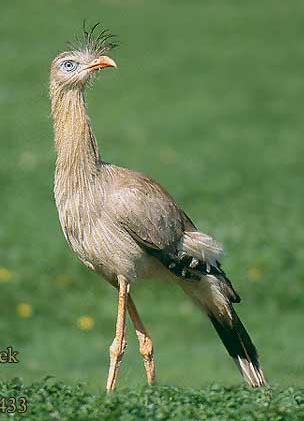 I’ve always been very interested in phorusrhacids and, unlike many of the animals I write about (the shame), I have some experience with them. What are they? They are universally agreed to be relatives of the living seriemas (Cariamidae), but differ from them in having a far more robust bill and jaws, smaller bony processes on the humerus, and a narrower pelvis. They also, of course, grew to a much larger size. The two living seriema species are South American, but members of similar, closely related groups (the bathornithids and idiornithids) inhabited
The various phorusrhacid genera and species have been reviewed twice in the past 50 years. Patterson & Kraglievich (1960) looked at the Pliocene species and mostly discussed the relatively obscure taxa Hermosiornis and Onactornis (the latter is currently regarded as synonymous with Devincenzia). Perhaps because their study was written in Spanish [with only a brief English summary], it has been widely overlooked. It also has far too few illustrations and – to quote Storrs Olson (1985)* – is ‘a nightmare of typographical errors’ (p. 145). Apparently it was meant to be just the preliminary nomenclatural part of a much larger revision of the whole group by Bryan Patterson, but this never appeared. Fortunately, Alvarenga & Höfling (2003) looked at phorusrhacids anew and reviewed all the taxa, providing information on historical taxonomy, palaeoecology, and phylogenetic affinities. While they didn’t perform a cladistic analysis, this is pretty much the sort of study we have long needed, and the fact that it is widely and freely available on the web as a pdf (go here) means that it will enjoy widespread consultation (if only all publishers did this with academic papers: remember, the availability of pdfs is never under the control of authors). For now, it is the ‘standard work’ on the group.
* More than any other person in zoological writing, Olson has produced an impressive list of scathing quotes and insults. One day I’ll make a point of collecting them all together.
Alvarenga & Höfling (2003) grouped phorusrhacids into five subgroups; the small, gracile psilopterines, known from the Palaeocene to the Pliocene and including the oldest of all phorusrhacids; the mid-sized, shallow-skulled, gracile-legged mesembriornithines of the Miocene-Pliocene; the mid-sized patagornithines of the Oligocene, Miocene and Pliocene; the gigantic, robust brontornithines of the Oligocene and Miocene; and the mostly large, gracile-legged phorusrhacines of the Miocene, Pliocene and Pleistocene. The last group was the only one to make it into the Pleistocene, and the only group to invade
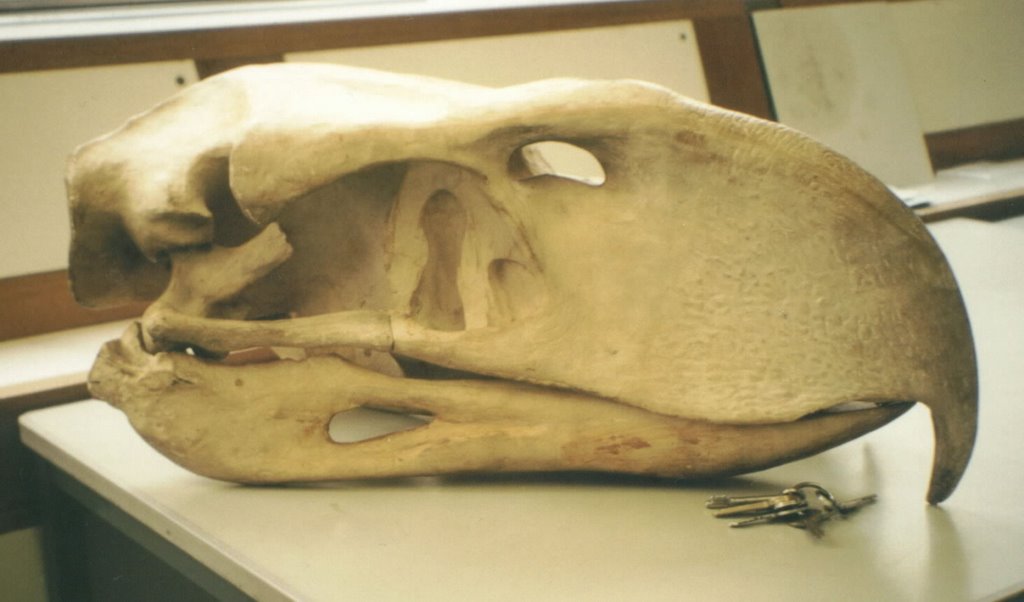 It is of minor frustration that the phorusrhacids we hear about the most are among the most poorly known. The ‘best known’ phorusrhacid, the one featured in every single prehistoric animal book, is Phorusrhacos longissimus from the Miocene of Argentina. But it’s only ‘best known’ because it was the first member of the group to be named, and compared to a number of far more obscure species, it is poorly known and mysterious. Of its skull, for example, we only have the lower jaw and some fragments of cranium. Florentino Ameghino (1854-1911), the famous Argentine zoologist/palaeontologist who discovered and named it and several other phorusrhacids, did write in 1895 of seeing a complete skull, encased in rock in the field, but he was only able to sketch it and recover fragments. His drawing is of a complete, pristine skull and it is on the basis of this that an entire replica skull has been produced (see accompanying image). Compare this with the patagornithines Patagornis and Andalgalornis, for example, both of which are known from awesome, complete skulls with good, associated, near-complete skeletons.
Incidentally, you might have seen the name Phorusrhacos written as Phororhacos (and Phorusrhacidae written as Phororhacidae). The former is the older, and thus correct, spelling, coined by Ameghino in 1887. At this time Ameghino thought that he had discovered a new herbivorous toothless mammal, perhaps a sloth, and Phorusrhacos was named to mean something like ‘branch holder’. It’s also a switched-round version of Rhacophorus, a genus of arboreal Asian frogs: that name also meaning ‘branch holder’. This isn’t a coincidence – Ameghino did this sort of thing with lots of names. When in 1889 Ameghino discovered that Phorusrhacos was really a bird, he changed the name to Phororhacos, as this (apparently) means something like ‘rag bearer’ and Ameghino regarded this as more appropriate etymologically than ‘branch holder’ (I regret that I have no idea why, however). Changing of names like this is not allowed under the guidelines of the ICZN and hence Phororhacos – still used by some people even today – should be suppressed. An ICZN ruling of 1992 made Phorusrhacos and Phorusrhacidae the officially accepted spellings.
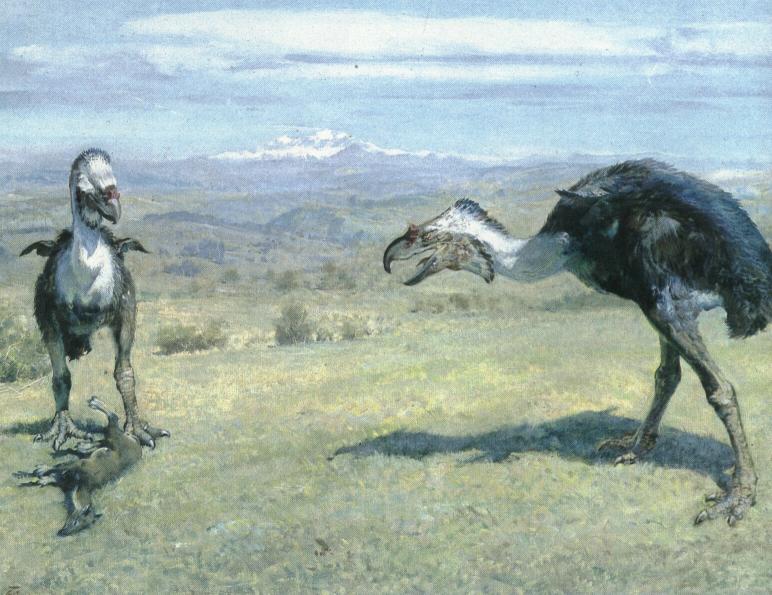
Speaking of Phorusrhacos, the painting at top - depicting this taxon - is one of the most famous phorusrhacid renditions ever (it's borrowed from the Burian gallery), and was produced by one of the 20th century's greatest palaeo-artists, Zdenek Burian (1905-1981). The colour scheme used in the painting has been widely copied by other artists: for a discussion on this subject go here.
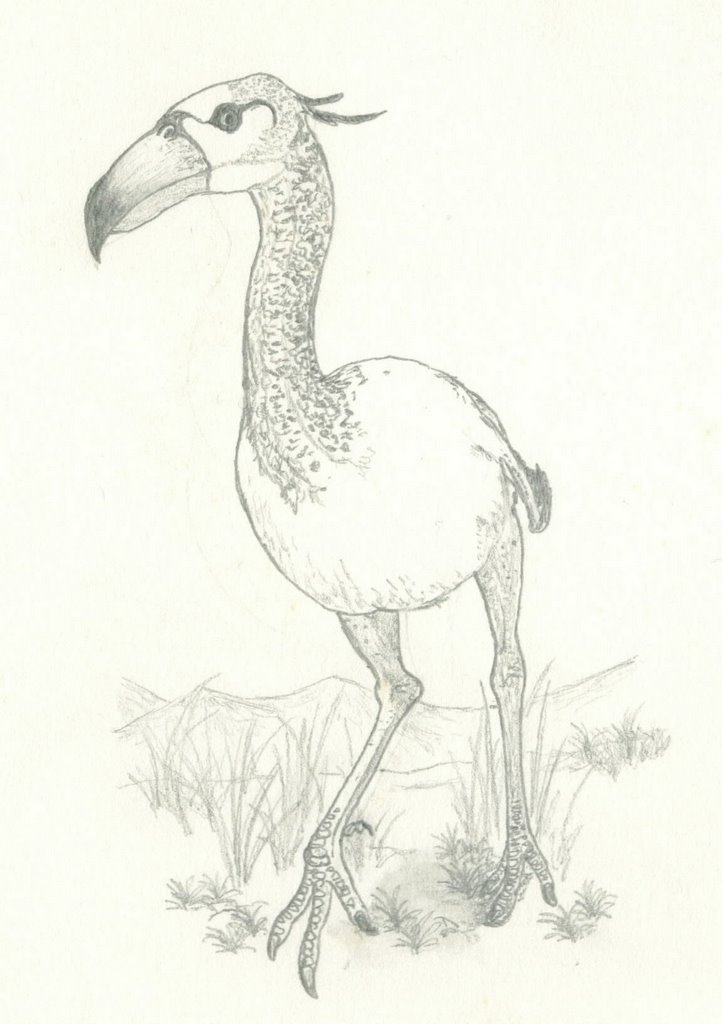 The new phorusrhacid described by Chiappe & Bertelli (2006) consists only of a skull and some leg bones (other elements might be known, but aren’t mentioned), but is significant for its size and the completeness of the skull. Discovered in Miocene rocks of
And I have to stop there. More on phorusrhacids in the next post, looking at brontornithine lifestyle, mesembriornithine running speed (were they the fastest-running birds ever?), and the anatomy of feet and skulls [available here].
PS - I intended to add more images to this post, but I’m having trouble in getting blogger to upload them. For the latest news on Tetrapod Zoology do go here.
Refs - -
Alvarenga, H. M. F. & Höfling, E. 2003. Systematic revision of the Phorusrhacidae (Aves: Ralliformes). Papéis Avulsos de Zoologia, Museu de Zoologia da Universidade de São Paulo 43, 55-91.
Chiappe, L. M. & Bertelli, S. 2006. Skull morphology of giant terror birds. Nature 443, 929.
Olson, S. L. 1985. The fossil record of birds. In Avian Biology, Volume III, pp. 79-238.
Patterson, B. & Kraglievich, J. L. 1960. Sistematica y nomenclatura de las aves fororracoideas
Labels: birds, ornithology, phorusrhacids
posted by Darren Naish at 11:11 PM
12 comments


