Tuesday, December 19, 2006

Obscure dinosaurs of the Kimmeridge Clay
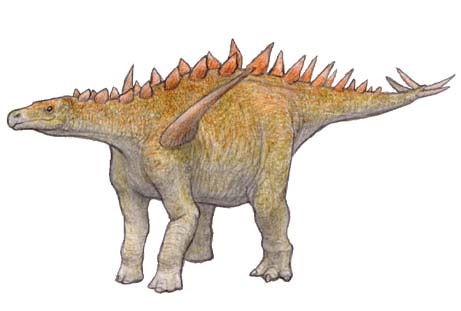
Someone – I forget who it was – once described dinosaurs as ‘the most American animals that ever lived’. Well, with all due respect to North America’s endemic dinosaurs (Tyrannosaurus, Triceratops and so on), and to the worthy history of North American palaeontological discoveries, this is crap. Dinosaurs are no more American than they are Patagonian, Nigerian or French. Or at least that’s the politically correct version. Reality is rather different: dinosaurs are in fact British, and – what’s more – specifically English, having been discovered in England by English scientists working on English fossils. Ok, lest some flag-waving patriot of any nation gets offended by this, let me assure you that this is all tongue-in-cheek and not to be taken seriously. Dinosaurs no more ‘belong’ to any country than do rodents or grasshoppers.

England has a rich dinosaur record, and many of the taxa first named from English rocks (e.g., Hypsilophodon, Cetiosaurus, Baryonyx) have proved globally important in terms of what they’ve told us about dinosaur evolution and diversity. Furthermore, these taxa and others (e.g., Scelidosaurus, Mantellisaurus, Neovenator) are represented by excellent remains that sometimes consist of near-complete skeletons. Also noteworthy is that English dinosaurs span most of the Mesozoic, from the Upper Triassic to about the middle of the Cretaceous (there is no dinosaur-bearing Upper Cretaceous in England). So as a gross generalisation of the worse kind, England’s dinosaur record is ‘good’.

Partly because the study of dinosaurs began in England, there is an extensive and voluminous literature on scrappy English dinosaur fossils. Furthermore, these early finds were usually given binomial names, but as our knowledge of these animals has improved, it is understandable that many of these remains are today considered inadequate in terms of establishing taxonomic validity. Ideas on British taxa were sometimes revised several or many times as knowledge improved, and the results are convoluted synonymy lists. As I’ve now mentioned several times on this blog, a major effort to review this mess has recently been produced by Dave Martill and myself, and is currently in press for a special bicentennial issue of Journal of the Geological Society. More on that when it appears. In an unrelated project, Dave, I and Sarah Fielding recently reviewed the English dinosaurs of the Kimmeridge Clay Formation, and as it’s only recently been published (Martill et al. 2006) I figured I may as well blog about it.

The Kimmeridge Clay

The Kimmeridge Clay Formation is an Upper Jurassic mudrock, deposited within a shallow marine environment, that crops out in a narrow strip from Dorset in the south-west to Yorkshire in the north-east. There are also a few outcrops in Scotland, and a contemporaneous equivalent that crops out in northern France. Like the older Oxford Clay Formation (go see Life in the Oxford Clay sea), the Kimmeridge Clay has yielded numerous ichthyosaurs, plesiosaurs, marine crocodyliforms and fish. Excepting the fish of course, those animals are all very interesting and worthy of discussion, but of more interest right now are the many dinosaurs that have also been discovered in the Kimmeridge Clay.

Why have so many dinosaurs been recovered from a geological unit deposited in a shallow sea? Despite the title of our paper, I don’t think this means much. The dinosaurs we find in these marine rocks don’t exhibit any features suggesting that they were aquatic or amphibious, and it appears most likely that the carcasses of the relevant species were washed out to sea on a fairly regular basis. This is well supported by the fact that other fossils, such as plants, and the sediments themselves, have clearly been derived from terrestrial sources. At a time when shallow seas covered the better part of the European continent, it makes sense that an unusually high number of terrestrial animals living on the archipelagos of the region found their way into the marine environment.

Kimmeridge Clay dinosaurs belong to most of the major groups living in Europe during the Upper Jurassic. There were large and small theropods, several types of sauropod, herbivorous ornithopods, and both stegosaurs and ankylosaurs.

Kimmeridge Clay sauropods

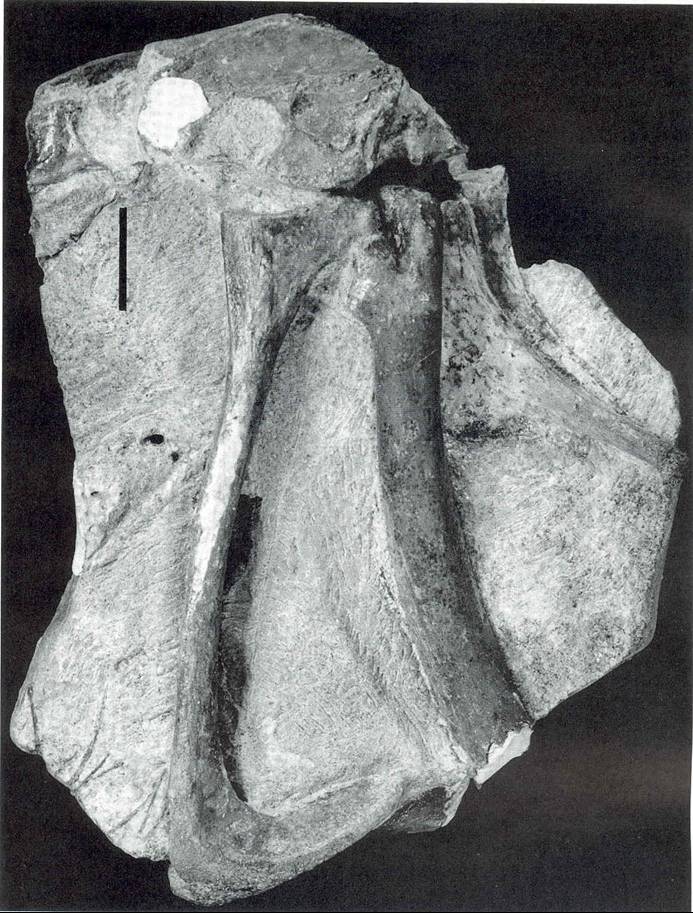
Perhaps the most interesting of the Kimmeridge Clay sauropods was named by John Whittaker Hulke* in 1874. Based only on a big humerus (1.3 m long, though perhaps 1.7 m long when complete: see adjacent image) discovered at Weymouth, Hulke named it Ceteosaurus humero-cristatus: note that he used a spelling of the generic name that later fell out of favour (the original, and thus favoured, spelling is Cetiosaurus), and used a hyphen in the specific name (an action that is illegal under today’s nomenclatural rules). This animal is quite certainly not really a species of Cetiosaurus (hence the quote marks used from hereon), as it is highly different in detail from the humerus of Cetiosaurus oxoniensis, the type species of the genus (well, actually, C. oxoniensis is not yet the type species of the genus, but that’s a long and complex issue that I can’t go into right now). So what is it? Its length, slender proportions and particularly prominent deltopectoral crest show that it is a brachiosaurid and, among brachiosaurids, its particularly long deltopectoral crest makes it unique and diagnosable. ‘C.’ humerocristatus is therefore one of those annoying fossil tetrapods that clearly needs a new name. So why doesn’t it have one?

The problem is that most workers who encounter problems like this prefer to err on the side of hyper-conservatism (Peter Dodson’s advice is that ‘the practise of naming genera on [the basis of isolated remains] is a highly undesirable one, greatly to be discouraged’ (Dodson 1996, p. 240): for more on this subject see Cryptic dinosaur diversity). Some therefore opt not to name something that they themselves have said deserves a name. In their review of sauropod species referred to Cetiosaurus, Upchurch & Martin (2003) concluded that ‘C.’ humerocristatus ‘is regarded as a distinct taxon referable to the Brachiosauridae’ but went on to state that ‘[w]e prefer to wait for more complete material before proposing a new name for this taxon’ (p. 213). Similarly, Upchurch et al. (2004) regarded ‘C.’ humerocristatus as ‘a potentially distinct taxon … [but] it would be unsafe to erect a new generic name given the material available’ (p. 309). This perpetuates the cycle, and the taxon goes unnamed for even longer.
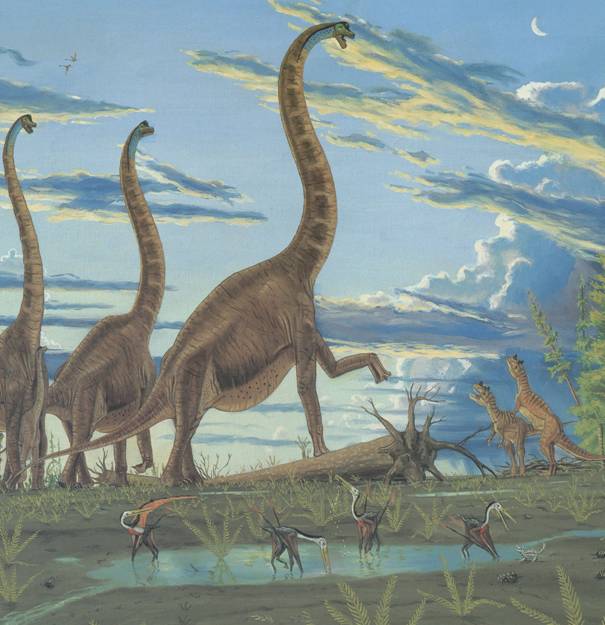
I’m equally as guilty of this as are Upchurch and Martin: in an earlier draft of the Kimmeridge Clay manuscript, my co-authors did actually come up with a new generic name for ‘C.’ humerocristatus (it has to be said, a pretty awful one), but I managed to get it removed. While I think it would be useful if this apparently diagnostic brachiosaur were named, I guess I’m bowing to peer pressure. Presumably, ‘C.’ humerocristatus was built much like better-known brachiosaurids (such as Brachiosaurus: adjacent image is Greg Paul’s old restoration of Brachiosaurus with Ceratosaurus and pterosaurs), but it was surely different in various of its details. A few additional bones have been suggested to belong to it, but there’s no way of knowing whether these really do belong to the same animal as the diagnostic humerus.

* One of the most prolific dinosaur workers in England during the latter half of the 19th century, Hulke (1830-1895) was a renowned ophthalmologist and firm ally of Huxley. Elected Fellow of the Geological Society of London in 1868, he was President by 1887 and, later, Foreign Secretary. Hulke was elected to the Royal Society for his work on the retina and received the Wollaston Medal in 1887. Research on prehistoric reptiles was only his hobby, but he published multiple papers on them, with 25 appearing in the Quarterly Journal of the Geological Society of London alone.

Various other sauropod remains have been reported from the Kimmeridge Clay. ‘Ornithopsis’ manseli was named in 1888 for another isolated humerus, and again it appears to be from a brachiosaurid. In fact it might be the same animal as ‘C.’ humerocristatus. Yet again it was originally placed in an inappropriate genus: Ornithopsis is a Lower Cretaceous sauropod (first named for dorsal vertebrae), and there’s no reason at all to think that an Upper Jurassic humerus should be referred to a genus based on Cretaceous vertebrae.

Then there’s Bothriospondylus suffossus, based on vertebrae. Often regarded as a brachiosaurid, its remains are not diagnostic, nor is there any reason to think that they belong to a brachiosaurid, nor even to a macronarian (Macronaria is the sauropod clade that includes brachiosaurids and titanosaurs). Because Bothriospondylus was named early in the scientific discovery of sauropods (in 1875), it quickly became a sort of ‘waste-basket’ taxon to which sauropod remains from all over the world were referred. Thus, various Cretaceous sauropod remains from England, as well as remains from the Middle Jurassic of Madagascar and the Upper Jurassic of France, have been identified (erroneously) as Bothriospondylus. Incidentally, the specific name of the type species of this genus is conventionally spelt incorrectly, with it usually being written ‘suffosus’. On naming the species in 1875, Richard Owen used both double f and double s, but most authors seem to have missed this for some reason.

Kimmeridge Clay theropods

Only a few theropods (predatory dinosaurs) have been reported from the Kimmeridge Clay, and two of them are particularly interesting. The first is interesting because it’s both reasonably well represented (its remains include vertebrae from all parts of the column, pelvic and hind-limb elements), and something new. It’s some kind of peculiar, gracile tetanuran, and is due to be studied as part of a larger project on Jurassic theropods.

The second specimen is considerably less impressive, consisting only of two phalanges from the foot. Discovered at Fleet in Dorset, they are presently part of a private collection. What makes them particularly interesting is the fact that they’ve been identified as belong to an ornithomimid (Brokenshire & Clarke 1993): a theropod clade (often known as ostrich dinosaurs) otherwise restricted to the Cretaceous. If the identification is correct, the history of this group would be extended considerably. However, an identification this precise, given that the material consists only of worn, isolated toe bones, is problematic and there is little reason to think that it is correct. The bones do superficially resemble the toe bones of ornithomimids, but they superficially resemble the toe bones of many other theropods as well. Consequently they are better identified as Theropoda indet. (Martill et al. 2006).

That’ll do for now. Of course there are also the ornithischians: anachronistic ornithopods and pliosaur chew-toys. More on them in the near future. Remember to keep checking for new Christmas cards. Seasons greetings to all - I don’t think I’ll get the chance to do any blogging between now and the new year.

A pdf of Martill et al. (2006) is available should anyone want it (email me: eotyrannus at gmail dot com).

For the latest news on Tetrapod Zoology do go here.

Refs - -

Brokenshire, A. J. and Clarke, J. B. 1993. Important recently collected dinosaurian remains from the Lower Kimmeridge Clay at Weymouth. Proceedings of the Dorset Natural History and Archaeological Society 115, 177-178.

Dodson, P. 1996. The Horned Dinosaurs. Princeton University Press, Princeton, NJ.

Martill, D. M., Naish, D. & Earland, S. 2006. Dinosaurs in marine strata: evidence from the British Jurassic, including a review of the allochthonous vertebrate assemblage from the marine Kimmeridge Clay Formation (Upper Jurassic) of Great Britain. In Colectivo Arqueológico-Paleontológico Salense (ed) Actas de las III Jornadas sobre Dinosaurios y su Entorno. Salas de los Infantes (Burgos, España), pp. 47-83.

Upchurch, P., Barrett, P. M. & Dodson, P. 2004. Sauropoda. In Weishampel, D. B., Dodson, P. & Osmólska, H. (eds) The Dinosauria, Second Edition. University of California Press (Berkeley), pp. 259-322.

- . & Martin, J. 2003. The anatomy and taxonomy of Cetiosaurus (Saurischia, Sauropoda) from the Middle Jurassic of England. Journal of Vertebrate Paleontology 23, 208-231.

Labels: , , , ,

Friday, June 16, 2006

Basal tyrant dinosaurs and my pet Mirischia

I knew when I started this blog that my posts would be a random compilation of thoughts and observations on both living and fossil tetrapods, and I’d somehow imagined that the posts about fossil tetrapods would draw more attention than those on the living ones. I felt this prediction had come true when the post on azhdarchid pterosaurs attracted a record 14 responses.

But by and large the posts on extant animals have drawn equal amounts of praise and attention. I’m a vertebrate palaeontologist specializing in dinosaurs, but I’m as interested in living animals as I am in long-dead ones, so this is all fine by me. I do sometimes get paranoid that I’m not bigging up my own subject enough, however, and for this reason I feel pressured to produce a post on dinosaurs. And given that I have my proverbial fingers on the pulse of basal tyrant dinosaur research, they’re as good a group to examine as any.

A few introductory comments for novices before I begin. Theropoda is the group name for the predatory dinosaurs (including birds), and Coelurosauria is a major theropod group that includes birds and all the bird-like theropods (including tyrannosauroids). Tyrannosauroidea includes the familiar giant tyrannosaurs like Tyrannosaurus of the Upper Cretaceous as well as an assortment of less familiar theropods, the oldest of which are from the Upper Jurassic.

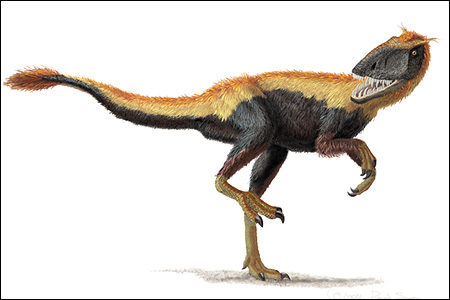
So is it time to produce the definitive blog post on Eotyrannus lengi, the dinosaur I did my phd on? Maybe. Actually, no. Eotyrannus was named by myself and colleagues in 2001, and in that initial paper we proposed that it was a basal tyrannosauroid, and one of the most basal members of the group (Hutt et al. 2001). Since then I’ve described the anatomy of Eotyrannus in full and tedious detail (the relevant thesis chapter is 118 pp and over 30,000 words long) and have come to know it well. I am now utterly convinced that it is a tyrannosauroid, and the results of my cladistic analysis (and those of others – see Holtz 2004) support this. Every dinosaur expert who knows anything about Eotyrannus agrees, by the way.

It turns out that the 2001 characterisation of Eotyrannus is horrendously wrong, as a new rigorous skeletal reconstruction (to be published soon) shows. The animal looked substantially different from the way I initially reconstructed it (see Naish 2001, Naish et al. 2001 and Holtz 2004), and in detail it’s proved to be strikingly odd and unique in many, many features. I’ll talk about these details some time soon, but not now. In fact I’m currently making arrangements to get the full monograph published in a high prestige journal, and with the co-authorship of a leading expert on tyrant dinosaurs I hope to produce an important work on tyrannosauroid phylogeny and morphology. More on this as and when it happens.

Since Eotyrannus was published a few very interesting things have been happening in the world of basal tyrannosauroids. I was aiming to discuss all of these here, but as usual I veered off at a tangent and have hardly scratched the surface. Eotyrannus seems to have been a mid-sized theropod. The type specimen is a juvenile individual that would have been 4.5 m long when complete, but fragmentary specimens from larger individuals indicate that adults were perhaps around 7 m long. But other basal tyrannosauroids are way smaller than this, mostly being less than 3 m long.

We begin with Dilong paradoxus, a basal tyrannosauroid known from excellent near-complete specimens from the Lower Cretaceous Yixian Formation of Liaoning Province, China (Xu et al. 2004). The Yixian Formation is the now famous unit that has produced all those little coelurosaurs with feathers and other integumentary structures preserved, and Dilong is no exception. It is preserved with simple quill-like integumentary structures that seem antecedent to the true complex feathers that evolved later.

Dilong has proved to be a sort of Rosetta stone for me, allowing several previously enigmatic Lower Cretaceous coelurosaurs to be reinterpreted as additional basal tyrannosauroids. Given that I haven’t published the relevant details, I’d be silly if I gave the game away here, but to be honest the only people who really care about this already know the relevant details, and furthermore I am silly anyway. The news is that a controversial little coelurosaur from the Isle of Wight’s Wessex Formation, Calamosaurus foxi (known only from two cervical vertebrae, one of them incomplete), is so similar to the cervical vertebrae of Dilong that I am confident that it too should be identified as a basal tyrannosauroid. This is mentioned in a large manuscript that came back from review some weeks ago and is currently undergoing revision, but the full story is to be revealed in a short paper that’s been completed and reviewed but now awaits post-review revamping.

I previously had Calamosaurus down as a compsognathid (Naish et al. 2001). Compsognathids are, like tyrannosauroids, basal coelurosaurs, but they retained small body size throughout their history (so far as we know). They were also conservative in all being rather alike: morphologically unspecialized with relatively short forelimbs, rather long and gracile legs and feet, and a long tail. There’s a lot more that could be said about them but this isn’t the time. Here’s the thing: the fact that Calamosaurus probably isn’t one of them after all leads us to a key question. Namely, do all the other compsognathids really go together, or is Compsognathidae as currently perceived actually an artificial assemblage of distantly related (yet superficially similar) theropods?

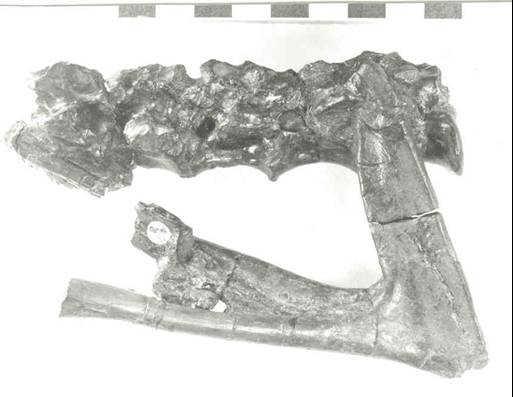
Back in 2004 I and colleagues named the new Brazilian theropod Mirischia asymmetrica (photo at left). That name means ‘asymmetrical wonderful pelvis’, and I think it’s a rather good descriptive name. The only known specimen really is a ‘wonderful pelvis’ (though it also includes some of the hindlimb bones), as it is 3-D and fantastically well-preserved, including even soft tissues like part of the gut and a probable post-pubic air sac (and to know the importance of that latter feature you’ll have to wait for a future post). As you might guess, it’s also asymmetrical, but I won’t talk about that here. I also don’t want to talk about the embarrassing fact that Mirischia’s generic name might imply that it was named after the fund-giving Mirisch Foundation, but (annoyingly) I only found this out after the publication of the Mirischia paper.

Anyway, Mirischia is enough like Compsognathus – particularly in the detailed anatomy of its pubis – for me to convince myself that it must belong together with Compsognathus in a little clade, and by definition this clade has to be called Compsognathidae. So in the 2004 paper, Naish et al. argued strenuously that (1) there is a little clade called Compsognathidae, the members of which can be united on the basis of shared derived characters, and (2) in addition to Compsognathus, this clade includes Sinosauropteryx and Mirischia. This published opinion is in part the result of a long series of to-ings and fro-ings between myself and my good friend Nick Longrich, for Nick has long been a vocal opponent of the idea that Compsognathidae really is monophyletic. Nick thinks that some so-called compsognathids are basal maniraptorans, and that others aren’t even coelurosaurs, but to date he’s only published an abstract on this (and to see why this is interesting and important you’ll have to wait until yet another future post. Think alvarezsaurids and stagodontids). Alas poor Longrich, surely he can’t be right. By the way, if you’re at all interested in what Nick looks like, click here. Sorry Nick.

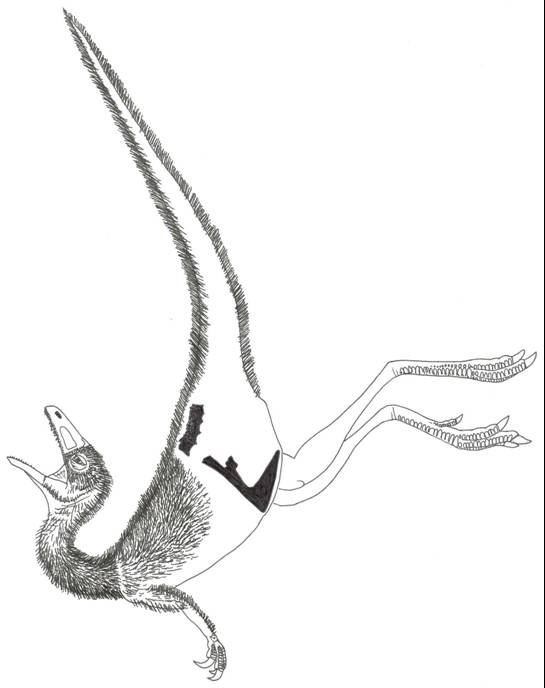
Here’s where we bring Dilong back in. The pelvic anatomy of Dilong – an undoubted basal tyrannosauroid – is (like that of Mirischia) rather like that of Compsognathus. This is disturbing, as it all but destroys the reasons for thinking that Mirischia can only be a compsognathid. Might it actually be a basal tyrannosauroid? This has implications for another supposed compsognathid: the Isle of Wight taxon Aristosuchus pusillus (photo at left, with interpretative restoration below) which, again, I’d previously identified with confidence as a close relative of Compsognathus (Naish 2002, Naish et al. 2001, 2004). So we can now doubt that those ‘compsognathids’ known only from pelvic material really truly are compsognathids. Again, this is an idea that I’m mentioning in that large in-preparation manuscript.

In my thesis I tried to test all of this: I included all of the relevant taxa (except Aristosuchus, as I decided it wasn’t complete enough to code) and all of the characters that have been used in this debate. And the result? Well, yes, there was a monophyletic Compsognathidae, but it consisted only of Compsognathus and one other taxon (and I’d rather not say which taxon that was right now). It wasn’t Mirischia, as this came out as… a basal tyrannosauroid. Two characters helped pull Mirischia into Tyrannosauroidea. One of these was discussed in the Naish et al. (2004) paper but the other was previously overlooked. I’ll not mention them here for fear of giving away all the secrets.

Furthermore, other supposed compsognathids did not group with Compsognathidae proper. Instead they were scattered about the base of Coelurosauria. So right now – while further work and further testing and further incorporation of data is needed – I am thinking that Nick was right, and that Compsognathidae in its old, inclusive sense is an artificial grouping.

People sometimes ask what sort of relevance stuff like this really has for our understanding of animals and their evolution. Well, it actually tells us an awful lot of stuff about patterns and trends. If so-called compsognathids – all of them relatively small, ecologically and morphologically generalized, long-limbed, long-tailed theropods that hunt small vertebrate prey – are not a clade but are actually scattered about the base of the coelurosaur family tree, this likely indicates that this ecotype was the ancestral one for coelurosaurs. We might already have thought that based on other lines of evidence, but this would help confirm it. There are indications that ‘compsognathids’ could make a living just about anywhere (for reasons that, again, I’ll have to cover in another post), and if this is valid then again we have another really interesting discovery about evolution at the base of Coelurosauria.

And I’ll have to stop there. I was planning to discuss the Jurassic basal tyrannosauroids Aviatyrannis (from Portugal) and Guanlong (from China). Another time. To readers who already knew all of this stuff, I apologise. To those who didn’t: welcome to the fantastic world of dinosaurs! More to come. For the latest news on Tetrapod Zoology do go here.

Refs - -

Holtz, T. R. 2004. Tyrannosauroidea. In Weishampel, D. B., Dodson, P. & Osmólska, H. (eds) The Dinosauria, Second Edition. University of California Press (Berkeley), pp. 111-136.

Hutt, S., Naish, D., Martill, D. M., Barker, M. J. & Newbery, P. 2001. A preliminary account of a new tyrannosauroid theropod from the Wessex Formation (Early Cretaceous) of southern England. Cretaceous Research 22, 227-242.

Naish, D. 2001. Eotyrannus lengi, a new coelurosaur from the Isle of Wight. Dino Press 5, 82-91.

- . 2002. The historical taxonomy of the Lower Cretaceous theropods (Dinosauria) Calamospondylus and Aristosuchus from the Isle of Wight. Proceedings of the Geologists’ Association 113, 153-163.

- ., Hutt, S. & Martill, D. M. 2001. Saurischian dinosaurs 2: Theropods. In Martill, D. M. & Naish, D. (eds) Dinosaurs of the Isle of Wight. The Palaeontological Association (London), pp. 242-309.

- ., Martill, D. M. & Frey, E. 2004. Ecology, systematics and biogeographical relationships of dinosaurs, including a new theropod, from the Santana Formation (?Albian, Early Cretaceous) of Brazil. Historical Biology 16, 57-70.

Xu, X., Norell, M. A., Kuang, X., Wang, X., Zhao, Q. & Jia, C. 2004. Basal tyrannosauroids from China and evidence for protofeathers in tyrannosauroids. Nature 431, 680-684.

Labels: , , ,

Saturday, February 25, 2006

Lots of sauropods, or just a few sauropods, or lots of sauropods?

I have a window of about 30 minutes before I need to get back to the British dinosaurs manuscript (which really needs to be finished by next week), so let’s see if I can get this done. As discussed in the previous blog entry, early last week Mike Taylor (see accompanying hilarious photo) and I spent the better part of a day working on Wealden sauropods in the Natural History Museum collections. The main point of this excursion was to have our final look (‘final’ as in last look before we submit our paper) at a specimen that we’ve been working on: a highly unusual, in fact deeply weird, new taxon collected in the late 1800s from the Ashdown Beds Formation (Valanginian) near Hastings. I won’t be saying more about it until it’s published, but its ‘discovery’ has prompted me to revisit the problematic area of Wealden sauropod diversity. Well, ok, I’m ‘revisiting’ that area anyway right now, what with the British dinosaurs manuscript, but still. Was sauropod diversity in the Early Cretaceous of England high, or low?

First things first: it’s misleading to think of the ‘Wealden’ as a short chunk of time, as this term actually applies to three formal stratigraphic groups (the Berriasian-Barremian Hastings Beds and Weald Clay Group of the mainland, and the Hauterivian-Aptian Wealden Group of the Isle of Wight). ‘Berriasian to Aptian’ is something like 30 million years, so that’s a lot of time for a whole lot of species to come and go. Whole assemblages of species in fact. Certainly the animals known from the Hastings Beds Group are not the same as those of the Barremian Wessex Formation (the best known dinosaur-bearing unit in the Wealden Group). The Hastings Beds Group has yielded Pelorosaurus conybeari (which is actually the same thing as Cetiosaurus brevis, but we won’t go there right now) and P. becklesii (which clearly isn’t congeneric with P. conybeari). P. conybeari, based on caudal vertebrae, chevrons and a large and gracile humerus, is a basal titanosauriform, perhaps a brachiosaurid. P. becklesii, named for tremendously short and robust forelimb elements and skin, is clearly a titanosaur. This is significant as it’s among the oldest of verified body fossil representing this clade. However, there are trackways that appear to have been produced by titanosaurs from the Bathonian of Ardley, Oxfordshire (Day et al. 2002, 2004), so titanosaurs had been around since the Middle Jurassic at least.

That’s not all – the Hastings Beds Group has also yielded a single metacarpal which has been identified as belonging to a diplodocid: that’s right, not just a diplodocoid, but a diplodocid. Angela Milner initially made this identification, and more recently I’ve had it verified by Matt Bonnan (pers. comm. 2006). Then we have the new taxon that Mike and I are looking it. It doesn’t seem that any of these animals can be conspecific, so, we have: a basal titanosauriform (and possible brachiosaurid), a good titanosaur, a diplodocid, and a new taxon that isn’t any of these.

What about the Wessex Formation, where 30-odd Barremian dinosaur species are known? Naish & Martill (2001) and Naish (2005) thought that sauropod diversity here was quite high, with a possible camarasaurid (Chondrosteosaurus), a few brachiosaurids, a titanosaur (Iuticosaurus valdensis), and an unnamed diplodocoid (represented by a chevron as well as isolated teeth and other elements). This now seems erroneous, or perhaps over-optimistic. The characters supposedly indicating camarasaurid status for Chondrosteosaurus are rubbish, and it’s more likely a basal titanosauriform (and it’s non-diagnostic anyway). The supposed diplodocoid bits are controversial, and the ‘sled-like’ morphology initially used to support a diplodocoid identity for the famous chevron (Charig 1980) is now thought to have been primitive for neosauropods, rather than derived for diplodocoids (see Upchurch 1998). It’s also difficult to be sure that there’s more than one brachiosaurid. The evidence for titanosaurs (procoelous caudal vertebrae, with a distinctively located neural arch) is reasonable, but the remains aren’t diagnostic.

Accordingly, when Paul Upchurch spoke about Wessex Formation sauropod diversity at the British dinosaurs Palaeontological Association Review Seminar in November 2003 (co-hosted by Dinosaur Isle Museum and the University of Portsmouth) he cautioned that diversity might have been over-estimated, and that titanosauriforms accounted for what diversity there was.

But while some groups – like camarasaurids – have now been removed from the list of taxa, new ones have been added (as it happens, camarasaurids were apparently present elsewhere in Lower Cretaceous Europe, but more about that another time). Firstly, there are definitely brachiosaurids present in the Wessex Formation: the big MIWG 7306 cervical vertebra that I and colleagues described in 2004 (Naish et al. 2004) is clearly more like the vertebrae of Brachiosaurus and Sauroposeidon than anything else (go here for more), and some of the dorsal vertebrae referred by Blows (1995) to his problematic taxon Eucamerotus foxi are also clearly brachiosaurid in the strict sense. Then there are the clearly titanosaurian caudal vertebrae, such as those described by Le Loeuff (1993). But there’s more.

A big and highly distinctive, pristine tooth forms the holotype of Oplosaurus armatus. Naish & Martill (2001), the idiots, thought that this might be another brachiosaurid, but that’s clearly wrong: Canudo et al. (2002) suggested that Oplosaurus might instead have been closer to Camarasaurus, and Upchurch et al. (2004) regarded it as a distinct neosauropod of uncertain affinities. Then there are the brachiosaurid teeth named Pleurocoelus valdensis: most authors have regarded these as non-diagnostic bits of brachiosaurid, but Ruiz-Omeñaca & Canudo (2005) have argued that they’re diagnostic and really represent a good species. Whatever they are, they’re clearly something else from Oplosaurus.

And then, finally, there are the diplodocoid teeth figured by Naish & Martill (2001) and identified by Wilson & Sereno as…. rebbachisaurid teeth! I can’t provide the citation for the latter as I don’t yet have the paper, but the recognition of these teeth as rebbachisaurid verifies the presence of diplodocoids in the Wessex Formation. Ok, so they aren’t diplodocid-like forms as Charig and others thought when they were looking at the chevron, but they’re diplodocoids nonetheless. In some senses this discovery isn’t a surprise as rebbachisaurids have lately been reported from Barremian-Aptian Spain (Fernández-Baldor et al. 2001, Pereda Suberbiola et al. 2003), but it now means that the oldest rebbachisaurids in the world are from England. Huh, so much for this being an exclusively Gondwanan clade.

So, in the Wessex Formation we have… an unusual neosauropod of uncertain affinities (Oplosaurus), definite brachiosaurids, definite titanosaurs, and a rebbachisaurid. That’s not bad in terms of diversity (adjacent picture shows diplodocoid and titanosaur). To remind you, in the older Hastings Beds Group we have a basal titanosauriform (and possible brachiosaurid), a titanosaur, a diplodocid, and a new and unusual taxon that isn’t any of these. So, also, not bad in terms of diversity, and in fact not that different from the Wessex Formation roster, which implies stability from the point of view of long-term diversity.

And, it’s on that point that I must get back to work. I was going to talk about the theropods, but that can wait.

Ref - -

Blows, W. T. 1995. The Early Cretaceous sauropod dinosaurs Ornithopsis and Eucamerotus from the Isle of Wight, England. Palaeontology 38,187-197.

Canudo, J. I., Ruiz-Omeñaca, J. I., Barco, J. L. & Royo Torres, R. 2002. ¿Saurópodos asiáticos en el Barremiense inferior (Cretácico Inferior) de España? Ameghiniana 39, 443-452.

Charig, A. J. 1980. A diplodocid sauropod from the Lower Cretaceous of England. In Jacobs, L. L. (ed.) Aspects of Vertebrate History, Essays in honour of E. H. Colbert. Museum of Northern Arizona Press, pp. 231-244.

Day, J. J., Norman, D. B., Gale, A. S., Upchurch, P. & Powell, H. P. 2004. A Middle Jurassic dinosaur trackway site from Oxfordshire, UK. Palaeontology 47, 319-348.

- ., Upchurch, P., Norman, D. B., Gale, A. S. & Powell, H. P. 2002. Sauropod trackways, evolution, and behavior. Science 296, 1659.

Fernández-Baldor, T., Pereda Suberiola, X., Huerta Hutado, P., Izquierdo, L. A., Montero, D. & Pérez, G. 2001. Descripción preliminar de un dinosaurio rebaquisáurido (Sauropoda Diplodocoidea) del Cretácico Inferior de Burgos (España). II Jornadas de Paleontología de Dinosaurios y su Entorno. Salasa de los Infantes (Burgos, España), 203-211.

Le Loeuff, J. 1993. European titanosaurs. Revue de Paléobiologie 7, 105-117.

Naish, D. 2005. The sauropod dinosaurs of the Wealden succession (Lower Cretaceous) of southern England. The Quarterly Journal of the Dinosaur Society 4 (3), 8-11.

Naish, D. & Martill, D. M. 2001. Saurischian dinosaurs 1: Sauropods. In Martill, D. M. & Naish, D. (eds) Dinosaurs of the Isle of Wight. The Palaeontological Association (London), pp. 185-241.

Naish, D., Martill, D. M., Cooper, D. & Stevens, K. A. 2004. Europe’s largest dinosaur? A giant brachiosaurid cervical vertebra from the Wessex Formation (Early Cretaceous) of southern England. Cretaceous Research 25, 787-795.

Pereda Suberbiola, X., Torcida, F., Izquierdo, L. A., Huerta, P., Montero, D. & Perez, G. 2003. First rebbachisaurid dinosaur (Sauropoda, Diplodocoidea) from the early Cretaceous of Spain : palaeobiogeographical implications. Bulletin de la Societe Geologique de France 174, 471-479.

Ruiz-Omeñaca, J. I. & Canudo, J. I. 2005. “Pleurocoelusvaldensis Lydekker, 1889 (Saurischia, Sauropoda) en el Cretácico Inferior (Barremiense) de la Península Ibérica. Geogaceta 38, 43-46.

Upchurch, P. 1998. The phylogenetic relationships of sauropod dinosaurs. Zoological Journal of the Linnean Society 124, 43-103.

Upchurch, P., Barrett, P. M. & Dodson, P. 2004. Sauropoda. In Weishampel, D. B., Dodson, P. & Osmólska, H. (eds) The Dinosauria, Second Edition. University of California Press (Berkeley), pp. 259-322.

Labels: , , ,