Wednesday, January 10, 2007

Biggest sauropod ever (part…. II)
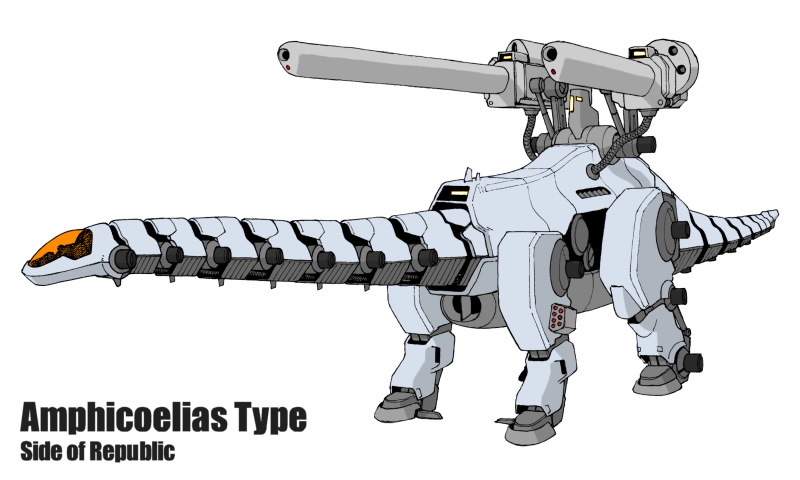
In the previous post we looked at the obscure and poorly known mega-sauropod Amphicoelias fragillimus, described in 1878 on the basis of an incomplete but enormous dorsal vertebra and the distal end of a femur. Its details show that it was a diplodocoid, and thus related to more familiar taxa like Diplodocus and Apatosaurus. Despite its absurd size – suggesting (by comparison with other diplodocoids) a total length of 60 m – this material somehow vanished prior to 1921. Due in part to these facts (and also, perhaps, to its poorly publicised and unfamiliar-sounding – or ‘crappy’ – name), Amphicoelias fragillimus was to be all but forgotten in the decades that followed…

During the 1990s, little-known articles by John McIntosh (revered older statesman of sauropod research) and Greg Paul looked briefly at A. fragillimus. McIntosh (1998) went through Cope’s inventories of the Garden Park discoveries (these records had been missed by Henry Osborn and Charles Mook in their 1921 review of Copes sauropod collection) and found that, perhaps because the contents of several crates have no surviving records, the shipment of A. fragillimus to New York wasn’t recorded. Paul (1994a, b) estimated the size of A. fragillimus based on the dimensions provided by Cope, suggesting (again, based on comparison with more completely known diplodocoids) a total length of 40-60 m, a weight of 100-150 tons, and that it would have been 9 m tall at the hips, and with thighs 3.8 m long.
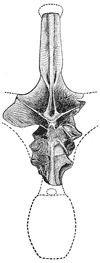
The news is that, at long last, a proper reappraisal of this mysterious giant has finally appeared: it’s a new paper by Ken Carpenter of the Denver Museum of Nature and Science, and while, sadly, it doesn’t report the discovery of a new, articulated A. fragillimus specimen, it does cover pretty much everything we know about this dinosaur (Carpenter 2006). By the way, Carpenter and colleagues have tried looking for additional remains of A. fragillimus, thus far without success. Actually, I have to note here the rumour that new A. fragillimus material has been discovered, and that it will be discussed at the 2008 Society of Vertebrate Paleontology meeting. We shall see [adjacent image is Copes original 1878 figure of the A. fragillimus vertebra. I ripped it off from Matt Celeskeys post about A. fragillimus from August of last year (go here). Sorry Matt].

Was A. fragillimus a hoax?

Unsurprisingly, quite a few people have been sceptical about the existence of this all-too-conveniently lost mega-sauropod. Can we be sure that it ever really existed, or could it be that Cope was pulling a fast one in order to beat his rival, Othniel Charles Marsh, hands-down in an effort to describe the biggest sauropod? As attractive as this scenario might appear, hoaxing is highly, highly unlikely. Consider the following:-

-- Cope was very specific about all the discovery details of A. fragillimus. According to his field notes, it was collected in late 1877 by Oramel Lucas (described by Cope as his ‘indefatigable friend’) at Garden Park, specifically from quarry III, a site southwest of the hill known today as Cope’s Nipple (Carpenter 2006). The rocks here yielded several other particularly large Morrison Formation dinosaurs (such as Camarasaurus supremus).

-- Furthermore, the shipment records discovered by McIntosh show that Oramel Lucas and his brother Ira knew of A. fragillimus and labelled some remains with this name (McIntosh 1998, p. 487 and p. 498). If it was a hoax, then the Lucas brothers must have been in on it too, which now makes it a conspiracy.

-- The conspiracy would have to extend even further, as an American Museum of Natural History catalogue number, AMNH 5777, was reserved for the A. fragillimus material.

-- The rivalry that existed between Cope and Marsh is also relevant here (Marsh is pictured at left). As is well known, Marsh enjoyed making a very public fool of Cope when he made a technical error (Storrs 1994, Davidson 2002), and when he disagreed with Cope, or thought him wrong, Marsh was tediously pedantic in his criticisms (see Marsh’s 1873 papers on dinoceratans, for example). Marsh never criticised, nor even questioned, the reality of A. fragillimus. Carpenter (2006) notes that ‘Marsh is known to have employed spies to keep tabs on what Cope was collecting, and it is quite possible that he had independent confirmation for the immense size of A. fragillimus’ (p. 134).
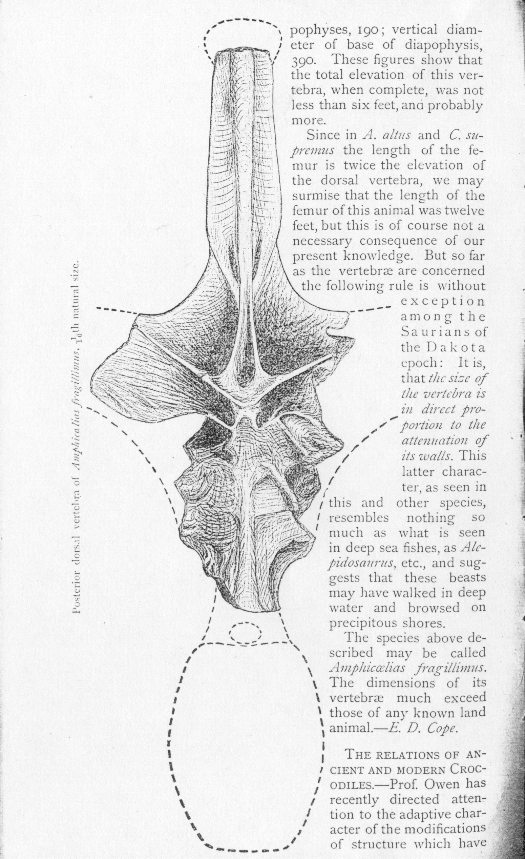
-- Cope’s drawing of A. fragillimus is accurate-looking and elaborate, and his description refers to small detailed features, all of which conform in details with what we know of diplodocoid vertebrae (part of the description is reproduced at left: from here). He would have to have made all of this stuff up if the specimen was a hoax: it’s not as if the only record of A. fragillimus is a scribbled fragment in a diary, saying ‘On Tuesday I saw the biggest vertebra ever… it was thiiiiis big…’. Rather, the material is documented, in detail, in a proper technical paper. To hoax an entire paper of this sort would be severe science-crime, and there is no indication that Cope was unscrupulous or dastardly, or prepared to stoop this low.

-- It is noteworthy that workers well known for their methodical and conservative approach to sauropod studies (notably John McIntosh) have accepted Cope at his word. Osborn, who succeeded Cope as vertebrate palaeontologist for the US Geological Survey and is well known for speaking his mind when he had a problem with something, also never voiced doubts about A. fragillimus.

All of this is circumstantial, for sure, but I agree with Carpenter (and others) that the idea of Cope perpetrating a hoax of this magnitude is pretty much unthinkable. I think we have to assume that the specimens really existed. Therefore, they must have become lost or destroyed some time between 1878 and 1921 (when Osborn and Mook failed to find them). As Carpenter (2006) points out, it in fact appears likely that the material was too fragile to survive, and that it crumbled to bits some time after its discovery. Matt Celeskey also noted this possibility (go here). Cope commented on this fragility, writing ‘in the extreme tenuity of all its parts, this vertebra exceeds this type of those already described, so that much care was requisite to secure its preservation’ (p. 563), and his drawing also suggests that the vertebra had been subjected to extensive weathering and hence was already fragile. Indeed its fragile nature explains the specific name he chose for it.

Furthermore, ‘preservatives had not yet been employed to harden fossil bones, the first of which was a sodium silicate solution used in O. C. Marsh’s preparation lab at Yale University beginning in the early 1880s’ (Carpenter 2006, p. 134). Support for the hypothesis that the material simply did not survive collection and storage comes from the fact that, within recent years, a Camarasaurus supremus vertebra collected from the same area is known to have crumbled into small useless fragments.

The other Amphicoelias

As I’ve now mentioned a few times, the detailed anatomy of the A. fragillimus vertebra (as figured by Cope) shows us that this sauropod was a diplodocoid. We can make a confident statement like this because it is relatively easy to distinguish the different sauropod clades on the basis of their vertebral anatomy, and A. fragillimus has all the distinctive anatomical features typical of diplodocoids. In fact it strongly resembles the vertebrae of the first named species of Amphicoelias, A. altus, which Cope described in February 1878.
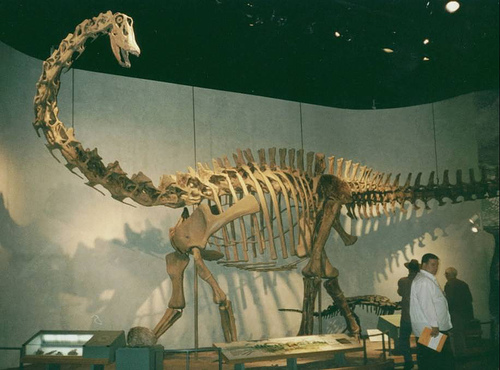
A. altus is poorly known, but not as poorly known as A. fragillimus: it was first described for vertebrae, a pubic bone and a femur (Cope 1878), but a scapula, coracoid, ulna and partial skull were later referred to it. Based on these remains, A. altus was similar in size to Diplodocus carnegii and probably around 25 m long (Paul 1994a, b), and it is particularly interesting among diplodocoids in that its femora were markedly elongate and slender. Some workers have regarded A. altus as particularly close to Diplodocus, in which case it would be a diplodocid diplodocoid, and probably a diplodocine diplodocid diplodocoid. However, it has also been asserted that A. altus was a basal diplodocoid, and thus more archaic than diplodocids and other flagellicaudatan diplodocoids (that’s right, I said flagellicaudatan) [adjacent image shows Diplodocus mount at Denver Museum of Nature and Science].

Was Cope right in referring his second Amphicoelias species to the same genus as the first? Several authors have thought so, and in fact have gone so far as to state that ‘it is doubtful … if the characters described by Cope warrant the placing of the type [of A. fragillimus] in another species different from A. altus’ (Osborn & Mook 1921, p. 279), or ‘there is no reason not to consider [A. fragillimus] a very large individual of A. altus’ (McIntosh 1998, p. 502). If this is true then, like A. altus, it’s reasonable to assume that A. fragillimus was also superficially Diplodocus-like, and with particularly elongate, slender femora (a shocking idea given the animal’s size).

Carpenter argues in his new paper that, in fact, A. fragillimus seems to have differed from A. altus in a number of anatomical details, and that the two might not have been congeneric after all. As he notes, this remains untestable in the absence of better remains however. Let’s all hope and pray that a new generic name is up for grabs, and I don’t want any ‘superlative + saurus’ nominations.
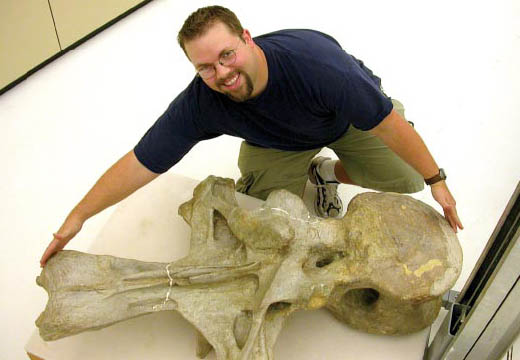
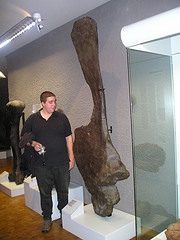
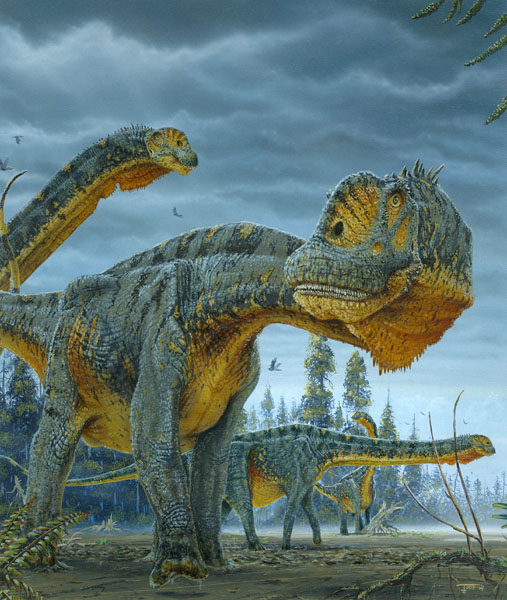
One final thing. Whats with the image at the top of the page? I discovered it while googling Amphicoelias. Huh, in my day the only decent zoid was Hellrunner... For the story on the image at left go here (no, thats not an Amphicoelias vertebra, its Matt Wedel. The bone, however, is from a diplodocoid... although not an Amphicoelias), and for previous posts on sauropods see the series on Angloposeidon, the Christmas post on Turiasaurus, some assorted ramblings on British Wealden sauropods, and a post devoted entirely to the anatomy of their hands.

Refs - -

Carpenter, K. 2006. Biggest of the big: a critical re-evaluation of the mega-sauropod Amphicoelias fragillimus Cope, 1878. New Mexico Museum of Natural History and Science, Bulletin 36, 131-137.

Cope, E. D. 1878. On the saurians recently discovered in the Dakota Beds of Colorado. The American Naturalist 12 (2), 71-85.

Davidson, J. P. 2002. Bonehead mistakes: the backround in scientific literature and illustrations for Edward Drinker Copes first restoration of Elasmosaurus platyurus. Proceedings of the Academy of Natural Sciences of Philadelphia 152, 215-240.

McIntosh, J. S. 1998. New information about the Cope collection of sauropods from Garden Park, Colorado. Modern Geology 23, 481-506.

Osborn, H. F. & Mook, C. C. 1921. Camarasaurus, Amphicoelias and other sauropods of Cope. Memoirs of the American Museum of Natural History, n.s. 3, 247-287.

Paul, G. S. 1994a. Big sauropods – really, really big sauropods. The Dinosaur Report Fall 1994, 12-13.

- . 1994b. Is Garden Park home to the world’s largest known land animal? Tracks in Time 4 (5), 1.

Storrs, G. W. 1984. Elasmosaurus platyurus and a page from the Cope-Marsh war. Discovery 17 (2), 25-27.

Labels: , , ,

Tuesday, January 09, 2007

Biggest…. sauropod…. ever (part…. I)

Finally, its that post on gigantic mega-sauropods you’ve all been oh-so-patiently waiting for. Note that Ive decided to do a new thing, and have left the teaser post on its own (rather than over-writing it with this new version). Talking of new things, recall that something about my blogging habits is set to change soon.. the word is already on the street (to use the words of Carel Brest van Kempen), but Im going to keep quiet about it for a bit longer. All will be revealed [UPDATE: go here for the news]. Anyway, to business. Even if you’re not an expert on dinosaurs, it’s likely that you’ve heard – firstly – that some sauropods were rily, rily big and – secondly – that these biggest of the big included such whoppers as Seismosaurus, Supersaurus and Argentinosaurus. It’s always helpful that their names are easy to remember. Recent work has not only resulted in the publication of reasonably accurate size estimates for these dinosaurs, it has also clarified their taxonomy and phylogenetic positions.

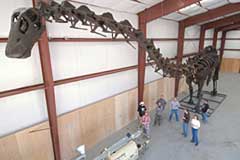
Supersaurus vivianae from the Morrison Formation of Colorado is, despite its name, a valid taxon – specifically it’s a diplodocid diplodocoid, and apparently an apatosaurine (the image at the top of page shows a new skeletal mount of this taxon). Recent estimates put its total length at 33 m. The most oft-figured bit of Supersaurus is its immense scapulocoracoid: it’s usually depicted with the late Jim Jensen, its discoverer and describer, lying alongside it. For a change, here (at left) is a curious new take on the theme (borrowed from here). Oh, and if you’re wondering about Ultrasauros (originally informally named Ultrasaurus: note the spelling difference), it’s no longer regarded as a valid taxon: the type material - a dorsal vertebra - was shown by Brian Curtice and colleagues (Curtice et al. 1996) to belong to Supersaurus (come back Brian, all is forgiven!) while the famous Ultrasauros scapulocoracoid seems to belong to Brachiosaurus. Below, at left, you can see dead fish expert Graeme Elliott standing alongside the Ultrasauros scapulocoracoid (go here for hilarious caption, sorry Graeme).

Moving on, Seismosaurus hallorum (originally described as S. halli), from the Morrison Formation of New Mexico, is also a diplodocid diplodocoid, but recent work indicates that it is not generically distinct from Diplodocus and should thus be renamed Diplodocus hallorum. Originally claimed to be over 40 m long, new estimates put it between 30 and 35 m. Supersaurus and Diplodocus hallorum, being relatively gracile diplodocids, probably weighed between 25 and 50 tons (Paul 1994a, b, 1997).

A few more super-sauropods have been added to the list in recent years. Most are titanosaurs, the predominantly Cretaceous sauropod clade originally thought to be late-surviving relatives of diplodocoids but now known to be close kin of the short-skulled camarasaurs and brachiosaurs. Argentinosaurus huinculensis, named in 1993, is a huge titanosaur from the Upper Cretaceous Río Limay Formation of Argentina: it was perhaps 30 m long. Paralititan stromeri is another massive titanosaur, this time from the Upper Cretaceous of Egypt. Estimated by its describers as having been around 30 m long, it has more recently been down-sized to a mere 26 m (image below left is Todd Marshalls painting of Paralititan, taken from here. Go here for yours truly posing in bizarre fashion with the same image). Puertasaurus reuili, named in 2005 and from the Upper Cretaceous Pari Aike Formation of Argentina, was similar in size to these forms. Finally, Turiasaurus riodevensis is a gigantic Spanish form, and it’s not a titanosaur, belonging instead to a hitherto unrecognised clade termed Turiasauria. It was described at the end of 2006 (go here for more) and is one of the biggest sauropods known, with a length of 36-39 m.

Exactly how heavy these mega-sauropods were is mildly controversial. Accurate mass estimates generally agree that they were on the order of 80-90 tons, but Royo-Torres et al. (2006), the describers of Turiasaurus, put this animal at half this. However, they used a notoriously unreliable method of estimating weight.

While you might have heard of Supersaurus, Seimosaurus or Argentinosaurus – and perhaps even Turiasaurus and Paralititan – have you heard of… Amphicoelias fragillimus? Well, ok, if you’re a dinosaur ubernerd then the answer will be yes, but not if you’re a normal person. Though described as long ago as 1878, this sauropod has remained decidedly obscure and hardly heard of until pretty recently. I’ve done my part for the cause, having mentioned it at every opportunity: in both Dinosaurs of the Isle of Wight, and Walking With Dinosaurs: The Evidence, it’s discussed and touted as, possibly, the biggest sauropod of them all. Naish & Martill (2001), for example, stated ‘What has recently been claimed as the biggest of all sauropods and, indeed, the biggest of all land animals, is actually a specimen discovered in 1878. Based only on a single enormous vertebra, now lost, Amphicoelias fragillimus has been estimated to have reached a length of 60 m and may have attained a weight of 150 tons!’ (p. 230). If these estimates are valid, then this animal was twice as long as Supersaurus and Diplodocus, and perhaps over four times heavier. Err, gosh.

Amphicoelias fragillimus, giant of giants

In August 1878 the famous and prolific scientist* Edward Drinker Cope (1840-1897), portrait at left, described a new immense sauropod, Amphicoelias fragillimus, from the Garden Park quarries of the Morrison Formation of Colorado. It was represented only by an incomplete dorsal vertebra and the distal end of a femur (contra Naish & Martill above: whoops!). A good drawing of the vertebra was provided (Cope 1878), showing that this sauropod was clearly a diplodocoid: a member of the same sauropod clade as Diplodocus, Apatosaurus and their relatives (the name Diplodocimorpha is also sometimes used for these animals: see Taylor & Naish 2005: free pdf available here). The big deal is how, err, big these remains were. The partial vertebra had a preserved height of 1.5 m and, when reconstructed on the basis of comparison with complete diplodocoid vertebrae, has a total height of 2.7 m. Again… gosh (or words to that effect).

* Though usually described (by palaeontologists) as a palaeontologist, Cope was also an accomplished herpetologist and ichthyologist, which explains the name of the journal Copeia.

If history were fair, we would all have grown up familiar with Cope’s hyper-enormous Amphicoelias fragillimus, and we would be less impressed by Brachiosaurus and Balaenoptera, let alone with paltry little 20-m long sauropods like ‘Angloposeidon’ (go here). But it was not to be, and it was to sink into the morass of obscurity. In a major 1921 review of Cope’s sauropods, Henry Fairfield Osborn and Charles Mook noted that they were unable to locate the immense vertebra in Cope’s sauropod collection (Osborn & Mook 1921), today at the American Museum of Natural History (New York). It was lost.

And… I’ll have to stop there. The rest of the story will come in part II: I am aiming to post it tomorrow (10th Jan 2007). It concentrates on those recent studies that have looked at this species, and one of the most-asked questions about this remarkable dinosaur: was it a hoax? Stay tuned, all will be revealed. And I’m not stringing it out on purpose – I honestly don’t have enough time in my life to deal with all this stuff in one go. Sigh. And apologies to Ken Carpenter, who is no doubt wondering why I haven’t yet cited his paper…

Refs - -

Cope, E. D. 1878. A new species of Amphicoelias. American Naturalist 12, 563-565.

Curtice, B. D., Stadtman, K. L. & Curtice, L. J. 1996. A reassessment of Ultrasauros macintoshi (Jensen, 1985). In Morales, M. (ed) The Continental Jurassic. Museum of Northern Arizona Bulletin 60, 87-95.

Davidson, J. P. 2002. Bonehead mistakes: the backround in scientific literature and illustrations for Edward Drinker Cope's first restoration of Elasmosaurus platyurus. Proceedings of the Academy of Natural Sciences of Philadelphia 152, 215-240.

McIntosh, J. S. 1998. New information about the Cope collection of sauropods from Garden Park, Colorado. Modern Geology 23, 481-506.

Naish, D. & Martill, D. M. 2001. Saurischian dinosaurs 1: Sauropods. In Martill, D. M. & Naish, D. (eds) Dinosaurs of the Isle of Wight. The Palaeontological Association (London), pp. 185-241.

Osborn, H. F. & Mook, C. C. 1921. Camarasaurus, Amphicoelias and other sauropods of Cope. Memoirs of the American Museum of Natural History, n.s. 3, 247-287.

Paul, G. S. 1994a. Is Garden Park home to the world’s largest known land animal? Tracks in Time 4 (5), 1.

- . 1994b. Big sauropods – really, really big sauropods. The Dinosaur Report Fall 1994, 12-13.

- . 1997. Dinosaur models: the good, the bad, and using them to estimate the mass of dinosaurs. In Wolberg, D. L., Stump, E. & Rosenberg, G. D. (eds) Dinofest International: Proceedings of a Symposium Sponsored by Arizona State University. Academy of Natural Sciences (Philadelphia), pp. 129-154.

Royo-Torres, R., Cobos, A. & Alcalá, L. 2006. A giant European dinosaur and a new sauropod clade. Science 314, 1925-1927.

Taylor, M. P. & Naish, D. 2005. The phylogenetic taxonomy of Diplodocoidea (Dinosauria: Sauropoda). PaleoBios 25, 1-7.

Labels: , , ,

Friday, January 05, 2007

Finally, some hot giant amphicoelian action


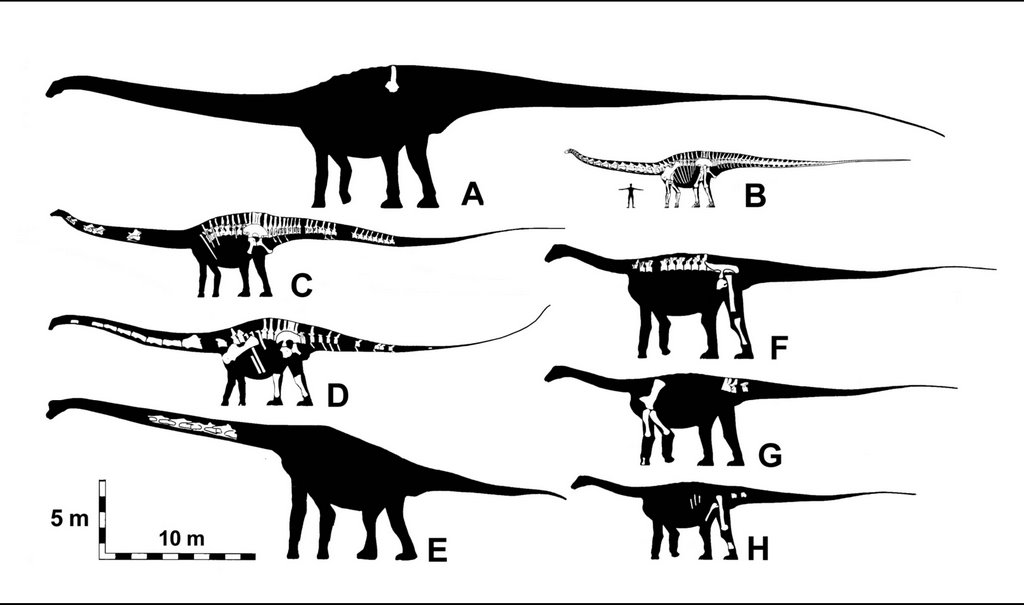
[click for larger version. Diagram produced by Ken Carpenter]

FULL POST TO COME LATER TODAY (9th Jan 2007)

After years of suffering all-too-brief mentions, asides and speculative remarks, the oft-alluded-to but long-neglected gigantic diplodocoid sauropod Amphicoelias fragillimus has been re-examined. Named by Edward Drinker Cope in 1878, it is known only from scant material (a single partial vertebra and fragment of femur) that – to make a bad situation worse – was somehow lost prior to the 1920s. But scant and lost or not, this material shows that A. fragillimus was immense, and in fact the most immense of all mega-sauropods. Full post to follow soon…

Thanks to Mike P. Taylor for the heads-up.

And for the latest news on Tetrapod Zoology do go here.

Labels: , , ,

Saturday, December 23, 2006

Happy Christmas, from gigantic Spanish sauropods... or, alas, poor ‘Angloposeidon’

I said the last post would likely be the last before 2007. I lied, as while checking my emails this morning, something came up that I just can’t resist commenting on. As regular blog-readers will know, back in 2004 I and colleagues described a large cervical vertebra from an Isle of Wight sauropod dinosaur (see ‘Angloposeidon’, the unreported story: part I, part II, part III and part IV). Belonging to a large brachiosaurid closely related to the Upper Jurassic Brachiosaurus and Lower Cretaceous Sauroposeidon, the Isle of Wight specimen is 745 mm long, which suggests a total length exceeding 20 m. That made it the largest published European dinosaur (Naish et al. 2004). However, when the time came to talk to journalists about the discovery, I mentioned on several occasions the fact that even bigger European dinosaurs were due to the published in the near future. As I said in part IV

During the long period of time in which the [‘Angloposeidon’] manuscript was in preparation I spoke to several European colleagues who told me of new sauropods from Portugal and Spain that would easily outclass MIWG.7306 in terms of size. I had this on my mind all the way through the submission process, and at any time I expected there to be some report of a new European sauropod that had a total length exceeding 30 m. But even today such discoveries have yet to materialise, and having now seen some of the specimens in question I know that they fail to come close to the 20 m + estimated for MIWG.7306.

The news, of course, is that one of these Iberian giants has just been published (Royo-Torres et al. 2006): its the new taxon Turiasaurus riodevensis from the Villar del Arzobispo Formation (Jurassic-Cretaceus boundary) of Riodeva (Teruel Province, Spain) [many thanks to those who have sent the pdf!]. And it doesnt fail to meet the hype: it really is immense (so, the other Iberian giants that Ive seen were mere pretenders). Turiasaurus has a humerus about 1.8 m long and an estimated weight of over 40 tons. This makes it quite bigger than ‘Angloposeidon’ and in fact one of the biggest sauropods in the world, almost on par with immense titanosaurs like Argentinosaurus and Paralititan. Furthermore, phylogenetic analysis indicates that Turiasaurus belongs to a new clade located close to the origin of Neosauropoda (the macronarian-diplodocoid clade). Galveosaurus (named in 2005, and previously regarded as a cetiosaurid*) and Losillasaurus (named in 2001 and regarded as a diplodocoid, but since suggested to be a mamenchisaurid**) also seem to be turiasaurians. Thats pretty interesting, though it has to be said that the statistical support for turiasaurian monophyly is not overwhelmingly impressive.

* And later renamed Galvesaurus by a different group of authors. I will cover the Galveosaurus-Galvesaurus issue some time in the future.

** The correct term for the group dubbed omeisaurids by some.


Furthermore, the fact that Turiasaurus is represented by good, associated remains means that it might help clear up some of the mess represented by isolated remains (see previous post: Obscure dinosaurs of the Kimmeridge Clay). Scattered throughout the European Jurassic and Cretaceous record are assorted sauropod teeth that roughly resemble the teeth of better known forms, such as camarasaurs and brachiosaurids, but also have a unique look about them. Examples include the huge, beautifully preserved tooth named Oplosaurus armatus (from the Isle of Wight*) and the unusual specimen Cardiodon rugulosus from the Middle Jurassic Forest Marble Formation of Bradford-on-Avon, Wiltshire. It now turns out that these teeth are similar to those of Turiasaurus, which raises the interesting possibility that they are further representatives of this newly-recognised group. That would be cool.

* For more on Oplosaurus and other Lower Cretaceous English sauropods go here.

Anyway, Ill have more to say on turiasaurians and other Iberian sauropods in the future. And it really is relevant as I and colleagues (Barbara Sánchez-Hernández and Mike Benton) currently have an article in press on dinosaurs (including sauropods) from the Villar del Arzobispo Formation. Maybe some of the material we have belongs to Turiasaurus? Well see...

Finally, in other dinosaur news, youll note from the big picture above that Tom Holtzs big dinosaur encyclopedia is finally being advertised. I discussed it previously here.

All the best for Christmas and the New Year. My new year’s resolution? To finish writing all those blog posts I’ve been promising for the last year. Controversial mammals from Borneo, the passerine supertree, rhinogradentians, giant Australian feral cats, temnospondyls, more on tupuxuarids, agamas and sea snakes, the biggest slow worms, fake Chinese turtles, amphisbaenians, and loads more on sauropods, theropods, pneumaticity, flightless birds, bizarre pterosaurs, and giant eagles. And keep an eye on Tetrapod Zoology’s 1st Birthday... Goodbye 2006!

Refs - -

Naish, D., Martill, D. M., Cooper, D. & Stevens, K. A. 2004. Europe’s largest dinosaur? A giant brachiosaurid cervical vertebra from the Wessex Formation (Early Cretaceous) of southern England. Cretaceous Research 25, 787-795.

Royo-Torres, R., Cobos, A. & Alcala, L. 2006. A giant European dinosaur and a new sauropod clade. Science 314, 1925-1927.

Labels: , , ,

Tuesday, December 19, 2006

Obscure dinosaurs of the Kimmeridge Clay

Someone – I forget who it was – once described dinosaurs as ‘the most American animals that ever lived’. Well, with all due respect to North America’s endemic dinosaurs (Tyrannosaurus, Triceratops and so on), and to the worthy history of North American palaeontological discoveries, this is crap. Dinosaurs are no more American than they are Patagonian, Nigerian or French. Or at least that’s the politically correct version. Reality is rather different: dinosaurs are in fact British, and – what’s more – specifically English, having been discovered in England by English scientists working on English fossils. Ok, lest some flag-waving patriot of any nation gets offended by this, let me assure you that this is all tongue-in-cheek and not to be taken seriously. Dinosaurs no more ‘belong’ to any country than do rodents or grasshoppers.

England has a rich dinosaur record, and many of the taxa first named from English rocks (e.g., Hypsilophodon, Cetiosaurus, Baryonyx) have proved globally important in terms of what they’ve told us about dinosaur evolution and diversity. Furthermore, these taxa and others (e.g., Scelidosaurus, Mantellisaurus, Neovenator) are represented by excellent remains that sometimes consist of near-complete skeletons. Also noteworthy is that English dinosaurs span most of the Mesozoic, from the Upper Triassic to about the middle of the Cretaceous (there is no dinosaur-bearing Upper Cretaceous in England). So as a gross generalisation of the worse kind, England’s dinosaur record is ‘good’.

Partly because the study of dinosaurs began in England, there is an extensive and voluminous literature on scrappy English dinosaur fossils. Furthermore, these early finds were usually given binomial names, but as our knowledge of these animals has improved, it is understandable that many of these remains are today considered inadequate in terms of establishing taxonomic validity. Ideas on British taxa were sometimes revised several or many times as knowledge improved, and the results are convoluted synonymy lists. As I’ve now mentioned several times on this blog, a major effort to review this mess has recently been produced by Dave Martill and myself, and is currently in press for a special bicentennial issue of Journal of the Geological Society. More on that when it appears. In an unrelated project, Dave, I and Sarah Fielding recently reviewed the English dinosaurs of the Kimmeridge Clay Formation, and as it’s only recently been published (Martill et al. 2006) I figured I may as well blog about it.

The Kimmeridge Clay

The Kimmeridge Clay Formation is an Upper Jurassic mudrock, deposited within a shallow marine environment, that crops out in a narrow strip from Dorset in the south-west to Yorkshire in the north-east. There are also a few outcrops in Scotland, and a contemporaneous equivalent that crops out in northern France. Like the older Oxford Clay Formation (go see Life in the Oxford Clay sea), the Kimmeridge Clay has yielded numerous ichthyosaurs, plesiosaurs, marine crocodyliforms and fish. Excepting the fish of course, those animals are all very interesting and worthy of discussion, but of more interest right now are the many dinosaurs that have also been discovered in the Kimmeridge Clay.

Why have so many dinosaurs been recovered from a geological unit deposited in a shallow sea? Despite the title of our paper, I don’t think this means much. The dinosaurs we find in these marine rocks don’t exhibit any features suggesting that they were aquatic or amphibious, and it appears most likely that the carcasses of the relevant species were washed out to sea on a fairly regular basis. This is well supported by the fact that other fossils, such as plants, and the sediments themselves, have clearly been derived from terrestrial sources. At a time when shallow seas covered the better part of the European continent, it makes sense that an unusually high number of terrestrial animals living on the archipelagos of the region found their way into the marine environment.

Kimmeridge Clay dinosaurs belong to most of the major groups living in Europe during the Upper Jurassic. There were large and small theropods, several types of sauropod, herbivorous ornithopods, and both stegosaurs and ankylosaurs.

Kimmeridge Clay sauropods

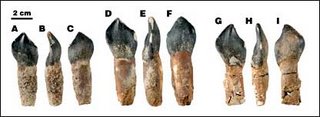
Perhaps the most interesting of the Kimmeridge Clay sauropods was named by John Whittaker Hulke* in 1874. Based only on a big humerus (1.3 m long, though perhaps 1.7 m long when complete: see adjacent image) discovered at Weymouth, Hulke named it Ceteosaurus humero-cristatus: note that he used a spelling of the generic name that later fell out of favour (the original, and thus favoured, spelling is Cetiosaurus), and used a hyphen in the specific name (an action that is illegal under today’s nomenclatural rules). This animal is quite certainly not really a species of Cetiosaurus (hence the quote marks used from hereon), as it is highly different in detail from the humerus of Cetiosaurus oxoniensis, the type species of the genus (well, actually, C. oxoniensis is not yet the type species of the genus, but that’s a long and complex issue that I can’t go into right now). So what is it? Its length, slender proportions and particularly prominent deltopectoral crest show that it is a brachiosaurid and, among brachiosaurids, its particularly long deltopectoral crest makes it unique and diagnosable. ‘C.’ humerocristatus is therefore one of those annoying fossil tetrapods that clearly needs a new name. So why doesn’t it have one?

The problem is that most workers who encounter problems like this prefer to err on the side of hyper-conservatism (Peter Dodson’s advice is that ‘the practise of naming genera on [the basis of isolated remains] is a highly undesirable one, greatly to be discouraged’ (Dodson 1996, p. 240): for more on this subject see Cryptic dinosaur diversity). Some therefore opt not to name something that they themselves have said deserves a name. In their review of sauropod species referred to Cetiosaurus, Upchurch & Martin (2003) concluded that ‘C.’ humerocristatus ‘is regarded as a distinct taxon referable to the Brachiosauridae’ but went on to state that ‘[w]e prefer to wait for more complete material before proposing a new name for this taxon’ (p. 213). Similarly, Upchurch et al. (2004) regarded ‘C.’ humerocristatus as ‘a potentially distinct taxon … [but] it would be unsafe to erect a new generic name given the material available’ (p. 309). This perpetuates the cycle, and the taxon goes unnamed for even longer.

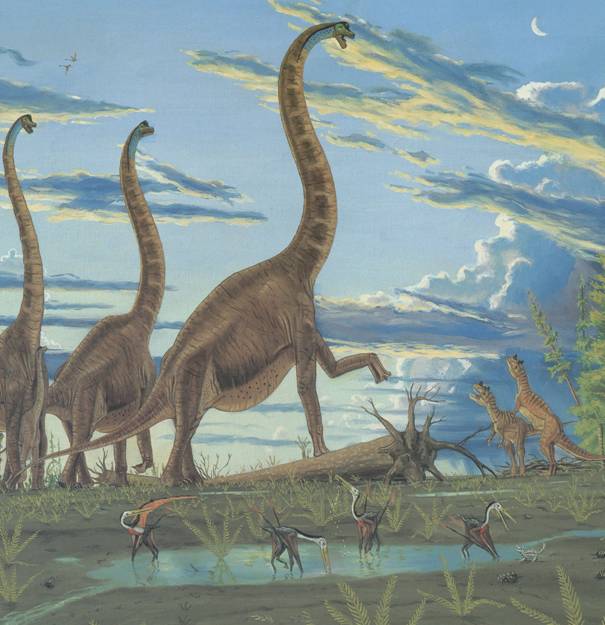
I’m equally as guilty of this as are Upchurch and Martin: in an earlier draft of the Kimmeridge Clay manuscript, my co-authors did actually come up with a new generic name for ‘C.’ humerocristatus (it has to be said, a pretty awful one), but I managed to get it removed. While I think it would be useful if this apparently diagnostic brachiosaur were named, I guess I’m bowing to peer pressure. Presumably, ‘C.’ humerocristatus was built much like better-known brachiosaurids (such as Brachiosaurus: adjacent image is Greg Paul’s old restoration of Brachiosaurus with Ceratosaurus and pterosaurs), but it was surely different in various of its details. A few additional bones have been suggested to belong to it, but there’s no way of knowing whether these really do belong to the same animal as the diagnostic humerus.

* One of the most prolific dinosaur workers in England during the latter half of the 19th century, Hulke (1830-1895) was a renowned ophthalmologist and firm ally of Huxley. Elected Fellow of the Geological Society of London in 1868, he was President by 1887 and, later, Foreign Secretary. Hulke was elected to the Royal Society for his work on the retina and received the Wollaston Medal in 1887. Research on prehistoric reptiles was only his hobby, but he published multiple papers on them, with 25 appearing in the Quarterly Journal of the Geological Society of London alone.

Various other sauropod remains have been reported from the Kimmeridge Clay. ‘Ornithopsis’ manseli was named in 1888 for another isolated humerus, and again it appears to be from a brachiosaurid. In fact it might be the same animal as ‘C.’ humerocristatus. Yet again it was originally placed in an inappropriate genus: Ornithopsis is a Lower Cretaceous sauropod (first named for dorsal vertebrae), and there’s no reason at all to think that an Upper Jurassic humerus should be referred to a genus based on Cretaceous vertebrae.

Then there’s Bothriospondylus suffossus, based on vertebrae. Often regarded as a brachiosaurid, its remains are not diagnostic, nor is there any reason to think that they belong to a brachiosaurid, nor even to a macronarian (Macronaria is the sauropod clade that includes brachiosaurids and titanosaurs). Because Bothriospondylus was named early in the scientific discovery of sauropods (in 1875), it quickly became a sort of ‘waste-basket’ taxon to which sauropod remains from all over the world were referred. Thus, various Cretaceous sauropod remains from England, as well as remains from the Middle Jurassic of Madagascar and the Upper Jurassic of France, have been identified (erroneously) as Bothriospondylus. Incidentally, the specific name of the type species of this genus is conventionally spelt incorrectly, with it usually being written ‘suffosus’. On naming the species in 1875, Richard Owen used both double f and double s, but most authors seem to have missed this for some reason.

Kimmeridge Clay theropods

Only a few theropods (predatory dinosaurs) have been reported from the Kimmeridge Clay, and two of them are particularly interesting. The first is interesting because it’s both reasonably well represented (its remains include vertebrae from all parts of the column, pelvic and hind-limb elements), and something new. It’s some kind of peculiar, gracile tetanuran, and is due to be studied as part of a larger project on Jurassic theropods.

The second specimen is considerably less impressive, consisting only of two phalanges from the foot. Discovered at Fleet in Dorset, they are presently part of a private collection. What makes them particularly interesting is the fact that they’ve been identified as belong to an ornithomimid (Brokenshire & Clarke 1993): a theropod clade (often known as ostrich dinosaurs) otherwise restricted to the Cretaceous. If the identification is correct, the history of this group would be extended considerably. However, an identification this precise, given that the material consists only of worn, isolated toe bones, is problematic and there is little reason to think that it is correct. The bones do superficially resemble the toe bones of ornithomimids, but they superficially resemble the toe bones of many other theropods as well. Consequently they are better identified as Theropoda indet. (Martill et al. 2006).

That’ll do for now. Of course there are also the ornithischians: anachronistic ornithopods and pliosaur chew-toys. More on them in the near future. Remember to keep checking for new Christmas cards. Seasons greetings to all - I don’t think I’ll get the chance to do any blogging between now and the new year.

A pdf of Martill et al. (2006) is available should anyone want it (email me: eotyrannus at gmail dot com).

For the latest news on Tetrapod Zoology do go here.

Refs - -

Brokenshire, A. J. and Clarke, J. B. 1993. Important recently collected dinosaurian remains from the Lower Kimmeridge Clay at Weymouth. Proceedings of the Dorset Natural History and Archaeological Society 115, 177-178.

Dodson, P. 1996. The Horned Dinosaurs. Princeton University Press, Princeton, NJ.

Martill, D. M., Naish, D. & Earland, S. 2006. Dinosaurs in marine strata: evidence from the British Jurassic, including a review of the allochthonous vertebrate assemblage from the marine Kimmeridge Clay Formation (Upper Jurassic) of Great Britain. In Colectivo Arqueológico-Paleontológico Salense (ed) Actas de las III Jornadas sobre Dinosaurios y su Entorno. Salas de los Infantes (Burgos, España), pp. 47-83.

Upchurch, P., Barrett, P. M. & Dodson, P. 2004. Sauropoda. In Weishampel, D. B., Dodson, P. & Osmólska, H. (eds) The Dinosauria, Second Edition. University of California Press (Berkeley), pp. 259-322.

- . & Martin, J. 2003. The anatomy and taxonomy of Cetiosaurus (Saurischia, Sauropoda) from the Middle Jurassic of England. Journal of Vertebrate Paleontology 23, 208-231.

Labels: , , , ,

Thursday, November 16, 2006

Those sexy tupuxuarids

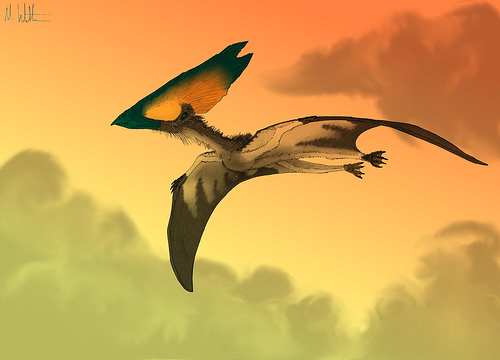
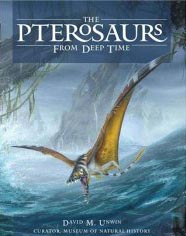
Thanks to my good friend (and former phd supervisor) Dave Martill, I am finally in possession of my own copy of David Unwin’s 2006 book The Pterosaurs from Deep Time. It’s a handsome, well-illustrated and well-written book literally packed full of data. Given that there are only a handful of books devoted to pterosaurs (the only ones worthy of note are Seeley’s 1901 Dragons of the Air*, Wellnhofer’s 1991 The Illustrated Encyclopedia of Pterosaurs and Buffetaut & Mazin’s multi-authored 2004 Evolution and Palaeobiology of Pterosaurs), the appearance of any new volume on the subject is noteworthy. However, Unwin’s book gets more than an honorary mention: it deserves some serious bigging-up, if you’ll pardon the expression, as it is, frankly, excellent. But what’s odd is that, thus far, I’ve only seen two reviews of it. The first (posted to an internet discussion group) was negative, but its author is notorious for holding a deeply idiosyncratic view of pterosaurs that cannot be, and isn’t, taken seriously. The second, produced by two close acquaintances of mine, is not really negative, but it’s not particularly positive either [adjacent image by Mark Witton, from his flickr site].

* This book is often said to be rare and expensive. Maybe that’s true, but I got mine for £3 in a second-hand book shop.

Given this lamentable situation let me continue with the bigging-up. The Pterosaurs from Deep Time is not, as some have said, a coffee-table book. Yeah, it features some big and highly attractive pictures (both excellent photos of specimens, and colour artwork), but in its thorough coverage of what we know about pterosaur diversity, evolution, biology and lifestyle, it is unparalleled and awesome. If only books like this existed on all the tetrapod groups. Seriously, I am hard pressed to think of any detail about pterosaurs that Unwin has not covered. Todd Marshall’s artwork, scattered throughout the book, is great, with accurate, dynamic animals poised in realistically cluttered, detailed environments. I’ve collaborated with Todd (I advised him when he produced artwork for Usbornes 2004 World Atlas of Dinosaurs), and I get the impression that he works hard to make fossil animals look like long-time denizens of their environments. Think about it: living animals generally aren’t pristine objects, looking as if they’ve just come out of the pages of a field guide; they are often physically untidy, or dirty. Their colours and surface textures may mimic or even incorporate the sediments and plants of their environment. They often look like they belong. This is the feeling I get from Todd’s animals.

My technical work, back when I could consider myself a palaeontologist (right now I consider myself simply unemployed), was on theropod dinosaurs. But as with so much in life I kept finding myself distracted and spending time on extraneous side projects, and every now and again I’ve dabbled on pterosaurs (e.g., Naish & Martill 2003). During 2004 and 2005, Dave Martill and I spent a lot of time on an unusual Cretaceous pterosaur from Brazil called Tupuxuara. Inspired mostly by the discovery of a new specimen, our research culminated in the 2006 publication of our paper ‘Cranial crest development in the azhdarchoid pterosaur Tupuxuara, with a review of the genus and tapejarid monophyly’. Snappy title, no? There’s lots to say about Tupuxuara: on its phylogenetic relationships and taxonomy, on its feeding behaviour, and on the changes that it underwent during growth. Let’s see how much of this I can get out of the way in what will eventually turn out to be several blog posts.

First described for a partial snout from the Brazilian Santana Formation, Tupuxuara longicristatus Kellner & Campos, 1988 is a toothless Cretaceous pterosaur with a rather long, subtriangular skull. A tall mid-line crest grew like a sail from the dorsal margin of the snout and cranium. It now seems that nearly all of the characters proposed initially to distinguish Tupuxuara from other pterodactyloid pterosaurs are problematic in not being unique to the genus, but in fact Tupuxuara is clearly diagnosable, being unique in having a sort of deep premaxillary crest in which the dorsal margin extends subparallel to the dorsal margin of the nasoantorbital fenestra (Martill & Naish 2006, p. 931). While Tupuxuara is known today from near-complete skeletons (frustratingly, these specimens still await proper description), the good thing about this diagnosis is that it applies even to the 1988 type material.

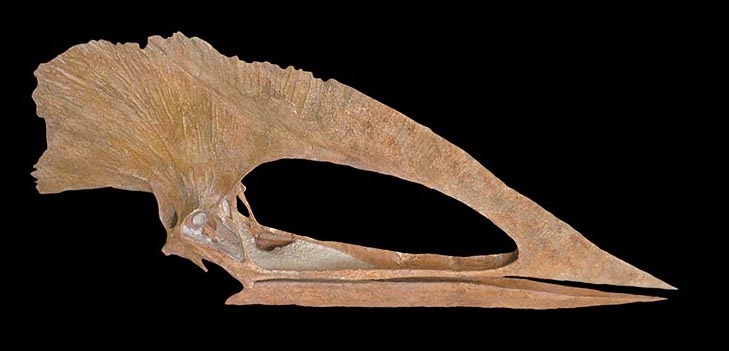
A second Tupuxuara species, T. leonardii Kellner & Campos, 1994, is also from the Santana Formation and, curiously, was also represented initially only by an incomplete section of snout. A few other tupuxuarid specimens have been reported. A specimen named Santanadactylus spixi Wellnhofer, 1985 is almost certainly a close relative of Tupuxuara (possibly even a member of the genus), despite the fact that it was named as a new species of an ornithocheirid genus (ornithocheirids are long-skulled toothed pterodactyloids closely related to Pteranodon and Nyctosaurus, and not particularly closely related to azhdarchoids). Various taxonomically indeterminate Crato Formation specimens also seem referable to the group. Then there is Thalassodromeus sethi Kellner & Campos, 2002, also from the Santana Formation of Brazil. Thalassodromeus is, supposedly, distinct from Tupuxuara, but this is debatable. More on this issue another time [adjacent Tupuxuara skull image from the pterosaurier site].

Finally, a pterosaur snout and lower jaw from the late Maastrichtian Javelina Formation of Texas, illustrated in Wellnhofer’s Illustrated Encyclopedia of Pterosaurs and labelled therein as Quetzalcoatlus, also seems to be a tupuxuarid and possesses a snout morphology highly similar to that regarded as diagnostic for Tupuxuara. This is really interesting for a few reasons. It shows that tuxupuarids existed in North America as well as South America, and also shows that they survived until late in the Cretaceous. Virtually all Maastrichtian pterosaurs are azhdarchids and it is implied by some that this was the only pterosaur group to make it to this time. If the Javelina Formation specimen really is a tupuxuarid, it indicates that at least one other pterodactyloid clade survived this late.

What sort of pterosaur is Tupuxuara? Based mostly on characteristic features of the skull and hand, there is universal agreement among pterosaur experts that Tupuxuara is an azhdarchoid: that is, a close relatives of the azhdarchids – those large to enormous long-necked pterodactyloids that, I argue, most likely lived a stork-like lifestyle. But, among azhdarchoids, is Tupuxuara particularly close to azhdarchids, or is it actually more closely related to the bizarre, shorter-skulled Tapejara? Here we come to a fundamental disagreement among pterosaur experts.

Pointing to similarities in the shape of the orbit, snout tip and crest, and the anatomy of the coracoid, Alex Kellner (2003a, b, 2004) has argued that Tapejara and Tupuxuara should be united as the Tapejaridae. Conversely, noting derived characters in the hand and skull seen in Tupuxuara and azhdarchids but not in Tapejara, Unwin (2003) has proposed that Tupuxuara forms a clade with the azhdarchids (dubbed Neoazhdarchia), rather than one with Tapejara. Several recently described azhdarchoids complicate this area. Sinopterus and Huaxiapterus, both with two species each (all from the Lower Cretaceous of China), appear intermediate in some respects between Tapejara and azhdarchids, and the supposed Tapejara species T. navigans is also more like azhdarchids in some details than it is like the type species of Tapejara, T. wellnhoferi.

In a new evaluation of the characters employed in this debate, Dave and I concluded that the concept of Neoazhdarchia is better supported than the idea of a Tapejaridae that includes Tupuxuara (Martill & Naish 2006). Note, however, that our cladistic analysis is weak with a small data set. Furthermore, while we didn’t find Tupuxuara to group together with Tapejara, we did sometimes find Tapejara to group together with Sinopterus. While Kellner’s concept of Tapejaridae may be paraphyletic, it therefore seems that there is a clade that we should call Tapejaridae: it includes Tapejara wellnhoferi, Sinopterus and Huaxiapterus. A subsequent study came to the same conclusion (Lü et al. 2006).

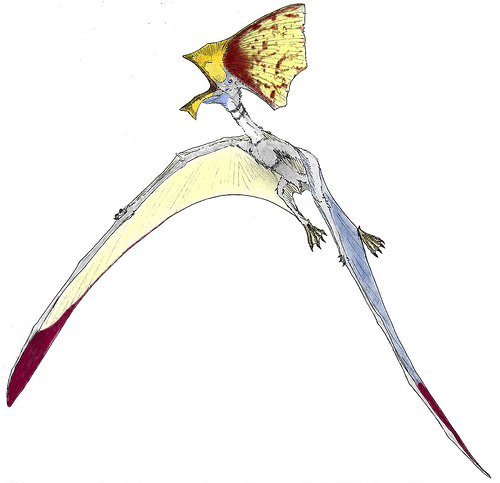
What I found particularly interesting is that we didn’t find the several Tapejara species to group together, but this isn’t surprising given how distinct they are. The type species, T. wellnhoferi, is relatively short-skulled and with a modest bony crest and just a short bony projection at the skull’s rear margin. T. imperator and T. navigans, in contrast, are longer-skulled, with immense vertical crests, supported by thin subvertical spines at their leading edges. A really long bony spike projects backwards from the skull’s rear margin in T. imperator. A study due to be published soon revises the taxonomy of these supposed close relatives: more news on that when it appears [adjacent image shows T. imperator. Yet again borrowed from Mark Wittons flickr site. Sorry Mark].

And I’ll have to stop there. Given that the main point of Martill & Naish (2006) was to document ontogenetic changes that occurred in Tupuxuara – changes linked to the probable use of the cranial crest as a sexual signal – it’s ironic that I haven’t covered this story here, but I will in future. And, as I said, there’s also the debate about tupuxuarid feeding biology and so on. And don’t worry if you’re hoping to see more on phorusrhacids – I haven’t finished with them yet. Stuff on British dinosaurs coming soon. Oh yeah – pdfs of both Naish & Martill (2003) and Martill & Naish (2006) are available, feel free to ask and I can send them.

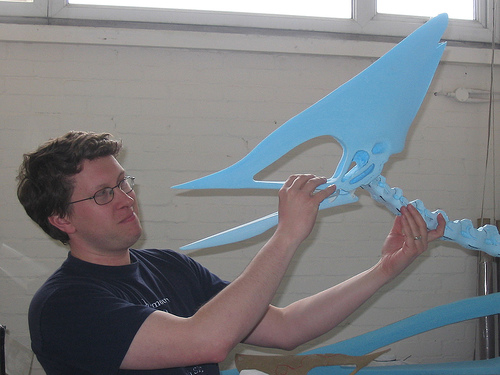
For previous posts on pterosaurs see Pterosaur wings and Why azhdarchids were giant storks. Posts on tupuxuarids have been promised for a while: see Attack of the blue foamy pterosaurs. For those interested, we are now at 33 ‘100 year European mammals. For the latest news on Tetrapod Zoology do go here.

Refs - -

Kellner, A. W. A. 2003a. Pterosaur phylogeny and comments on the evolutionary history of the group. In Buffetaut, E. & Mazin, J.-M. (eds) Evolution and Palaeobiology of Pterosaurs. Geological Society Special Publication 217. The Geological Society of London, pp. 105-137.

- . 2003b. Comments on the phylogeny of the Pterodactyloidea. Rivista del Museo Civico di Scienze Naturali “Enrico Caffi” 22, 31-37.

- . 2004. New information on the Tapejaridae (Pterosauria, Pterodactyloidea) and discussion of the relationships of this clade. Ameghiniana 41, 521-534.

Lü, J., Jin, X., Unwin, D. M., Zhao, L., Azuma, Y. & Ji, Q. 2006. A new species of Huaxiapterus (Pterosauria: Pterodactyloidea) from the Lower Cretaceous of western Liaoning, China with comments on the systematics of tapejarid pterosaurs. Acta Geologica Sinica 80, 315-326.

Martill, D. M. & Naish, D. 2006. Cranial crest development in the azhdarchoid pterosaur Tupuxuara, with a review of the genus and tapejarid monophyly. Palaeontology 49, 925-941.

Naish, D. & Martill, D. M. 2003. Pterosaurs – a successful invasion of prehistoric skies. Biologist 50 (5), 213-216.

Unwin, D. M. 2003. On the phylogeny and evolutionary history of pterosaurs. In Buffetaut, E. & Mazin, J.-M. (eds) Evolution and Palaeobiology of Pterosaurs. Geological Society Special Publication 217. The Geological Society of London, pp. 139-190.

Labels: ,

Thursday, November 02, 2006

Dinosauroids revisited

Pretty much everyone interested in dinosaurs, in the history of life, or in such matters as the evolution of intelligence and/or brain size, will be familiar with the various speculations on ‘humanoid dinosaurs’ that have made their way into the literature. During the 1970s it became widely accepted that one group of Cretaceous theropods – the troodontids (known at the time as saurornithoidids) – were relatively big-brained, with encephalisation quotients overlapping those of modern birds and mammals. In reality, troodontids might therefore have been as ‘smart’ as bustards, emus or opossums. The notion that these dinosaurs were ‘big brained’ and therefore ‘intelligent’ seems to have given rise to a myth however: that these were really smart dinosaurs, approaching the anthropoid level in terms of their ability to solve problems and understand the world around them. At least one book on earth mysteries and the paranormal states that some dinosaurs were ‘probably as intelligent as primitive man’ – a quote almost certainly based on studies of troodontids. In Jurassic Park, the dromaeosaurids are intellectually on par with chimpanzees.

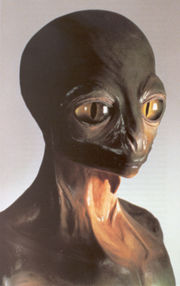
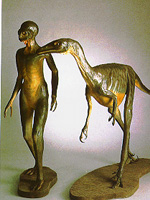
Inspired by new data on troodontid brain size, Carl Sagan speculated about intelligent dinosaurs in The Dragons of Eden (1977) and posed the question: what if non-avian dinosaurs hadn’t become extinct? If Cretaceous forms were already so ‘smart’, what would have happened given another 60-odd million years of evolution? His question seems to have inspired a number of science fiction stories that appeared soon afterwards. Among the most important data on troodontid brain size was that published by Dale Russell, then of the National Museum of Natural Sciences (Ottawa), and besides publishing several key studies on troodontid anatomy and functional morphology, in 1982 he did a rather peculiar thing. Co-operating with taxidermist and model maker Ron Séguin, he produced the article ‘Reconstruction of the small Cretaceous theropod Stenonychosaurus inequalis and a hypothetical dinosauroid’.

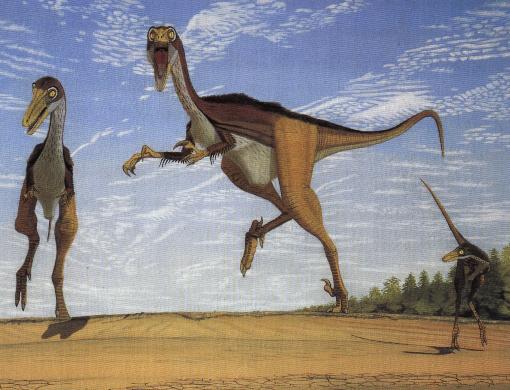
While part of the article discussed how a life-sized model Stenonychosaurus (presently regarded as a junior synonym of Troodon) was reconstructed and made, the rest was devoted to a thought experiment in which Russell & Séguin (1982) reconstructed a hypothetical ‘evolved’ troodontid that had reached an encephalisation quotient similar to that of humans. Most of us are familiar with the look of the finished product, dubbed the dinosauroid, but some of the decisions Russell & Séguin made in creating the creature have not been mentioned or discussed outside of their paper [adjacent Greg Paul painting, showing a group of troodontids, borrowed from here].

They reasoned that an enlarged brain would result in a shortened facial region, and they used the cranial proportions of a chick embryo as a guide. Based on the idea that troodontids had a reduced dentition compared to other theropods, and on the notion that big-brained primates have a reduced dentition compared to smaller-brained forms, they made the dinosauroid toothless. They further argued that a big-brained head would need to be supported directly over the body, and that a short neck and vertical human-like posture would evolve. The vertical posture meant goodbye to the tail (reduced to a stump in the dinosauroid), and the need to give birth to big-headed babies led them to imagine a broad, human-like pelvis. Dinosauroids were imagined to be viviparous, so the model is equipped with a navel. Because human legs obviously work well for humans, Russell & Séguin proposed that human-like legs would also work for a human-like dinosauroid, and they gave the creature plantigrade feet. Interestingly, they used tree kangaroos as a model, and the feet of the dinosauroid are not tridactyl and clawed as usually shown in drawings, but four-toed, with nails rather than claws, and with the two medial toes smaller than the lateral ones.

All in all, the dinosauroid is disturbingly human-like and, I think, too human-like. While Russell & Séguin made efforts to justify their chain of logic, they may as well have looked at life restorations of hominids, and just ‘reptilised’ them a bit. Essentially the message is that the human body plan is the ‘best’ body plan for a big-brained tetrapod. But Russell & Séguin knew that they would be accused of this, and they ended their discussion by wondering if they had been directed by bias, or if the humanoid shape really would crop up convergently, as do so many other body shapes. Are they wrong, and would things have been different? Well, the last line of their article is: ‘We invite our colleagues to identify alternate solutions’ (p. 36).

Understandably, the unveiling of the dinosauroid model in 1981 resulted in a huge media furore, with Dale Russell in the middle. Some people liked it, others hated it. Today it seems well-known, but I don’t think many people really understand what the point of it was. This isn’t helped by the fact that tabloid newspapers have often used images of it in stories about reptilian aliens or lizard-men, or whatever. Most amusing are those cases where the dinosauroid was completely misunderstood, as is the case in the obscure little book Dinosaur Mysteries (O’Neill 1989). Accompanying some illustrations of Dale Russell, and both Russell and Séguin’s troodontid and dinosauroid models, O’Neill’s text stated…

In 1969, a scientist named Dale Russell found some bones of a small, meat-eating dinosaur called Stenonychosaurus … This dinosaur’s skull showed that it had been small, but with a large skull. The skull also showed that Stenonychosaurus’s eyesight worked like ours. Stenonychosaurus also had hands that resembled humans’. It had thumbs that could be turned inwards to grasp things. This is unusual among animals.

Russell put together a startling model of Stenonychosaurus. He showed it standing upright, like a human. The model was 1.2 (4 ft) tall and weighed about 40 kilograms (90 lb). Russell called this human-like model a “dinosauroid”. People were amazed by this dinosaur which seemed so advanced for its time (p. 24).

I told all of this to Adrienne Mayor while she was researching the dinosauroid for inclusion in her The First Fossil Hunters (2000). She regarded the dinosauroid as an interesting palaeontological fiction echoing the tritons and satyrs made in ancient Greece, and noted that (like tritons and satyrs), the dinosauroid is deemed realistic enough by some for it to be misidentified as real, hence O’Neill’s mistake.

The reactions that palaeontologists have had to the dinosauroid have been mixed. Some have been fairly positive about it. David Norman (1985) considered the dinosauroid in a favourable light, concluding that ‘Such an idea is an obviously fanciful, though provocative thought’ (p. 55). On the same page, an illustration of the dinosauroid by John Sibbick (which looks a bit scarier than the Russell and Séguin model, and also differs from it in foot anatomy) is accompanied by a caption that is even more favourable. After listing the morphological changes required to turn a Cretaceous troodontid into a dinosauroid, it ends by stating that ‘given the right conditions, such changes would be quite feasible’. ‘Feasible’? Note that the captions in the book were not written by Norman, so he shouldn’t get the blame for that (I will refrain from saying who did write the captions).

Another of David Norman’s books, the 1991 Dinosaur!, discusses the use of a real, live dinosauroid in the Granada television TV series that the book was written to accompany (Norman 1991). Played by a person in a suit (obviously), the dinosauroid from Dinosaur! had a more reptilian look to it than Russell and Séguin’s model: it had far scalier-looking skin, snake-like ventral scales, and a vivid green and red colour scheme. The series concluded with the dinosauroid acting as narrator. Another positive interpretation of the dinosauroid came from Cristiano Dal Sasso (2004) in his Dinosaurs of Italy. He seems to have accepted Russell & Séguin’s idea as if it were universally agreed as likely, which it isn’t.

Other palaeontologists have been negative however. At least one reviewer of Russell & Séguin’s paper wrote that ‘I do not see much value in the extremely speculative ‘dinosauroid’ discussion’ (Russell 1987, p. 127). In Predatory Dinosaurs of the World, Greg Paul (1988) found the dinosauroid to be ‘suspiciously human’, and he argued that – were theropods to evolve big brains and ‘intelligence’ – we should instead expect them to retain horizontal bodies and long tails. Theropod expert Tom Holtz has stated much the same, and so far as I can tell from discussion, most dinosaur workers feel this way too. There really isn’t any reason to think that big-brained dinosaurs would have evolved in the first place (recall that even ‘big-brained’ Troodon was, at best, on par with ostriches and opossums), and even if they had, there is also no reason to think that they would have ended up looking like scaly people (or feathery people, given that we now know that troodontids were feathered).

The reason that we humans have the body shape that we do is not – I think – because it’s the ‘best’ body shape for a smart, big-brained biped to have, it is instead the result of our specific lineage’s evolutionary history. Given that, so far as we know, the humanoid body shape has evolved just once, we simply have no way of knowing whether it’s a particularly ‘good’ morphology or not. Furthermore, the humanoid body shape is not a prerequisite for the evolution of big brains given that brains proportionally as big as, or bigger than, those of hominids are found in some birds and fish (that's right: humans do NOT have the proportionally biggest brains).

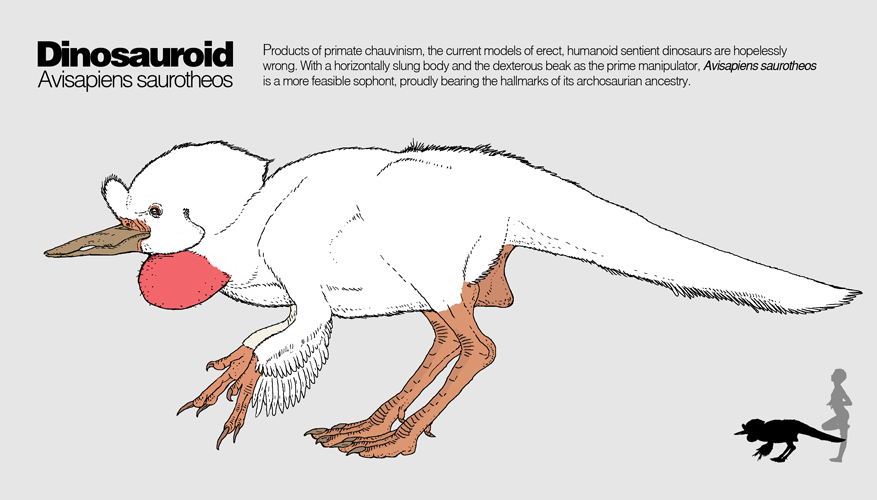
With this in mind, my feeling on dinosauroids and intelligent theropods and so on is that – if they were to evolve – they wouldn’t look like scaly, or feathery, people, but would instead be far more normal from the theropod point of view. A horizontal body posture, not a vertical one. Digitigrade feet, not plantigrade ones. A long tail, not a reduced one. The main theme here might be familiar to regular blog readers given that I’ve covered much of this before in a post on ground hornbills. While they aren’t particularly big-brained, ground hornbills can be regarded as avian pseudo-hominids, their evolution paralleling our own in several respects. The concluding paragraph of my ground hornbill post was…

No, post-Cretaceous maniraptorans wouldn’t end up looking like scaly tridactyl plantigrade humanoids with erect tailless bodies. They would be decked out with feathers and brightly coloured skin ornaments; have nice normal horizontal bodies and digitigrade feet; long, hard, powerful jaws; stride around on the savannah kicking the shit out of little mammals; and in the evenings they would stand together in the trees, booming out a duet of du du du-du, a deep noise that would reverberate for miles around.

And here we come to the whole reason for the appearance of this post. Inspired by what I wrote I guess, the unique Nemo Ramjet has come up with a new dinosauroid, and it is, I am pleased to say, a million miles away from scaly green humanoids. Dubbed Avisapiens saurotheos, it is of clear dinosaurian ancestry, and I like it. Please view a higher-resolution version at Nemo’s site. Thanks Nemo: awesome stuff!

By the way, no I haven’t yet finished on phorusrhacids.

UPDATE (added 9-11-2006): this blog article clearly inspired recent changes that have been made to wikipedia’s Troodon entry. And for some neat news on troodontids do go here.

Refs - -

Mayor, A. 2000. The First Fossil Hunters. Princeton University Press, Princeton.

Norman, D. B. 1985. The Illustrated Encyclopedia of Dinosaurs. Salamander Books, London.

- . 1991. Dinosaur! Boxtree, London.

O’Neill, M. 1989. Dinosaur Mysteries. Hamlyn, London.

Russell, D. A. 1987. Models and paintings of North American dinosaurs. In Czerkas, S. J. & Olson, E. C. (eds) Dinosaurs Past and Present, Volume I. Natural History Museum of Los Angeles County/University of Washington Press (Seattle and Washington), pp. 114-131.

- . & Séguin, R. 1982. Reconstruction of the small Cretaceous theropod Stenonychosaurus inequalis and a hypothetical dinosauroid. Syllogeus 37, 1-43.

Labels: , ,