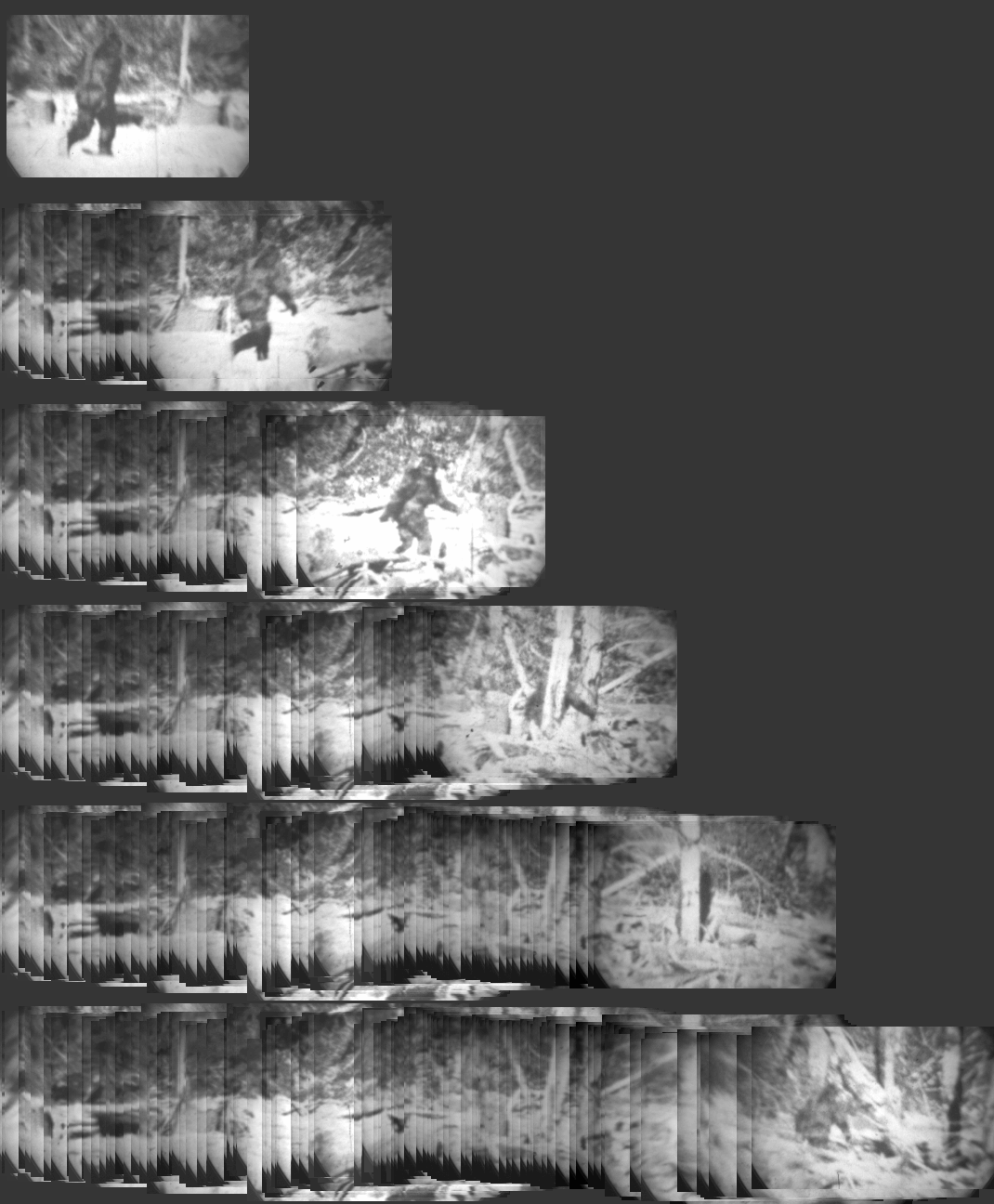
Wednesday, November 29, 2006

Frame 352, and all that
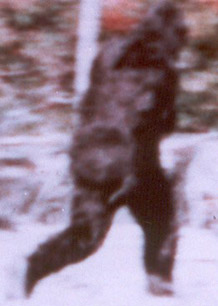
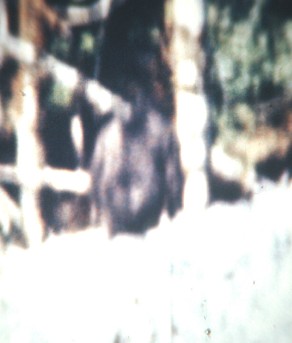
For some time now I’ve been toying with the idea of writing a blog post about sasquatch, North America’s legendary cryptic ape. And, generally, I’ve decided that doing so would be a really bad idea: I am chicken, and as someone trying to gain a reputation within the academic world, I think that even expressing an interest in issues like this is a bad idea. That’s ridiculously unfair of course, stemming only from ill-informed knee-jerk negativity to this subject, and given that scientific inquiry of any phenomenon is a worthwhile pursuit, I like to think that more zoologists should actually get informed about mystery animals (for a previous post making the same argument go here). I note that hardly any hard-line sceptics of things such as sasquatch display familiarity with the literature on the subject [adjacent image shows frame 310 of the Patterson film: see below].

In the interests of hypothesis testing, I finally decided: what the hell. My hypothesis is: will writing about sasquatch negatively affect my career prospects? Well, let’s test the hypothesis. Let me state from the start that I do not “believe” in sasquatch, nor am I planning to promote either an anti-sasquatch, or a pro-sasquatch, point of view. What I have learnt from research on this area is that – contrary to the assertions of some – the evidence for sasquatch is, at the very least, scientifically interesting and worthy of investigation.

While purported evidence for the supposed reality of sasquatch continues to attract strong criticism, more interesting in my view is that a number of academically qualified primatologists have recently gone on record in stating that the evidence for sasquatch is scientifically compelling. These people do not only include well-known sasquatch proponents, such as the late Grover Krantz (1931-2002) of Washington State University, or Jeff Meldrum of Idaho State University. Daris Swindler (professor emeritus of physical anthropology at the University of Washington, author of Atlas of Primate Anatomy) stated, after examining the Skookum body cast (a large impression, made in mud, from Washington state, apparently created by a reclining man-like primate), that the heel impression visible on the cast is definitely that of a giant unknown primate. J. H. Chilcutt, an expert on human and non-human primate fingerprints (who initially examined casts of sasquatch tracks because he felt confident that he could debunk them), has expressed his absolute confidence in the validity of dermal ridges on footprints as demonstrative of the reality of sasquatch. On the Whitewolf Entertainment TV documentary ‘Sasquatch: Legend Meets Science’ (2003) he stated “I stake my career on it”.

Here I am going to discuss one particular piece of evidence for sasquatch: the Patterson-Gimlin film. This is that famous short piece of film that you’ve probably seen on TV many times: it depicts what appears to be an obviously female sasquatch striding across a clearing from left to right [for M. K. Davis’ stabilised version of the film go here]. You’ve probably heard that the film has been revealed to be a hoax. Well, sorry, that ain’t true.
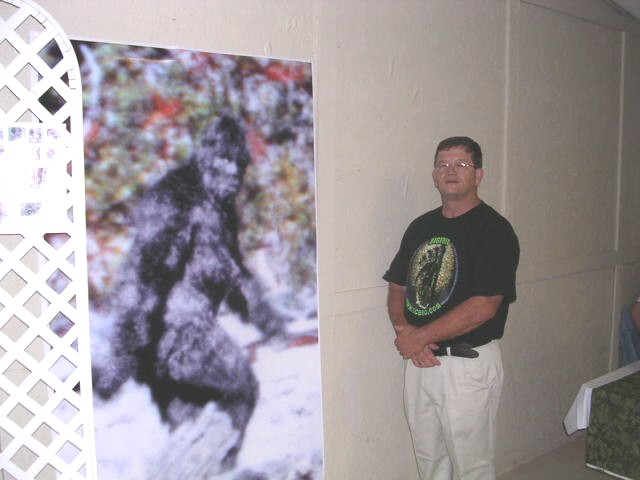
On October 20th 1967, Roger Patterson and Robert Gimlin claimed to capture on film an unexpected encounter with an adult female sasquatch. The resulting footage, filmed at Bluff Creek, northern California, contains 952 frames, but uncertainty over the filming speed affects the real-time duration of the event. Patterson’s camera was either set at 16 or 24 frames per second (fps), with 16 fps now considered more likely. It is not true that the footage is grainy or blurry, and high-resolution enlargements such as those produced by M. K. Davis (here shown standing next to the best of the enlargements) reveal a surprising amount of detail. Literally whole books have been written about the footage (e.g. Bayanov 1997), so I will try and keep these comments brief. In order to be impartial, I will refer to the alleged sasquatch as TAS (= The Alleged Sasquatch).

1. TAS looks genuine. Its coat is glossy, conforms to the underlying contours, muscular bulges, joints and other structures in the body, and looks realistic compared to living mammals. What appears to be a shallow parting extends axially along the spine and between the buttocks [in adjacent image, note the demarcated buttocks and apparent wear on the buttocks]. As TAS moves, its muscles (in its legs and elsewhere) can be seen to bulge and flex beneath the fur as they do in living mammals. TAS’s gait is fluid and natural and it differs in subtle details of posture and proportion from humans (see points 2 and 3). Its toes are seen to lift at one point. Its large breasts bounce and sway in a manner which looks realistic compared to how unsupported human breasts move during locomotion. It is also intriguing that TAS’s compliant gait and protruding heel match features reported by eyewitnesses (see point 2). High quality enlargements have been published of key frames from the footage several times (e.g. Bayanov 1997, Murphy et al. 2004) so it is easy to check all of these assertions. Put in its simplest terms: despite claims to the contrary, TAS looks realistic.

2. TAS walks with a compliant gait, and not with the same striding knee-locking gait of humans [adjacent image shows frame 352, the most famous and oft-shown part of the film]. Its knee is never fully straightened in its step cycle, even in the supporting phase. Its arms swing slightly more than those of humans, and its hands and wrists are held supinated and slightly flexed with the fingers curved (this is unlike the normal hand posture of humans). It’s clearly possible that all of these features could be faked by a knowledgeable human, and Daegling & Schmitt (1999) argued that the gait and speed used by TAS can be reproduced by humans. That person would, however, have to not only conform physically to the dimensions of TAS (see point 3), but would also have to be very good at walking with an unusual gait which is practised so well that it has convinced experts in biomechanics and primate anatomy (see point 4). That person would also have to be an expert, or at least supervised by one, on the eyewitness data (which describes identical points of posture and morphology). It is unlikely that such a person exists and/or was available to Patterson and/or Gimlin in 1967, and extensive biographical research on Patterson and Gimlin and their friends and colleagues has failed to uncover the existence of any such person.

3. TAS is physically large and with proportions that appear to be unlike those of our species. Its intermembral index (the ratio of humerus + radius length to femur + tibia length) is between 80 and 90, whereas in our species it averages 72*, and its breadth across its shoulders is about 35% of its total height. Krantz (1999) asserted that some humans (including inuit people) have a shoulder breadth that exceeds 30% of total height (this is apparently not the case in people that exceed 2 m in height), and that other data also indicates that the creature exceeds in torso width any human. Krantz (1999) concluded on the basis of this evidence ‘I can confidently state that no man of that stature is built that broadly’. However, Daegling & Schmitt (1999) challenged this torso-breadth data, and argued that the estimates do overlap with that from tall humans.

* In chimps and gorillas the intermembral indices are 106 and 117, respectively. TAS therefore seems intermediate between chimps and humans with regard to this feature.

Patterson and Gimlin photographed, and took casts from, a trackway which (they asserted) was made by TAS. These photographs and tracks survive today and both (i) appear genuine* and (ii) correspond with the details of TAS’s size and gait as seen in the footage. Average track length was 36.8 cm, and because the full length of TAS’s foot sole can be seen in several frames, the sole : total height ratio of about 1 : 5 gives a rough height of 184 cm. A similar height has been estimated by triangulation, by working out how the stride length used by TAS matches with humans of various statures, and by other methods.


* That is, like other ‘good’ sasquatch prints, they appear to have been made by a large, very heavy hominid with a flexible foot that exhibits several consistent anatomical novelties.
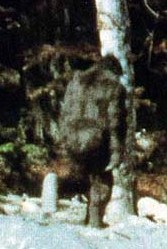
4. Several workers experienced with primate biomechanics and locomotion have examined the footage, and in several cases have published comments on it. All have concluded either that the film is genuine and depicts a non-human primate, or have admitted that their examination was inconclusive.

Dmitri Donskoy [Chief of the Chair of Biomechanics at the USSR Central Institute of Physical Culture, Moscow] concluded ‘[my analysis reveals] the walk of the creature as a natural movement without any signs of artfulness which would appear in intentional imitation. At the same time, with all the diversity of human gaits, such a walk as demonstrated by the creature in the film is absolutely nontypical of man’.

D. W. Grieve [Reader in Biomechanics, Royal Free Hospital School of Medicine, London] concluded ‘The possibility of fakery is ruled out if the speed of the film was 16 or 18 fps [as mentioned above, it was apparently filmed at 16 fps]. In these conditions a normal human being could not duplicate the observed pattern, which would suggest that the sasquatch must possess a very different locomotor system to that of man’.

Grover Krantz, well known as an advocate of sasquatch but nonetheless still an experienced and qualified anthropologist, argued that the creature’s size, proportions and gait demonstrated its genuine nature, concluding ‘there is no possibility that the film can be a man in a fur suit’. Bayanov (1997) cited views from several Russian biomechanists who thought that the creature’s gait could not be reproduced by a human. Jürgen Konczak [associate professor in the
School of Kinesiology and director of the Human Sensorimotor Control Laboraties at Minnesota University] concluded that the creature’s gait indicated that it was genuine and non-human. Other ‘positive’ interpretations of the footage, voiced by experienced, qualified biomechanists and/or primatologists, were broadcast in the Whitewolf Entertainment TV documentary ‘Sasquatch: Legend Meets Science’ (2003).

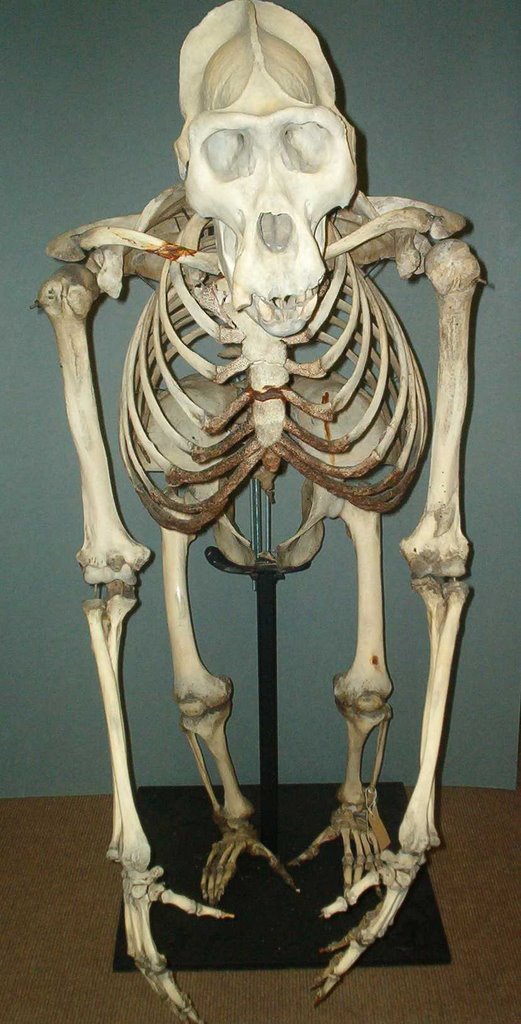
In view of this large number of ‘positive’ interpretations, most of which come from authoritative, technically qualified experts who do not have any axe to grind on the issue of sasquatch, what evidence has been marshalled by those who assert that the film is faked? To date, none. No analysis has been performed which shows that the creature can be explained as a man in a suit. Published objections have either asserted that the animal walks in a manner ‘consistent in general terms with the bipedal striding gait of modern man’ (Napier 1974), or have pointed to the presence of furry breasts, the presence of a sagittal cranial crest in a female, or the presence of breasts in a creature without female-like hips and a waist, as problems showing that the film must have been faked. These objections are all clearly erroneous (e.g. it is difficult to be confident that furry breasts are somehow impossible – while many primates do sport naked pectoral skin around their nipples and areolae, human breasts are hairy, it’s just that the hairs are very small and thin; sagittal crests are size-related, and only absent in the females of most hominid species because females do not match adult males in the size of their cranial musculature; broad hips and a waist are characters of our species, and not of other hominids or primates [gorilla skeleton at left]). Napier’s objections were vague and have not been supported by other workers experienced in biomechanics.

David Daegling [associate professor of anthropology at Yale University] and Daniel
Schmitt [assistant professor in the Department of Anthropology, Duke University Medical Center] published an article in Skeptical Inquirer in which they argued that TAS’s size and style of gait can be reproduced by people. They were still unable to assert that it was fake however, concluding ‘Based on our analysis of gait and problems inherent in estimating subject dimensions, it is our opinion that it is not possible to evaluate the identity of the film subject with any confidence’.

Multiple claims have been made that the footage was faked by a known individual, and that this individual has provided a death-bed confession, or something like that. It has been easy to knock down all of these claims and show them to be fabrications (e.g. Coleman 2003, Murphy et al. 2004, Vella 2004, Perez 2005).
5. In view of these observations, it is difficult to take seriously claims that TAS is actually some tall guy in a gorilla costume. Even today there is no maker of fake/synthetic fur, or of animal costumes, who can reproduce something this realistic, nor are there any suits which look so realistic, which allow the mimicry of moving musculature and breasts, and which are anatomically accurate compared to living primates. Two serious attempts have been made to reproduce the film using a man in a specially designed suit: one for the BBC TV series ‘The X Creatures’ [image at left]; the second for Kal Korff’s documentary ‘The Making of Bigfoot’. In both instances the resulting attempt to discredit the Patterson-Gimlin film backfired: their results look like a man in a monkey suit, and in no way come even close to resembling TAS in the 1967 Patterson-Gimlin film. Several special effects experts have been consulted on how possible it might be to reproduce what’s seen in the footage (this is particularly relevant as there have been repeated claims that someone in the Hollywood special effects community manufactured a suit for Patterson), including John Chambers [designer of the ape costumes seen in ‘Planet of the Apes’]. While some have claimed that the construction of a suit matching what’s seen in the Patterson film would be easy or possible, I am troubled by the fact that no-one has yet replicated it. At least some special effects people have stated that the creature seen in the footage exceeds in accuracy and realism the special effects available to workshops today, let alone those existing in 1967.

There’s a lot more that could be said on this subject, but I’ll leave it at that. I have not discussed Roger Patterson’s personal circumstances (relevant to claims that he faked the footage for money or fame), nor have I touched on the interesting story of what a farce Patterson and Gimlin’s eventual development and treatment of the film was. As Richard Greenwell (1942-2005) – former secretary of the International Society of Cryptozoology – said to me in a letter of March 2000: ‘In the big picture it matters little if Bigfoot exists or not; what matters is that proper procedure be followed in examining such evidence – or any evidence’.

UPDATE (29-11-2006): Loren Coleman has written a blog post about this one - see Napier, Naish, and Frame 352. For the latest news on Tetrapod Zoology please go here.

Refs - -

Bayanov, D. 1997. America’s Bigfoot: Fact, Not Fiction. Crypto Logos, Moscow.

Daegling, D. J. & Schmitt, D. O. 1999. Bigfoot’s screen test. Skeptical Inquirer May/June 1999, 20-25.

Coleman, L. 2003. Bigfoot! The True Story of Apes in America. Paraview Pocket Books, New York.

Krantz, G. S. 1999. Bigfoot Sasquatch Evidence. Hancock House, Surrey, B.C. & Blaine, WA.

Murphy, C. L., Green, J. & Steenburg, T. 2004. Meet the Sasquatch. Hancock House, Surrey, B.C. & Blaine, WA.

Napier, J. 1974. Bigfoot. Readers Union, Newton Abbot.

Perez, D. 2004. In defence of the Patterson-Gimlin film. Fortean Times 192, 36-37.

Vella, P. 2004. J’accuse. Animals & Men 34, 42-48.

Labels: , ,

Wednesday, October 25, 2006

Lunging is expensive, jaws can be noisy, and what’s with the asymmetry? Rorquals part III

In the previous post I discussed the basic anatomy and behaviour involved in lunge-feeding, a style of predation practiced by rorquals, the biggest, fastest and most dynamic of baleen-bearing cetaceans. By engulfing literally tons of water within a unique, flexible buccal pouch, rorquals change shape from ‘a cigar shape to the shape of an elongated, bloated tadpole’ (Orton & Brodie 1987, p. 2898). Their feeding style is anything but passive: Paul Brodie, an expert on rorqual feeding, has described it as ‘the largest biomechanical action in the animal kingdom’. After discussing rorquals with whale expert Nicholas Pyenson, my good friend Matt Wedel, in one of several blog posts on rorquals and other mysticetes (thats three separate links there), provided the most excellent quote…

The big baleen whales pick their targets and engulf them with their giant jaws and extensible mouth/throat region. They are often feeding on swarms of krill that measure kilometers in extent. Rather than think of big whales as filter feeders, we should think of them as predators that take bites off of superorganisms that are hundreds of times larger. The fact that the krill are strained out of the water by the baleen is a matter of processing - it comes after the whale has taken a bite.

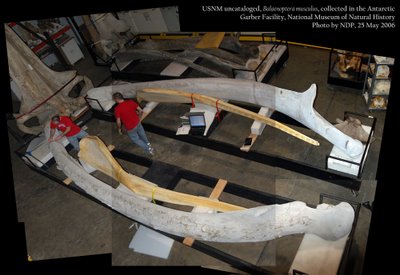
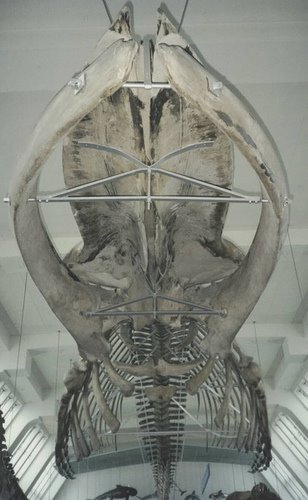
That’s great: I’ll be stealing it for use in lectures. The photo at top features the immense jaws of an Antarctic blue whale, kept at Washington D.C.s Garber Facility (part of the National Museum of Natural History), and is borrowed from here on Matt's blog site.

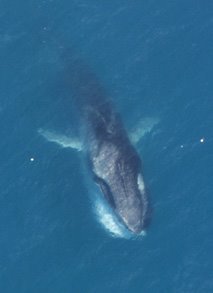
Recent studies show that lunge-feeding is not just dynamic, it is also extremely expensive in metabolic terms, and even though rorquals glide as they lunge (thereby conserving some energy), it still seems that lunge-feeding is so energetically costly that constraints are imposed on rorqual behaviour. Theoretically, large-bodied species store more oxygen thanks to their size, and therefore have a higher theoretical aerobic dive limit (TADL). Indeed in marine mammals as a whole there is a trend of increasing dive depth and duration with increasing body size. If we look at the largest rorquals – the blue and fin – we find TADLs of 31.2 and 28.6 minutes. Yet the actual aerobic dive limits of the two species are respectively 7.8 and 6.3 minutes (Croll et al. 2001). For comparison, right whales – which weigh about half as much as blue whales – spend about twice as long foraging under water as blue whales. To quote Acevedo-Gutiérrez et al. (2002) ‘the largest predators on earth have the shortest dive durations relative to their TADL’ (p. 1747). Note also that rorquals don’t dive deep for their size: fin whales have been reported to dive down to 470 m, but that’s not deep for such a big animal (total length 18-25 m), nor were the dives in question long in duration at less than 13 minutes [adjacent photo, from the Right Whale Aerial Surveys site, shows a feeding Fin whale].

Goldbogen et al. (2006) studied the kinematics of diving and lunge-feeding fin whales and showed that the rapid acceleration attained during lunge-feeding is immediately met by a relatively larger deceleration, presumably caused by the opening of the buccal pouch. The whales also rolled their bodies during lunging and may in fact spin about their long axis during feeding events, and at the bottom of a feeding dive a whale undertook a series of vertical excursions. It seems that the rapid acceleration and deceleration, and the dynamic movement, involved in lunge-feeding is highly costly, forcing rorquals to limit their dive time, and to increase the time that they need to spend at the surface recovering (Acevedo-Gutiérrez et al. 2002).

Some very interesting implications result from this expensive feeding style. Because lunge-feeding is so costly, it is likely only profitable where prey concentrations are high. Lunge-feeding rorquals cannot make a living anywhere there is suitable prey, therefore, but are ecologically tied to productive regions such as submarine canyons and the Southern Boundary of the Antarctic Circumpolar Current. A blue whale has been estimated to require one metric ton of krill per day.

When this is combined with the fact that some of the prey that rorquals depend upon, such as krill, are declining, it becomes clear why certain rorqual populations are struggling to recover from the days of commercial whaling. Indeed work on African hunting dogs Lycaon pictus has shown that high metabolic costs incurred during predation cause some species to be competitively inferior to others, forcing their populations to remain at low levels (Gorman et al. 1998). So lunge-feeding is a high-maintenance activity, and we should not be surprised that lunge-feeding rorquals that lunge-feed only on specific prey species are endangered, and liable to decline.

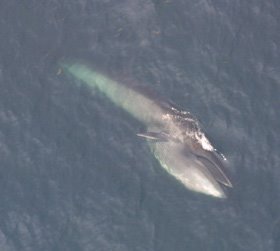
Here it’s worth noting that different rorqual species specialize on different prey, though some (the minkes and the fin whale) seem to be opportunists. Sei whales specialize on crustaceans, in particular on copepods, and blue whales are specialist krill predators (Sigurjónsson 1995). Furthermore, not all rorqual species feed by lunging – the sei in particular uses a technique called skimming, whereby the whale keeps its mouth slightly open and moves forward through a body of prey at a continuous speed. It would be interesting to know how the morphology, kinematics and energetics of the sei compare to those of lunge-feeding rorquals, but so far as I know these issues remain largely unstudied. We do know that its baleen is particularly fine, allowing it to filter the comparatively small copepods [adjacent photo, also from the Right Whale Aerial Surveys site, shows a feeding sei. Its feeding on its side. Hmm].

Thanks to the work of August Pivorunas, Paul Brodie and colleagues, the engulfing mechanism of rorquals has been reasonably well understood since the 1970s. However, questions always remained. How is it that, during lunge feeding, agile, highly reactive prey remain within the mouth cavity prior to the mouth’s closure? Man-made devices of similar size are incapable of retaining prey without them escaping prior to the devices’ closure (Brodie 1978). When a rorqual carcass is processed at a whaling station, the soft tissue of the throat is removed by flensing. Using cables and straps, the jaws are then winched open, and the tendons and muscles holding the mandibles in place are then cut, freeing the jaw from the skull. Because the jaw is winched open without the very heavy throat tissue attached, its movement during the procedure approximates the natural movement of the jaw when the animal is alive and underwater. As the jaw is winched open ‘a familiar sequence of sounds was observed to originate from the jaw apparatus … a growl or rumble, a low hydraulic suction noise, following by a powerful knock, the latter seeming to emanate from the tip of the jaw’ (Brodie 1993, p. 546). The noise reverberated throughout the jaw, making the entire structure vibrate. Unusual loud noises have been reported from live, feeding fin whales, so what Brodie reported apparently occurs in live whales, and not just dead ones.

What might cause these noises? Could it be that the articular condyles of the jaw bones were grinding against the bones of the skull? Well, no, as large masses of collagen and lipid are sandwiched between the lower jaw and skull, and in the specimens Brodie examined there was no suggestion that this tissue had been compromised. Could it be that the jaw tips were grinding together? Again, no, as soft tissue separates the jaw tips and, anyway, the jaw tips were being forced apart when the noises were being made, not together. Brodie (1993) concluded that the noise was a consequence of the stretching apart of a synovial capsule located between the jaw tips. And, funnily enough, here we have something that is of direct relevance to all of us (well, most of us. Well, those of us who have heard our joints make crack noises).

As synovial capsules are forced apart, a partial vacuum forms in the joint cavity. Adjacent water vapour and blood gases from surrounding tissues rush to fill the vacuum, and as it collapses a noise results. Such noises range from low rumbles to loud knocks. This process is termed pseudocavitation (to distinguish it from cavitation: the process whereby the medium actually ruptures), and I’ve just realized that this solves one of the greatest mysteries in all of biomechanics: why our knuckles crack. I can’t tell you how many times I’ve sat around with colleagues, pondering this very question.

If the lower jaws of fin whales really do make a loud bang or crack when they are opened to full gape, we can speculate that the whales might use this to help them retain prey within the mouth during engulfment. Captured prey would be startled away from the jaw edges by the noises, and this isn’t unlikely given that we’ve long known that rorquals exploit the behavioural traits of their prey to concentrate them during predation (it is well known that humpbacks use bubbles to encircle prey, and in fact fin and Bryde’s whales have been reported doing this too). To my knowledge, the ‘noisy jaw’ hypothesis has only been proposed for fin whales. Is it unique to this species, or practiced more widely?

And speaking of fin whales…. generally speaking, tetrapods have symmetrical bodies and symmetrical arrangements of pigmentation. Why then are fin whales asymmetrical? Mostly dark on the left side of the head (this goes for the baleen and the left side of the tongue), they are mostly light on the right side (and, again, this goes for the baleen and the right side of the tongue). While individuals belonging to various species will sometimes exhibit asymmetrical pigmentation (and rorquals, such as minkes and sei whales, are among them), fin whales are consistently like this: all of them.

Does this serve a function? Mostly it has been thought that it is something to do with counter-shading: if the whale swims anti-clockwise around its prey it might be camouflaged against the water and hence invisible, or is it that it swims clockwise around its prey, frightening them with its vivid whiteness and causing them to bunch up? Both ideas have been proposed (Ellis 1982). Most recently, cetologists seem to have favoured the idea that fin whales actually swim on their right side while lunge-feeding, thereby using a sort of rotated counter-shading. I’ve seen photos that apparently support this idea of right-sidedness, but I don’t know if there any good studies on the subject. There is widespread evidence for handedness across Tetrapoda (including in whales), so does this mean that all fin whales are right-handed, or left-handed?

That’s it on rorquals for now, though I plan at some stage to talk about the recently resurrected and recently discovered taxa, such as the Pygmy blue whale, Antarctic minke and Omura’s whale. And what is it with the name Balaenoptera musculus?

One last thing. I can’t go without relating the amazing tale of how I personally encountered Brodie’s 1993 paper ‘Noise generated by the jaw actions of feeding fin whales’. While collecting papers at Southampton University’s Boldrewood Biomedical Science Library one day, I decided to find and photocopy this paper. All I knew was that it had been published in Canadian Journal of Zoology. I had no idea what volume it had been published in, nor in what year it had been published. The problem is that the Boldrewood library has a near-complete run of Canadian Journal of Zoology, with many metres of shelving being taken up by volume after volume after volume. In a futile effort to begin my search, I pulled out a single volume, at random, and opened it, at random. I had found the paper. Ha – and people tell me I’m not psychic! :)

For the latest news on Tetrapod Zoology do go here.

Refs - -

Acevedo-Gutiérrez, A., Croll, D. A. & Tershy, B. R. 2002. High feeding costs limit dive time in the largest whales. The Journal of Experimental Biology 205, 1747-1753.

Brodie, P. F. 1978. Alternative sampling device for aquatic organisms. Journal of the Fisheries Research Board of Canada 35, 901-902.

- . 1993. Noise generated by the jaw actions of feeding fin whales. Canadian Journal of Zoology 71, 2546-2550.

Croll, D. A., Acevedo-Gutierrez, A., & Tershy, B. R. & Urbán-Ramírez, J. 2001. The diving behavior of blue and fin whales: is dive duration shorter than expected based on oxygen stores? Comparative Biochemistry and Physiology 129A, 797-809.

Ellis, R. 1982. The Book of Whales. Alfred Knopf, New York.

Goldbogen, J. A., Calambokidis, J., Shadwick, R. E., Oleson, E. M., McDonald, M. A. & Hildebrand, J. A. 2006. Kinematics of foraging dives and lunge-feeding in fin whales. The Journal of Experimental Biology 209, 1231-1244.

Gorman, M. L., Mills, M. G., Raath, J. P. & Speakman, J. R. 1998. High hunting costs make African wild dogs vulnerable to kleptoparasitism by hyaenas. Nature 391, 479-481.

Orton, L. S. & Brodie, P. F. 1987. Engulfing mechanisms of fin whales. Canadian Journal of Zoology 65, 2898-2907.

Sigurjónsson, J. 1995. On the life history and autecology of North Atlantic rorquals. In Blix, A. S., Walløe, L. & Ulltang, Ø. (eds) Whales, Seals, Fish and Man. Elsevier Science, pp. 425-441.

Labels: , ,

Tuesday, October 24, 2006

From cigar to elongated, bloated tadpole: rorquals part II

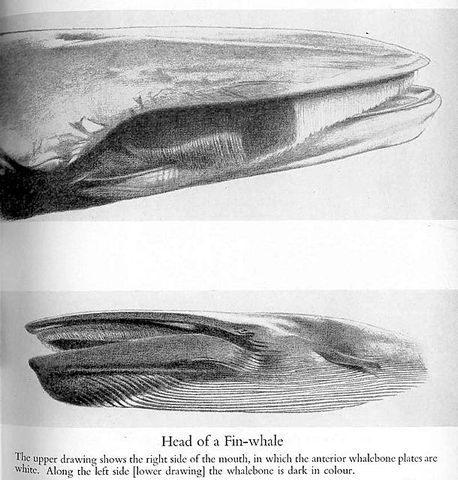
More on rorquals (for part I go here), this time looking at the basics of their morphology and feeding behaviour. The rostrum in rorquals is long and tapers to a point (though it is comparatively broad in blue whales) and, in contrast to other mysticetes, a stout finger-like extension of the maxillary bone extends posteriorly, overlapping the nasals and abutting the supraoccipital (the shield-like plate that forms the rear margin of the skull). The dorsal surfaces of the frontals (on the top of the skull) possess large depressions while the ventral surfaces of the zygomatic processes (the structures that project laterally from the cheek regions) are strongly concave, again unlike the condition in other mysticetes.

Rorqual lower jaws are immense, beam-like bones that bow outwards along their length. The symphyseal area (the region where the jaw tips meet) is unfused, as is the case in all mysticetes (even the most basal ones) but not other cetaceans, meaning that the two halves of the jaw can stretch apart at their tips somewhat. Exceeding 7 m in blue whales, rorqual lower jaws are the largest single bones in history (ha! Take that Sauropoda).

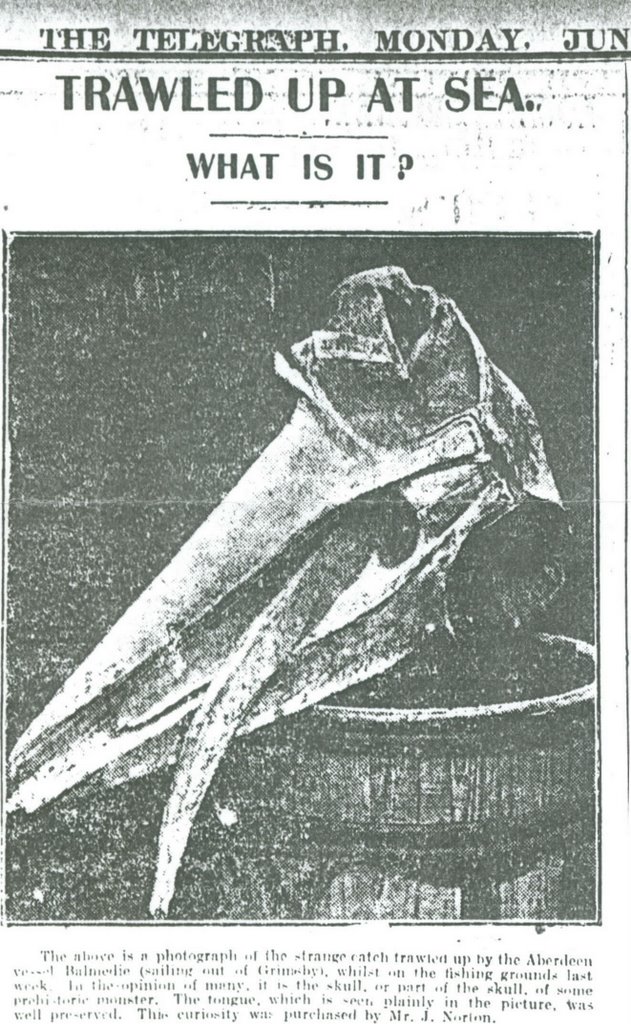
A section of blue whale jaw was once ‘discovered’ at Loch Ness and misidentified as the femur of an immense, hitherto undiscovered tetrapod. Occasionally rorqual skulls have been discovered in which the long lower jaws have been stuck wedged inside various of the skull openings and with their tips protruding like tusks. People unfamiliar with cetacean skulls have then naively assumed that the skull belonged to some sort of tusked prehistoric sea monster. Ben Roesch discussed cases of this (go here), and also noted the case of the Ataka carcass of 1956: a giant beached animal possessing divergent ‘tusks’ that are in fact the separated halves of a rorqual’s lower jaw (see adjacent image).

I’ve come across another case of this sort of thing. The accompanying newspaper piece, from The Telegraph of June 29th 1908, features a skull trawled up by the Aberdeen vessel Balmedie (sailing out of Grimsby), and thought by the article’s writer to be that of ‘some prehistoric monster’, apparently with tongue preserved. It’s clearly a rorqual skull, and the pointed, narrow rostrum and posterior widening of the mesorostral gutter indicates that it’s a minke whale skull.

Moving back to the morphology of the rorqual lower jaw, a tall, well-developed coronoid process – way larger than that of any other mysticete – projects from each jaw bone and forms the attachment site for a tendinous part of the temporalis muscle, termed the frontomandibular stay.

All of these unusual features are linked to the remarkable feeding style used by rorquals. How do they feed? Predominantly by lunge-feeding (also known as engulfment feeding): by opening their mouths to full gape (c. 45º), and then lunging into a mass of prey. Those depressed areas on the frontals and zygomatic processes have apparently evolved to allow particularly large temporalis and masseter muscles, the muscles involved in closing the jaw. The frontomandibular stay provides a strong mechanical linkage between the lower jaw and skull and seems primarily to amplify the mechanical advantage of the temporalis muscles.

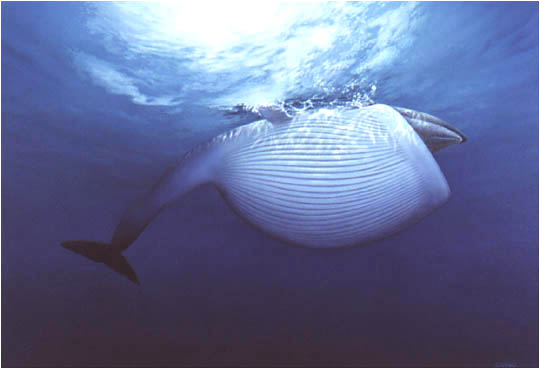
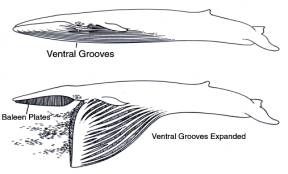
As a rorqual lunge-feeds, an immense quantity of water (hopefully containing prey) is engulfed within the buccal pouch, transforming the whale from ‘a cigar shape to the shape of an elongated, bloated tadpole’ (Orton & Brodie 1987, p. 2898). While a rorqual uses its muscles to open its jaws, the energy that powers the expansion of the buccal pouch is essentially provided by the whale’s forward motion, and not by the jaw muscles. In other words, the engulfing process is powered solely by the speed of swimming. Orton & Brodie (1987) noted that the engulfed water ‘is not displaced forward or moved backward by internal suction, but is simply enveloped with highly compliant material’ (p. 2905). Rorquals do not, therefore, set up a bow wave as they engulf.

A rorqual may engulf nearly 70% of its total body weight in water and prey during this action, which in an adult blue whale amounts to about 70 tons (Pivorunas 1979). In order to cope with this, the tissues of the buccal pouch must be highly extensible and able to cope with massive distortion. The ventral surface of the pouch is covered by grooved blubber, on which the 50-90 grooves extend from the jaw tips to as far posteriorly as the umbilicus. The ventral grooves can be extended to 4 times their resting width, and to 1.5 times their resting length. Internal to the grooved blubber is the muscle tissue of the buccal pouch, and this is unique, containing large amounts of elastin, and consisting of an inner layer of longitudinally arranged muscle bands and an outer layer where the bands are obliquely oriented (Pivorunas 1977).

When a rorqual lunges, delicate timing is needed, otherwise the buccal pouch will rapidly fill with seawater and not with prey. How then do rorquals get their timing just right? It seems that rorquals possess batteries of sensory organs within and around the buccal pouch: there are laminated corpuscles closely associated with the ventral grooves that might serve a sensory function, and located around the edges of the jaws, and at their tips, are a number of short (12.5 mm) vibrissae. Long assumed to be vestiges from the time when whale ancestors had body hair, it now seems that these structures have a role in sensing vibrations.

Once a mass of prey is engulfed, a rorqual then has to squeeze the water out through its baleen plates while at the same time retaining the prey. Rorqual baleen plates number between 219 to 475 in each side of the jaw (the number of plates is highly variable within species, with sei whales alone having between 219 to 402), and each plate ranges in length from 20 cm (in the minkes) to 1 m (in the blue). As the whale stops lunging forward, the pressure drops off, allowing deflation of the buccal pouch. Passive contraction of the blubber grooves and active contraction of the muscle layer within the buccal pouch also occurs at this time.

For an outstanding sequence of photos illustrating engulfment in action, see Randy Morse’s photos of a feeding blue whale here.

So that’s the basics. But there’s so much more to the subject than this. How is it that, during lunge feeding, agile, highly reactive prey remain within the mouth cavity prior to the mouth’s closure? Why do some rorquals make loud noises during lunge-feeding? Why, given their immense size and theoretical high aerobic dive limit, do big rorquals not spend more time lunge-feeding beneath the surface? Why do some rorquals exhibit strongly asymmetrical patterns of pigmentation? And don’t forget that not all rorquals lunge-feed. More on these issues in the following post.

The painting at top is from Valter Fogato's site.

For the latest news on Tetrapod Zoology do go here.

Refs - -

Orton, L. S. & Brodie, P. F. 1987. Engulfing mechanisms of fin whales. Canadian Journal of Zoology 65, 2898-2907.

Pivorunas, A. 1977. The fibrocartilage skeleton and related structures of the ventral pouch of balaenopterid whales. Journal of Morphology 151, 299-314.

- . 1979. The feeding mechanisms of baleen whales. American Scientist 67, 432-440.

Labels: , ,

Monday, October 23, 2006

A 6 ton model, and a baby that puts on 90 kg a day: rorquals part I

I’ve said it before but it’s worth saying again: everyone interested in animals is, I assume, fascinated by whales. All secondarily aquatic tetrapods are neat, but here we have a group that has evolved giant size, suspension feeding, macropredation, deep-diving and echolocation, among other things. Right now, I have rorquals on my mind, and I’m not quite sure why: I haven’t been doing any research on them lately, nor have they been in the news or anything*. However, later this week my family and I are visiting the Natural History Museum (London) and I’m particularly looking forward to showing Will (who’s 5) the life-sized Blue whale Balaenoptera musculus model that hangs in the Mammal Hall (the room formerly known as the Whale Hall). I’m so interested in this model that I feel it worthy of a short digression.

* Bar the news that Iceland is resuming low-level whaling. Yay Iceland.

Late in the 1920s plans to replace the old whale hall of the British Museum (Natural History) were fulfilled. The new, steel-girdled hall finally allowed the 1934 display of the Blue whale skeleton [image above, from here] that had been kept in storage for 42 years due to lack of space. Measuring 25 m in length, the animal had stranded at Wexford Bay, SE Ireland, in 1891. It – as in, the skeleton alone – weighs over 10 tons. But some people at the museum wanted more, and in 1937 taxidermist Percy Stammwitz (1881-1954) made the bold suggestion that a life-sized model of a Blue whale could be constructed within the Whale Hall itself. Later that year Stammwitz and his son, Stuart, began work on the project, their technical advisor being cetologist Francis C. Fraser (1903-1978).

Scaling up from a clay model, a wooden frame was constructed, and this was then covered in wire mesh and plaster. A trapdoor on the stomach was constructed for (I presume) internal maintenance, though apparently the workmen would sneak inside the model for secret smoking. On several occasions I’ve heard rumours that a time capsule was left inside this trapdoor before it was sealed: Stearn (1981) made no mention of this specifically, but did write that a telephone directory and some coins were left inside (p. 132). The completed model weighed between 6 and 7 tons and, when the time came for the whale to be painted, Stammwitz and Fraser disagreed, eventually choosing bluish steel-grey. Completed in December 1938, it was the largest whale model ever constructed though larger models, constructed from the same design templates, have since been produced by several American museums [adjacent image from here].

What are rorquals? They are the eight or so Balaenoptera species of the mysticete family Balaenopteridae*, all of which open their jaws wide to engulf masses of prey and possess a highly distensible throat pouch and extensible longitudinal grooves on the throat and belly. They occur in seas worldwide and range from 6 to 30 m in length. The only other living balaenopterid** is the Humpback Megaptera novaeangliae, and it is generally regarded as the sister-taxon to the rorquals. I’ve seen two explanations for the term rorqual. The commonest is that it derives from the Norwegian rørhval and means ‘grooved whale’ – a reference to those longitudinal grooves. The less common explanation is that it originated from the French for ‘red throat’, this supposedly being a reference to the reddish colour visible between the throat grooves when the whale’s buccal pouch is extended (Berta & Sumich 1990).

* Most books on whales state that there are five rorqual species. As with so many tetrapod groups, the number of recognised species has increased in recent years, both as ‘old’ species have been resurrected from synonymy (Antarctic minke B. bonaerensis and Pygmy bryde’s B. edeni), and as new species have been described (Omura’s whale B. omurai).

** Some workers have included the Grey whale Eschrichtius robustus within Balaenopteridae. It is mostly agreed, however, that Eschrichtius belongs to a small clade (Eschrichtiidae) best regarded as the sister-taxon to Balaenopteridae.

Rorquals grow fast, reaching sexual maturity at between 5 and 12 years of age in the larger species. They can produce up to 1.5 calves per 2-year period, though three years between calves is probably more normal. Pregnant females increase their weight by 26% and, thanks to lipids stored in their visceral fat and blubber, increase their total energy budget by a staggering 80% (Víkingsson 1995). After a pregnancy of 10-13 months, babies are suckled for 4-10 months and (in blue whales) are provided with 200 litres of milk a day. Unsurprisingly, babies increase their weight substantially during this time, with a 2-3 ton newborn blue whale putting on 90 kg a day, and reaching 20 tons by the time it is weaned. They are the fastest growing baby mammals. Rorquals are long-lived, with minkes B. acutorostrata reaching their forth or fifth decades, Sei B. borealis surviving to 65 or so, and Fins B. physalus to 85 or 90, or possibly 100. Incidentally, right whales (balaenids) are thought to survive into their second century, but they’re not rorquals.

We all know that rorquals are big, that they possess baleen, and that they feed by engulfing crustaceans, small fish and other prey. They spend summer in the polar regions, where they feed and put on weight, and then they migrate in the winter to the tropics, where they breed and give birth to their enormous calves… but they don’t _all_ do this, with some populations of some species being non-migratory. Of course, there’s more, a lot more, and in the next few posts I’d like to introduce a few details that you might not have encountered before… unless, that is, you’re a cetologist, or a close friend of one.

Thanks – mostly – to aerial photography, most of us are now familiar with the true body shape of live rorquals. They are shockingly gracile and incredibly long-bodied, with a shape that (when seen in dorsal view) has been likened to that of a champagne flute. While people had known this for a while (Roy Chapman Andrews wrote in 1916 of the Fin whale’s ‘slender body … built like a racing yacht’, for example), what may or may not be surprising is that only recently have people in general come to realize that rorquals are shaped like this. Basing their reconstructions on beached carcasses, or on rorquals killed by whaling vessels, artists and scientists had previously thought that rorquals were stouter, with fat bellies and flabby throats. Rorquals were still being depicted this way as recently as the 1960s, as in (for example) the excellent paintings and drawings of Sir Peter Scott [see above, borrowed from the Wildlife in Danger Brooke Bonds card set].

By photographing live sei and minke whales, underwater, from close range, Gordon Williamson (1972) argued that the traditional ‘baggy-throat’ reconstructions failed to show the true body shape of the animals. His drawings, reconstructed from his photos (which invariably failed to capture the entire animal in the frame), were dead accurate and among the first to depict rorquals in this way. Williamson’s whales were all captured, by harpoon, from a commercial whaling vessel. No explosive was placed in the harpoon head (normally, the harpoon head explodes within the body of the whale), so a harpooned whale was not killed immediately and was simply tethered to the ship. As it swam around, gradually tiring, Williamson approached it in the water and took his photos [the accompanying image, showing a young rorqual that beached in Florida in 2002, is borrowed from VisitGulf.com].

More on rorquals in the next post, this time focusing on the biomechanics of feeding: From cigar to elongated, bloated tadpole: rorquals part II. For the latest news on Tetrapod Zoology do go here.

Refs - -

Berta, A. & Sumich, J. L. 1999. Marine Mammals: Evolutionary Biology. Academic Press, San Diego.

Stearn, W. T. 1981. The Natural History Museum at South Kensington. Heinemann, London.

Víkingsson, G. A. 1995. Body condition of fin whales during summer off Iceland. In Blix, A. S., Walløe, L. & Ulltang, Ø. (eds) Whales, Seals, Fish and Man. Elsevier Science, pp. 361-369.

Williamson, G. R. 1972. The true body shape of rorqual whales. Journal of Zoology 167, 277-286.

Labels: , ,

Saturday, October 14, 2006

Oh deer oh deer oh deer

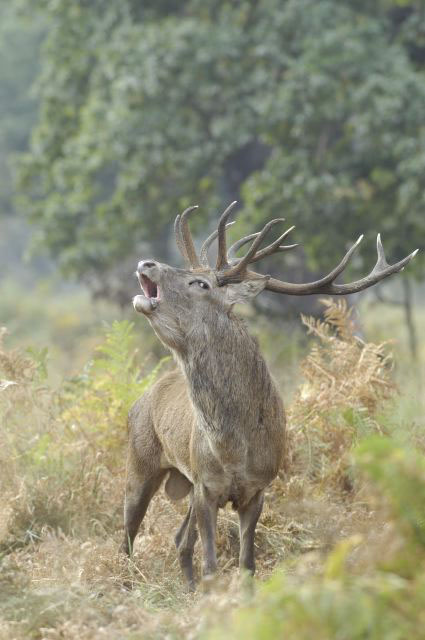
Welcome to Tetrapod Zoology’s one-hundredth blog post! And I’ve decided to crack open the champagne and celebrate by… writing a post all about temnospondyls rhinogradentians what happened to me on Friday the 13th. Well, originally I was going to do some kind of big analysis of subject distribution across the 100 posts, but having thought about it I can’t be bothered. Seriously, I’ll save that sort of thing for Tetrapod Zoology’s 1st birthday. For some time now Jonathan McGowan and I have been planning to go to the New Forest to watch the rutting deer, and right now is rutting season for Red deer Cervus elaphus, Fallow deer Dama dama, and Sika deer C. nippon. Jon is an outstanding, experienced naturalist (and excellent photographer, and professional taxidermist) and he might be best known for his association with the recently discovered green lizards of Boscombe Cliffs, Bournemouth (see Hunting green lizards in Dorset: new aliens or old natives?). And so it was that we headed off into the wild, eagerly awaiting the many close-hand encounters we would have with big wild deer.

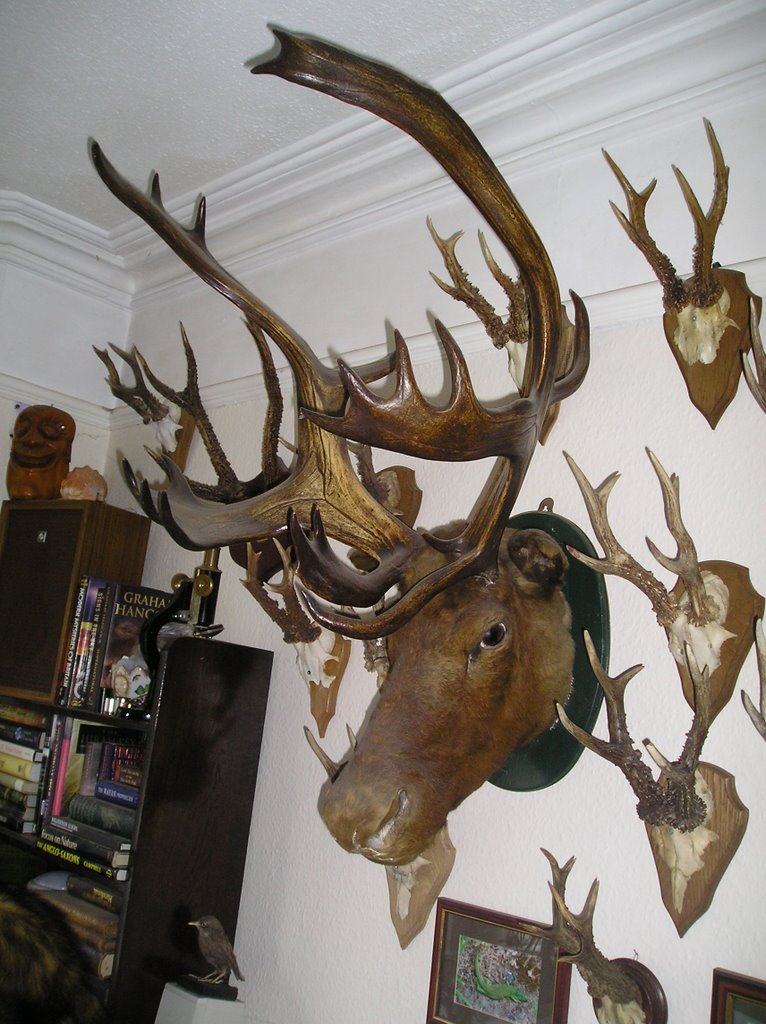
Jon’s collection of deer taxiderm specimens and antlers is amazing, as you can see from the photo above (which depicts only a small fraction of what he has). One of the centrepieces is the big animal you can see here, surrounded by roe deer. It’s an immense reindeer which blew me away in terms of its size and antler form: it appears to be an Osborn’s caribou Rangifer tarandus osborni Allen, 1902, a subspecies I’ve never seen before. Endemic to British Columbia and the Yukon, Osborn’s caribou is a reddish brown animal with a whitish lateral stripe and neck, and long and thick-beamed antlers that have semi-palmate brow and bez tines. And it’s a giant, as you see by comparing it with the adjacent roe. Geist (1999) puts this giantism down to growth in a highly favourable environment combined with a non-migratory habit. That’s right, not all reindeer migrate.

Reindeer are what Geist terms grotesque giants: species that exploit high-quality foods in cold climates, and are able to evolve luxury organs. The latter include large fat deposits, big and ornate antlers, tusks or horns, big brains, and manes or beards of long decorative hair. Big cold-adapted Pleistocene mammoths and rhinos are regarded by Geist as grotesque giants, as are big bears and, most interestingly, neanderthals and modern humans. Strongly adapted for life in open country, reindeer are the most cursorial of living deer. They have the proportionally biggest antlers of any living deer, the most complex pattern of pigmentation and array of ornamentation, among the showiest courtship display, and are among the most adaptable and behaviourally flexible of all deer. That last factor probably explains why reindeer are the only deer that have been properly domesticated.

Anyway, once in the field we headed to a location well known as a regular red deer rut site. But, unfortunately, only a few deer were to be seen, and they were hardly active, spending most of their time lazing in the vegetation. It was a very warm and sunny day, so I can’t blame them. Red deer in Britain have an interesting history. While the species was historically native to Britain, it is doubted if this is true for any of the English populations (even that of Exmoor, often said to be descended from old native stock): Lowe & Gardiner (1974) found that the only truly native red deer are those of the Lake District and Scottish Highlands, with the others being derived from continental introductions. Red deer numbers waxed and waned between the 13th century and the present (Yalden 1999).

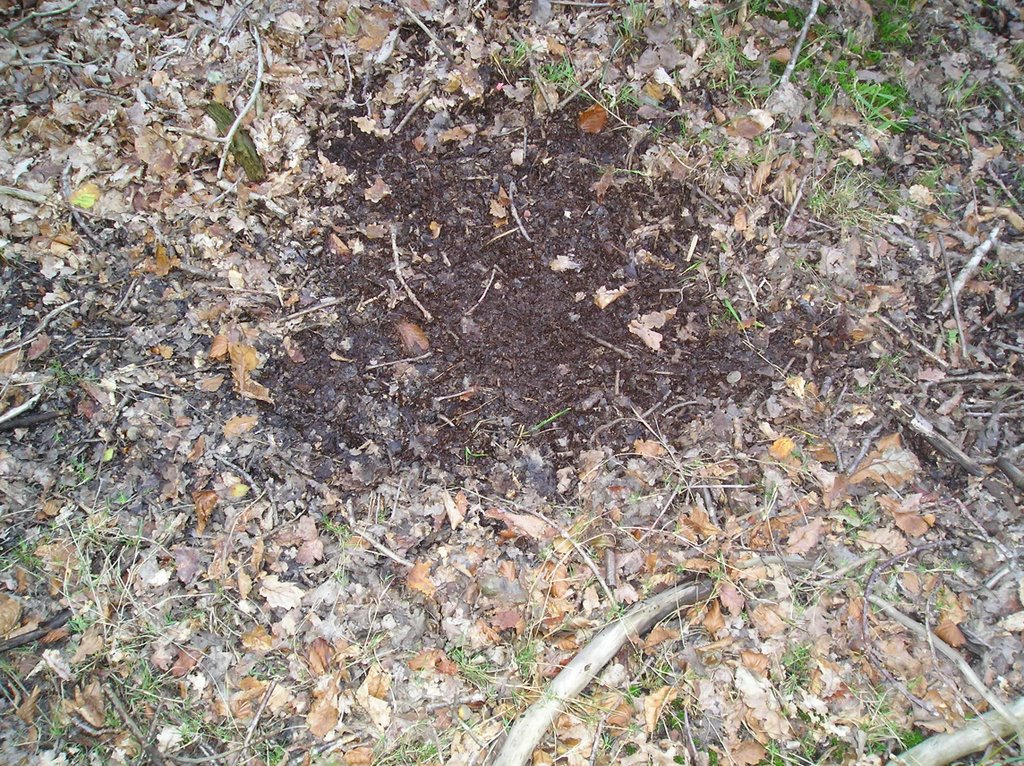
We also succeeded in hearing and seeing sika deer, though again not at the close range I was hoping for. Sika are sometimes described as combining an unconventional combination of characteristics: similar in size to fallow, they have a white rump recalling that of a roe, while their antlers are like those of a miniature red. As they flee, their pale rumps are prominent, and while we got to see quite a few fleeing rumps, we also got to within close range of a lone stag. He stopped and watched us for some time, and with large antlers that had ten points we thought that he was a magnificent individual. Prior (1963) stated that New Forest sika stags are unusual ‘for producing occasional heads of ten points instead of the usual eight’ (p. 72), so it’s good to confirm that ten-pointers are still around. Sadly, we weren’t close enough for me to get any photos. The adjacent photo is – honest – a scrape produced by a sika.

Sika are not native, having been introduced from China and Japan (read on) on multiple separate occasions. They haven’t spread that far, though there are amusing cases where populations introduced to islands (such as Brownsea Island in Poole Harbour) have swum to the mainland. Sika are ecotone deer that have been around since the Pliocene, and the larger cold-adapted forms of the species appear especially close to the ancestry of the apparently more advanced red deer. However, it has also been argued that things go the other way round, and that sika might descend from a red deer-like form.

In the New Forest, it is well known that sika occur south-east of the Bournemouth to London railway line, and that any seen north of it are shot. This is due to fears that they will interbreed with the ‘native’ red deer, as it is well documented that – despite their anatomical and ecological differences – the two species readily hybridise, with the hybrids being fully interfertile (which, incidentally, is relevant to the whole ‘domestic dogs represent a distinct species’ argument). Hybrids between red deer and sika have been known since 1940 when they were reported in the Lake District, and by the 1970s it became clear that the Irish deer of the Wicklow Mountains were pretty much all hybrids. Extensive hybridisation has occurred between the two elsewhere in the world, such as in New Zealand (Tate et al. 1997). Today, Scottish red deer – even those that look like good, honest reds – have been significantly contaminated by sika DNA.

As usual however, nature is inconsistent, and I am reliably informed that the latest data on New Forest deer shows that – even when sika get north of that railway line – they _do not_ hybridise with the reds. The consequence of this discovery is that the shooting of New Forest sika has stopped. Quite why sika and reds hybridise in Scotland and Ireland but not in southern England is beyond me, and I don’t know if anyone has proposed a reason. But here’s one. Britain’s introduced sika belong to two different subspecies: C. n. nippon of Japan and C. n. hortulorum of China. Maybe it’s only one of these subspecies that can routinely hybridise with C. elephus, and if this is so, then maybe that’s the subspecies that is doing the hybridisation in Scotland and Ireland. I don’t know, and I’d be interested if anyone does (Long et al. (1998) implied that at least some English sika are C. n. hortulorum whereas most British sika are C. n. nippon, but didn’t go into the subject further than that).

Incidentally, on New Zealand red deer have been extensively hybridised (via artificial insemination) with the highly distinctive Père David’s deer Elaphurus davidianus, and again the hybrids are fertile (Tate et al. 1997). This is odd given that Père David’s deer are significantly different genetically from red deer, differ from them in seasonality, behaviour, morphology and other details. There have also been attempts to cross Sambar C. unicolor with red deer on New Zealand (again via artificial insemination), though in this case only one calf survived of 400 inseminations (Muir et al. 1997).

You might wonder why New Zealanders are so interested in producing these unnatural hybrids. The answer is that the resulting animals are thought to be superior from the point of view of the deer farming trade, theoretically having a more flexible breeding season and shorter gestation period than pure red deer. Similar experiments involving Père David’s deer have been carried out in Scotland, with one argument for the introduction of Père David’s deer genes into red deer being that Père David’s deer is ‘in the words of one enthusiast “as tough as old boots”, and when it is not being eaten by Chinese peasants it will thrive almost anywhere’ (Tudge 1987). Tudge’s article – ‘Custom-built deer take to hills’ – implied that Père David’s x red hybrids would prove a big thing in the years to follow. Well, here we are in 2006 and I haven’t heard much about them lately. Hmm.

We have yet other deer in Britain, and again they are introductions, including Chinese water deer Hydropotes inermis and muntjacs. Muntjacs, aah yes, muntjacs….

For the latest news on Tetrapod Zoology do go here.

Refs - -

Geist, V. 1999. Deer of the World. Swan Hill Press (Shrewsbury).

Long, A. M., Moore, N. P. & Hayden, T. J. 1998. Vocalizations in red deer (Cervus elephus), sika deer (Cervus nippon), and red x sika hybrids. Journal of Zoology 244, 123-134.

Lowe, V. P. W. & Gardiner, A. S. 1974. A re-examination of the subspecies of Red deer (Cervus elephus) with particular reference to the stocks in Britain. Journal of Zoology 174, 185-201.

Muir, P. D., Semiadi, G., Asher, G. W., Broad, T. E., Tate, M. L. & Barry, T. N. 1997. Sambar deer (Cervus unicolor) x Red deer (C. elaphus) interspecies hybrids. The Journal of Heredity 88, 366-372.

Prior, R. 1965. Living With Deer. Andre Deutsch (London).

Tate, M. L., Goosen, G. J., Patene, H., Pearse, A. J., McEwan, K. M. & Fennessy, P. F. 1997. Genetic analysis of Père Davids’ x Red deer interspecies hybrids. The Journal of Heredity 88, 361-365.

Tudge, C. 1987. Custom-built deer take to the hills. New Scientist 114 (1555), 28.

Yalden, D. W. 1999. The History of British Mammals. T & A D Poyser (London).

Labels: , ,

Monday, September 11, 2006

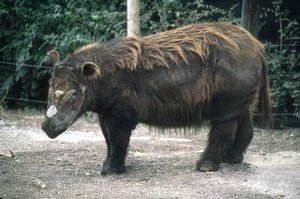
Are Sumatran rhinos really ‘living fossils’?

One of my least favourite terms in the whole of natural history writing is ‘living fossil’, and its use and meaning are on my mind right now as Loren Coleman (of Cryptomundo) and I have just been debating it. What exactly do people mean when they talk of organisms being ‘living fossils’, and does this term actually mean anything at all?

The event that sparked this off is the announcement that Sumatran rhinos Dicerorhinus sumatrensis have just been filmed on Borneo. Given how elusive the animals are (see below), this is a big deal, and all the more so given that the presence of a living Bornean population was only announced in 1986 (the discovery actually occurred in 1983 but was kept secret until 1986). Historically, Sumatran rhinos occurred across Sumatra and Borneo as well as north-eastern India, Myanmar, southern Bangladesh, the Malay Peninsula and possibly Vietnam and elsewhere. They were reported from Yunnan, China, as recently as the 1930s.

Because they are elusive, often nocturnal, and inhabit thick, often mountainous forests, it stands to reason that they are good at disappearing and reappearing. This goes for their presence on the Asian mainland as well as that on Borneo and Sumatra. John MacKinnon, the zoologist best known for his involvement in the discovery of the Saola Pseudoryx nghetinensis, has reportedly never seen a wild Sumatran rhino, despite all his time in the field and efforts to find them. Camera traps installed at Way Kamblas National Park, northern Sumatra, succeeded in photographing wild rhinos in 1995, allegedly the first time this had been done since 1932 (Bristow 1997).

Indeed, from the point of view of zoological discovery, Sumatran rhinos are interesting, having only been officially named by German biologist Johann Gotthelf Fischer von Waldheim in 1814. Actually, a published description of a Sumatran rhino had appeared 20 years prior to this, when William Bell sent a description and some illustrations to Joseph Banks, the then-president of the Royal Society of London. Bell had examined the animal after it had been shot near Fort Marlborough, Sumatra, in 1793. Even earlier, a pair of horns described by Jacobeus (1696) have been regarded by some as of Sumatran rhino origin. Linnaeus assumed that Jacobeus had been writing about the Black rhino Diceros bicornis, and as a result assumed ‘India’ as the type locality for this species.

Fischer von Waldheim had named his new rhino as a species of the genus Rhinoceros, but in 1841 Constantin Wilhelm Lambert Gloger thought that the species deserved its own genus, Dicerorhinus. Actually, an older generic name – Didermocerus – was coined by Joshua Brookes in 1828. Mostly forgotten about until George Simpson discussed it in 1945, it has been proposed that the publication where Didermocerus appeared (A Catalogue of the Anatomical and Zoological Museum of Joshua Brookes) should be considered invalid for the purposes of nomenclature. This view has a lot going for it, but for the fact that Brookes is usually taken as the author of Acinonyx, the cheetah genus (Boylan 1967). During the 1870s the taxonomy of Sumatran rhinos became more confusing. Sclater (1872a, b) argued that there were two species, Rhinoceros sumatrensis and R. lasiotis. Gray (1872, 1873) then thought that R. lasiotis was the ‘typical’ Sumatran rhino, that R. sumatrensis was synonymous with a species he had named in 1854 (R. crossii, later Ceratorhinus crossii), and that Malaysian and Burmese rhinos represented the new species C. niger and C. blythii.

Few of these putative taxa have stood the test of time. R. lasiotis (now R. s. lasiotis) has, and has been recognised as the subspecies of mainland Asia (Groves 1967). It is generally thought to be extinct, but a few individuals might persist in Myanmar and in 1999 it was announced that Sumatran rhinos had been seen near the Indian border with this country. In 1991 it was thought possible that individuals might also survive in Thailand and Laos (Martin & Vigne 1991). Groves & Kurt (1972) noted that the status of R. crossii remains somewhat uncertain: it is based on a single unusual and very long (80 cm) horn that is probably (but not definitely) from D. sumatrensis. The Bornean population was named as a distinct subspecies, D. s. harrissoni, in 1965 (Groves 1965), which makes it the largest recently named terrestrial mammal.

A small, two-horned species, the Sumatran rhino has long, shaggy reddish-brown fur covering its body and limbs. ‘Small’ for a rhino means that it is about 3 m long, 1-1.5 m tall at the shoulder, and between 800 and 2000 kg in weight. It has large lower canines (but no upper canines) that it uses in combat and both horns are short, the second (aka frontal) may be so low that it is barely more than a bump. A few individuals have been recorded with very long nasal horns of nearly 40, and even nearly 70, cm long.

In terms of their global population, Sumatran rhinos are in big trouble, and the estimated world population of 300 (as of 2001) is thought to be the remnants of one that crashed by c. 50% during the 1990s, mostly due to illegal hunting and habitat loss. Captive breeding has unfortunately not helped in boosting numbers: until fairly recently it was thought that Sumatran rhinos did quite well in captivity – they were the first rhino species to breed in captivity (a female kept at Calcutta gave birth in 1889), and a specimen kept at London died at age 32 (this individual was, incidentally, the type specimen of D. s. lasiotis). By the 1990s however, it had to be concluded that 20th century captive breeding had been a failure, with not one of the 39 zoo-kept individuals having bred (during 2004 however, one calf was born at Cincinnati Zoo). 18 of these 39 were dead by the late 1990s. Why the rhinos fare badly in captivity is not known, but it might be that they find small enclosures and exposure to sunlight too stressful. The solution to this problem might be the Sumatran sanctuary at Way Kambas National Park. European, American and Asian zoos are sending their rhinos to this park (Bristow 1997).

To get back to their current appearance in the global media, it seems inevitable that, whenever Sumatran rhinos are mentioned, that old chestnut about them being a ‘living fossil’ is trotted out. It is invariably stated that they are particularly close to the Pleistocene woolly rhino, Coelodonta, and it is often implied that their persistence to the presence is remarkable and that they should be regarded as an anachronism. Such comments aren’t restricted to the popular literature: Groves & Kurt (1972, p. 4) wrote ‘As presently defined, Dicerorhinus is the genus that gave rise to all living Rhinocerotidae; in this sense, and in that it closely resembles certain Miocene species, the Sumatran rhino may be regarded as a living fossil’ [some of these statements are arguable: read on].

This, I suppose, answers the question as to what a ‘living fossil’ is… it’s an archaic animal (i.e., one whose anatomy harks back to an early stage in its group’s evolution) that appears to have persisted for a long time, relatively unchanged. The problem is that this is so vague that it’s all but meaningless. What is a ‘long time’, given that different forms of life evolve at different paces? And what is ‘relatively unchanged’, given that the same sort of body shape can persist for tens of million of years?

I know that this ‘living fossil’ claim has a ‘long and useful educational tradition’, and that such august scientists as E. O. Wilson have employed the Sumatran rhino as such (go here for the quote). My point is that all of this is misleading, and that in fact Sumatran rhinos are no more ‘living fossils’ than many other living mammal species. Consider the following.

Is D. sumatrensis an old species?

No, the living species D. sumatrensis doesn’t have a fossil record extending beyond the Pleistocene. A few bone and teeth are known from the late Pleistocene of Borneo and a fossil subspecies, D. s. eugenei Sody, 1946, is known from the Holocene of Sumatra. So far as we know therefore, the Sumatran rhino isn’t a particularly old species. It’s apparently less than about 2 million years old, and thus utterly typical for a living mammal.

Is Dicerorhinus particularly old and/or conservative?

Dicerorhinus has a fossil history going back to the Miocene (and perhaps to the Late Oligocene). However, a great many living mammal genera have fossil records going back this far. Examples - picked at random - include Geomys (pocket gophers), Muscardinus (hazel dormice), Glis (edible dormice), Martes (martens), Genetta (genets), Viverra (civets), Tursiops (bottlenose dolphins), Orcinus (killer whales), Physeter (sperm whales), Balaenoptera (rorquals), Tragelaphus (bushbuck, kudus etc), and many others. As discussed in a previous post (Pleistocene refugia and late speciation: are extant bird species older than we mostly think?), some modern bird genera seem to have first appeared in the Miocene, and many thoroughly modern amphibians and reptile genera go back this far or further.

So if Sumatran rhinos should be regarded as ‘living fossils’, why aren't bottlenose dolphins, blue whales, edible dormice, sitatungas, gannets, barn owls or peafowl ever referred to as such? It seems either that we are surrounded by taxa that should be regarded as ‘living fossils’, or that the term is pretty much useless given that most modern animal species belong to groups that have a fossil history.

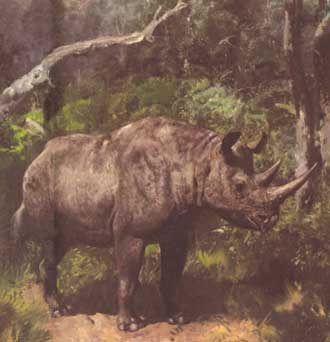
And was Dicerorhinus conservative throughout its evolutionary history? No, Dicerorhinus species were quite diverse. Among the many species, some (such as the Pleistocene Christol’s rhino D. megarhinus and Etruscan rhino D. etruscus) were gracile and long-legged compared to D. sumatrensis, others (like Merck’s rhino D. kirchbergensis) were large, while others (like the Steppe rhino D. hemitoechus) were apparently specialized grazers, with a downwardly-flexed head and neck. Incidentally, not all species traditionally placed in Dicerorhinus are still thought to belong there. Some belong to the closely related Lartetotherium for example (Cerdeño 1995) [the adjacent painting is Burian's restoration of an Etruscan rhino. Note the long legs].

Is D. sumatrensis anatomically archaic?

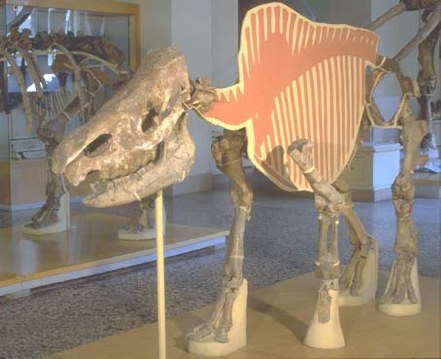
Interestingly (and in contradiction to that quote from Groves & Kurt 1972, p. 4, given above), most of the anatomical features that make Dicerorhinus appear ‘primitive’ seem to be reversals. That is, the genus has uniquely ‘switched back’ to primitive character states, but actually descended from ancestors with a more ‘modern type’ morphology (Cerdaño 1995). Furthermore, the genus seems not to be ancestral to other living rhinos, but a lineage that, within the rhinocerotid clade Rhinocerotinae, is closer to Rhinoceratina (containing Rhinoceros) than it is to Dicerotina (containing Ceratotherium and Diceros). As such, Dicerorhinus isn’t really any older than other extant rhino genera (Tougard et al. 2001) [image below features a reconstructed skeleton of a Steppe rhino. Borrowed from the La fauna del Quaternario site].

Everything restated, more simply… ish

Sumatran rhinos have been thought of as ‘living fossils’ because – supposedly – they belong to a particularly old group, the group they belong to was particularly conservative throughout its history, and they are anatomically archaic. Ignoring for a moment the fact that the species itself appears to be geologically young, these assumptions are no truer for Sumatran rhinos than they are for a great many other living tetrapods, and at worse they are just plain wrong. Dicerorhinus is NOT particularly old, it was NOT particularly conservative, and it is NOT particularly archaic in terms of anatomy! And if you want to argue that it is (in answer to all of the above), then I demand that Bottlenose dolphins and Peacocks and all those other tetrapods now be consistently referred to as ‘living fossils’ too, forever more.

Why then do we persist with this ‘living fossil’ twaddle? Mostly, I suppose, this is because some animals look ‘more ancient’ than others, and when it is found that they belong to a group with a reasonable fossil history… presto: living fossil. But as I have tried to show here, this term is essentially meaningless. Should we use it at all? If a single species could be shown to have persisted, unchanged, for a shockingly long length of geological time, then I suppose the term would be appropriate. But what is ‘shockingly long’. All in all, it has to be said that the whole concept of the ‘living fossil’ is utterly subjective, hence its uselessness.

Update: a response to this post has been written by Loren Coleman... Sumatran rhinos are living fossils. I think we'll have to agree to disagree. For the latest news on Tetrapod Zoology do go here.

Refs - -

Boylan, P. J. 1967. Didermocerus Brookes, 1828, v. Dicerorhinus Gloger, 1841, (Mammalia: Rhinocerotidae), and the validity of A Catalogue of the Anatomical and Zoological Museum of Joshua Brookes, 1928. Bulletin of Zoological Nomenclature 24, 55-56.

Britow, M. 1997. The rhino’s return. BBC Wildlife 15 (2), 68-69.

Cerdeño, E. 1995. Cladistic analysis of the family Rhinocerotidae (Perissodactyla). American Museum Novitates 3143, 1-25.

Gray, J. E. 1872. On the double-horned Asiatic rhinoceros. Annals and Magazine of Natural History 10 (series 4), 208-209.

- . 1873. On the dentition of rhinoceroses (Rhinocerotes) and on the characters afforded by their skulls. Annals and Magazine of Natural History 11 (series 4), 356-361.

Groves, C. P. 1965. Description of a new subspecies of rhinoceros, from Borneo, Didermoceros sumatrensis harrissoni. Säugertierk. Mitt. 13, 128-131.

- . 1967. On the rhinoceroses of southeast Asia. Säugertierk. Mitt. 15, 221-237.

- . & Kurt, F. 1972. Dicerorhinus sumatrensis. Mammalian Species 21, 1-6.

Jacobeus, O. 1696. Muséum Regium. Nürnberg.

Martin, E. B. & Vigne, L. 1991. The horn quintet. BBC Wildlife 9 (5), 356-357.

Sclater, P. L. 1872a. Untitled note. Proceedings of the Zoological Society of London 1872, 493-494.

- . 1872b. Untitled note. Proceedings of the Zoological Society of London 1872, 790-794.

Tougard, C., Delefosse, T., Hänni, C. & Montgelard, C. 2001. Phylogenetic relationships of the five extant rhinoceros species (Rhinocerotidae, Perissodactyla) based on mitochondrial cytochrome b and 12S rRNA genes. Molecular Phylogenetics and Evolution 19, 34-44.

Labels: , ,