Sunday, November 12, 2006

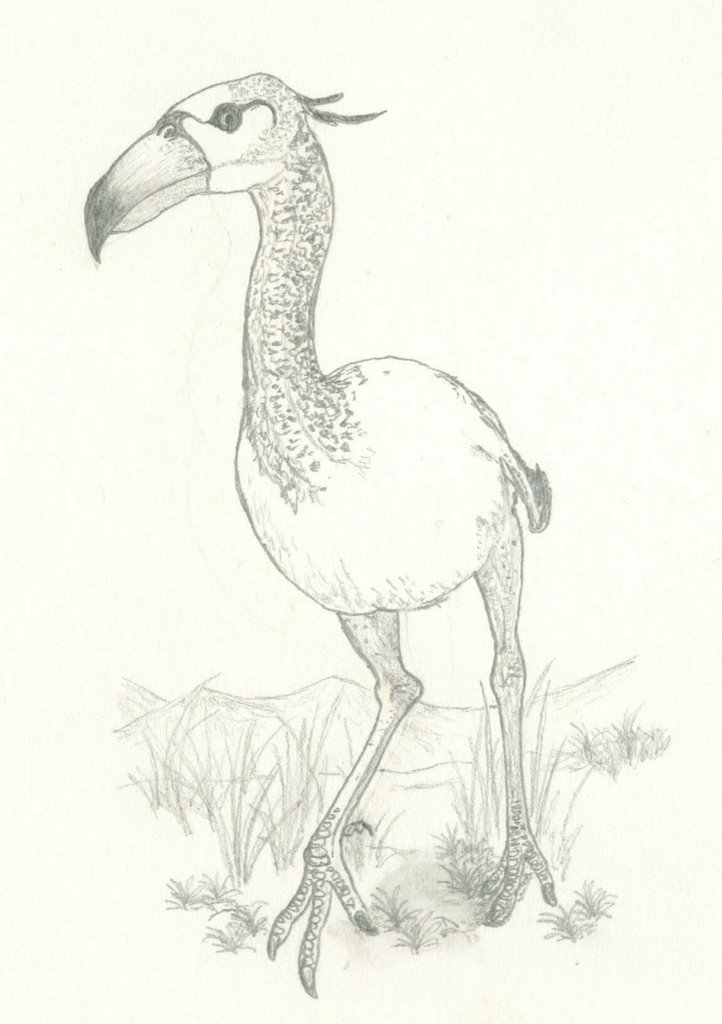
Goodbye, my giant predatory, cursorial, flightless hoatzin
Toxic Madagascan frogs are losing their toxicity, there is that ongoing controversy about the taxonomic status of the kouprey, and there have lately been some bizarre criticisms of Jeff Meldrum and his sasquatch research. One day I’ll build up enough courage to post about sasquatch, but not yet :) I am still planning to blog about Kimmeridge Clay dinosaurs and the elephant-killing lions of Chobe National Park (Botswana), not to mention temnospondyls. On a personal level, my life continues to go from bad to worse and I have been horribly ill over the past several days, but you don’t want to hear about that. Oh yeah, our house is being literally invaded by harlequin ladybirds (an alien species from Asia that arrived in Britain in 2004).

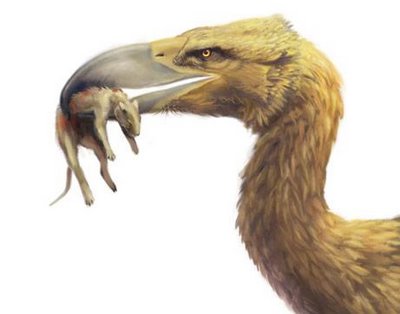
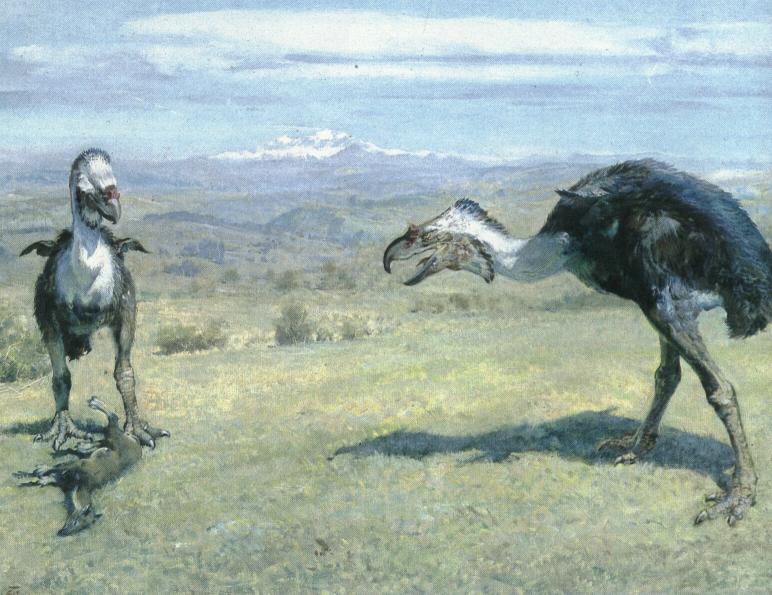
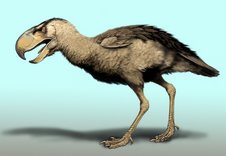
Anyway, as you’ll note from the accompanying image, I still plan for now to write about things that are related to, or inspired by, Chiappe & Bertelli’s recent paper on phorusrhacids. The image, depicting the controversial North American phorusrhacid Titanis, has been kindly provided by my good friend Carl Buell who has, I am very pleased to say, recently started blogging again after a very long absence.

In the previous post – a spinoff of a still earlier post about phorusrhacids – I discussed the South American landbird theory. It suggests that….

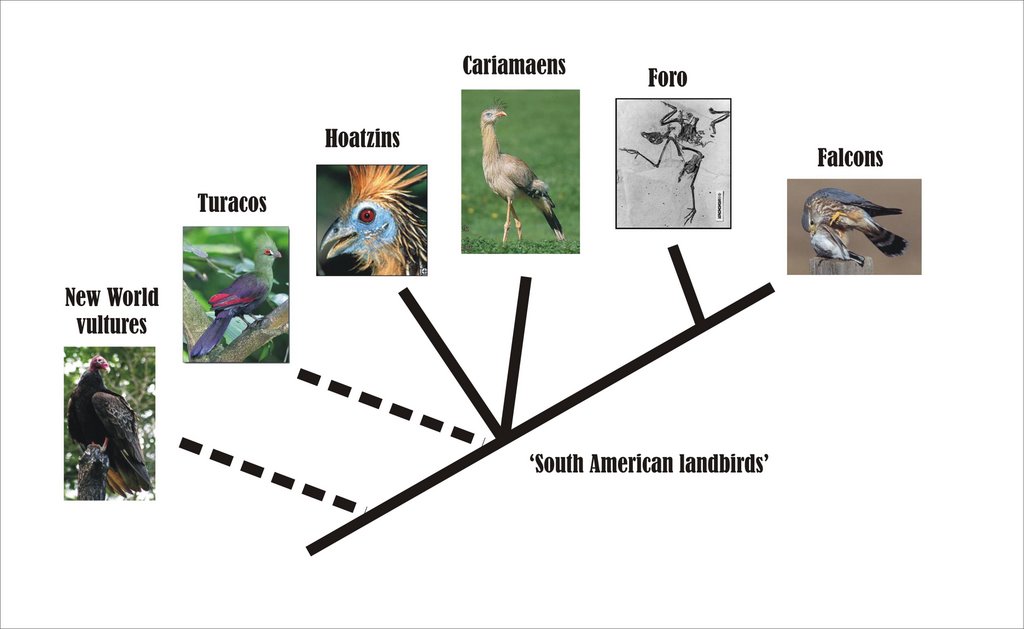
… there might be a hoatzin-cariamaen clade, probably persisting as relicts in South America but more widespread during the early Cenozoic. It may perhaps involve turacos, and perhaps also falcons. Finally, New World vultures (which have all their earliest fossil occurrences in the Old World) might be allies of the South American landbird group.

Support for this idea comes mostly from the similar hand morphology that some of these birds have, combined in part with the idea that they’re just about similar enough to be imagined as possible relatives. But if you’re only familiar with the view of bird classification presented in textbooks and so on, the idea that cariamaens might be close to such things as hoatzins is pretty surprising, as the former have conventionally been regarded as part of Gruiformes, the group that includes rails, cranes, trumpeters and several other groups. As mentioned in the previous post, there are substantial doubts however as to whether Gruiformes is monophyletic or not. What is the current thinking on this issue?

Dissipation of the gruiforms
In their comprehensive and influential study of DNA hybridization, Sibley & Ahlquist (1990) supported gruiform monophyly, as did Livezey (1998) in a large study of morphological data, and Cracraft et al. (2004) on genetic data. However, other large-scale studies have found different gruiforms to occupy different positions within the neornithine tree (in the following discussion I have not aimed to be comprehensive: rather, I am most interested in those studies that included seriemas [and hence provide data on the position of cariamaens]).

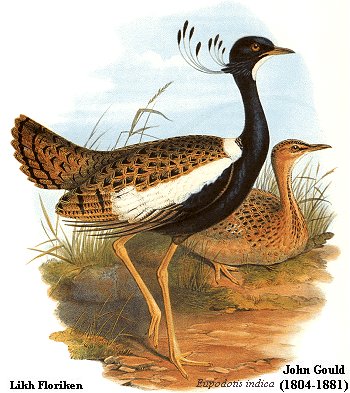
In a major and comprehensive study of morphological characters, Livezey & Zusi (2001) found gruiforms to be scattered about the neornithine tree. Seriemas were without close relatives and were the most basal group within Neoaves (the neognath clade that excludes waterfowl and gamebirds), bustards [see adjacent image] were on their own and near the middle of the neoavian radiation, trumpeters, cranes and limpkins grouped with hoatzins in a clade that also included flamingos, tubenosed seabirds, divers and penguins, and rails and finfoots were members of a ‘higher landbird’ clade. It should be noted that their paper is preliminary and that further studies (hopefully with better-resolved trees) will emerge from the immense amount of data that Livezey & Zusi collected. They noted in particular that the unusual positions they recovered for seriemas and other gruiforms were likely to change in future (p. 195).

In a study of osteological and soft-tissue characters, Mayr & Clarke (2003) also found gruiforms to be polyphyletic: rails, trumpeters and cranes (referred to from hereon as the ‘gruiform core’) were one of the most basal groups within Neoaves, bustards were without close relatives, and seriemas formed a clade with….. hoatzins. The seriema-hoatzin clade was closely allied with a cuckoo-turaco clade. The main characters tying seriemas, hoatzins, cuckoos and turacos together were those of the hand and the hip muscles, and they were also united in possessing distinctive recesses on the top of the pelvis. From the point of view of the South American landbird theory, Mayr & Clarke’s study is therefore significant in finding empirical character support for the monophyly of a turaco-hoatzin-seriema clade. However…

In a much-discussed study, Fain & Houde (2004) found that Neoaves consisted of two clades, Metaves and Coronaves. Their most exciting conclusion was that rampant convergence had occurred between these two parallel radiations: metavians include hoatzins, mesites and grebes, while coronavians include turacos, passerines and divers, for example (if those lists are lost on you, hoatzins are similar to touracos, mesites are similar to some passerines, and grebes are similar to divers). Different gruiforms were found to belong to both groups; mesites, kagus and sunbitterns were metavians close to owlet nightjars, grebes and sandgrouse; seriemas and bustards were coronavians without close relatives; while the gruiform core was part of a coronavian clade that included divers, cuckoos, turacos, tubenosed seabirds, storks, herons, penguins and pelicans.

Most recently, Ericson et al. (2006), in a study of molecular sequence data, also supported gruiform polyphyly. Their study is significant in that they found support for Fain & Houde’s Metaves-Coronaves division, and the gruiform groups fell into pretty similar positions, though with exceptions. Seriemas were not isolated within Coronaves (as they were in Fain & Houde’s study), but instead part of a clade that included parrots, passerines and falcons.

An approximate consensus

It’s difficult to conclude from these conflicting studies (and others) that we are anywhere near a consensus on neoavian affinities, but in fact we are getting somewhere, and the following details are common to all the recent major studies; gamebirds and waterfowl are at the base of Neornithes, and probably form a clade (Galloanserae) that is the sister-taxon to Neoaves; within Neoaves, tubenosed seabirds, pelicans, divers, herons and storks are part of a waterbird clade somewhere near the base of Neoaves; shorebirds (gulls, terns, skuas, auks, plovers and waders) form another clade near the base of Neoaves; and there is a ‘higher landbird’ clade that includes passerines, woodpeckers and allies, kingfishers and rollers. Owls, raptors, mousebirds, parrots, trogons, hornbills and hoopoes are most likely close to, or part of, the ‘higher landbird’ clade. Finally, there might be a hitherto overlooked metavian clade at the base of Neoaves: it includes such strange bedfellows as nightjars and other nightbirds, swifts and hummingbirds, kagus, pigeons, sandgrouse, flamingos and grebes, mesites, hoatzins and tropicbirds.

The accompanying cladogram is a highly simplified attempt at depicting this consensus.
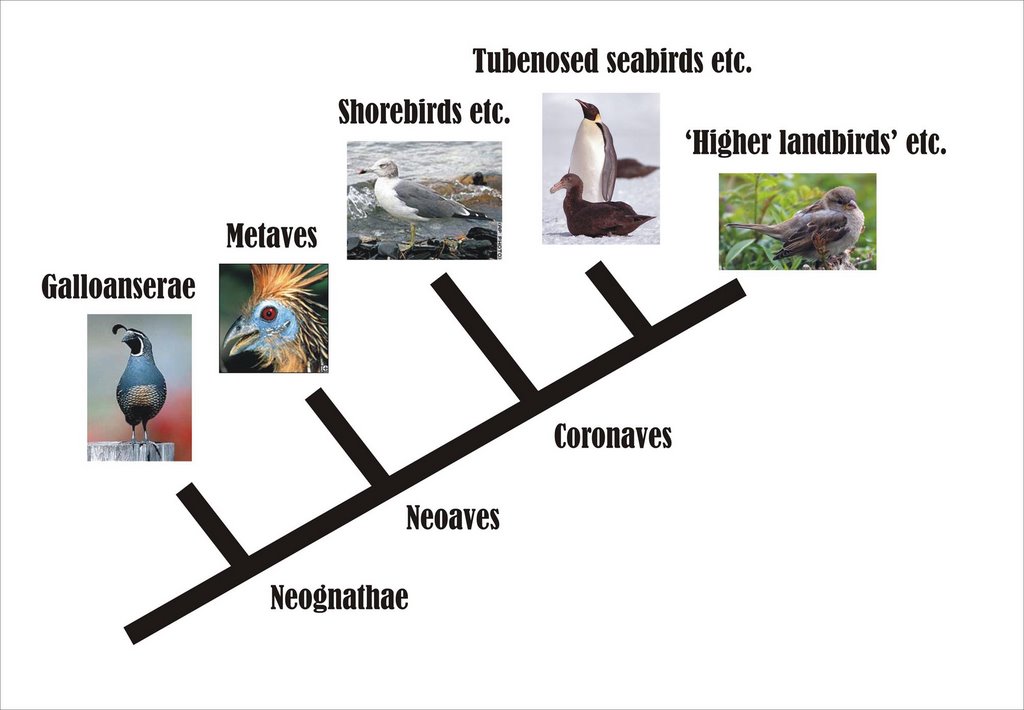
The idea that the hoatzin is not close to seriemas or turacos, but is in fact a member of a hitherto-overlooked metavian clade at the base of Neoaves is an exciting one, mostly because it would make this bird strongly convergent on the coronavian turacos. What do other studies have to say about the affinities of the hoatzin?

The hoatzin problem
Unfortunately the phylogenetic affinities of the hoatzin have been one of the most contested issues within avian systematics (there is an entire review article devoted to this subject: Sibley & Ahlquist 1973). Most usually considered close to either gamebirds or cuckoos (in fact, when first described in 1776 the hoatzin was classified as a species of Phasianus), hoatzins have also been allied over the years with turacos, rails, hornbills, sandgrouse and pigeons. Sibley & Ahlquist (1973) concluded that the hoatzin was not just closely related to cuckoos, but actually deeply nested within Cuculidae. This idea has been challenged by other studies, all of which find hoatzins to be outside of Cuculidae (Hughes & Baker 1999, Hughes 2000, Johnson et al. 2000), and the link with turacos has been better supported. The young of both groups clamber about among branches using their clawed fingers*, and exhibit stunted outer primaries that allow them to do this. They also share details of pterylography and soft tissue and skeletal anatomy, plus they’re generally alike in behaviour and ecology.

* Claims that young hoatzins do not use their clawed fingers in climbing (and that they rely on the bill and feet alone) are not correct. I’ve never seen a live hoatzin, but there are many photos and bits of footage showing them climbing with their fingers.

Arguing that ‘the hoatzin problem is still unresolved’, Sorenson et al.’s (2003) new analysis of mtDNA showed that there was little or no support for the linking of hoatzins with either turacos or cuckoos, and that their data best supported an affinity between hoatzins and columbiforms (pigeons and doves). While several early avian systematists also linked hoatzins with columbiforms, Sorenson et al. (2003) noted that their results were poorly supported. Interestingly, a louse (Osculotes) unique to the hoatzin does not have any close relatives among the lice that occur on cuckoos or turacos. Of special interest to our discussion here is that Sorenson et al. (2003) didn’t include any gruiforms in their study, and hence didn’t/couldn’t test the possibility that hoatzins might be allied to any of the taxa included within that group.

Worth noting is that, while there are two fossil hoatzins, neither of them preserve enough information to tell us anything useful about hoatzin affinities, or about the way of life of the fossil forms. Hoazinoides from the Miocene of Colombia, known from a partial skull, seems to have been very similar to Opisthocomus while Onychopteryx from the Eocene of Argentina is known only from a partial tarsometatarsus and hence is not too informative.

In conclusion; Sibley & Ahlquist’s (1973) idea that hoatzins are cuckoos has now been rejected; Sorenson et al.’s (2003) conclusion that hoatzins are close to columbiforms is both poorly supported and unsatisfactory in that too few other neornithine taxa were included for comparative purposes; and studies linking hoatzins with turacos (Hughes & Baker 1999, Hughes 2000) are now questionable given that there is strong evidence from the β-fibrinogen gene that hoatzins are part of a metavian clade that does not include turacos (Fain & Houde 2004, Ericson et al. 2006).

Goodbye, my giant predatory, cursorial, flightless hoatzin

After all this then, how seriously should we take the idea that the South American landbird group is real? While recent phylogenetic studies strongly indicate that gruiforms are not monophyletic, only one large-scale study (Mayr & Clarke 2003) has found support for a clade that corresponds roughly with the South American landbird group. More recent studies, with larger data sets, have failed to group any of these birds however, and in fact hoatzins and seriemas seem to be at different ends of the neornithine tree.

In the most recent word on the subject, Ericson et al. (2006) found molecular sequence data to support a grouping of seriemas within a clade that included parrots, passerines and falcons. Is this where phorusrhacids and their relatives will finally go then? As always, we await future work, but if this view is valid, then seriemas, phorusrhacids and other cariamaens most likely evolved from small, arboreal coronavians. Their terrestrial, cursorial adaptations would then be late-evolved novelties, and not primitive features inherited from earlier neornithines.
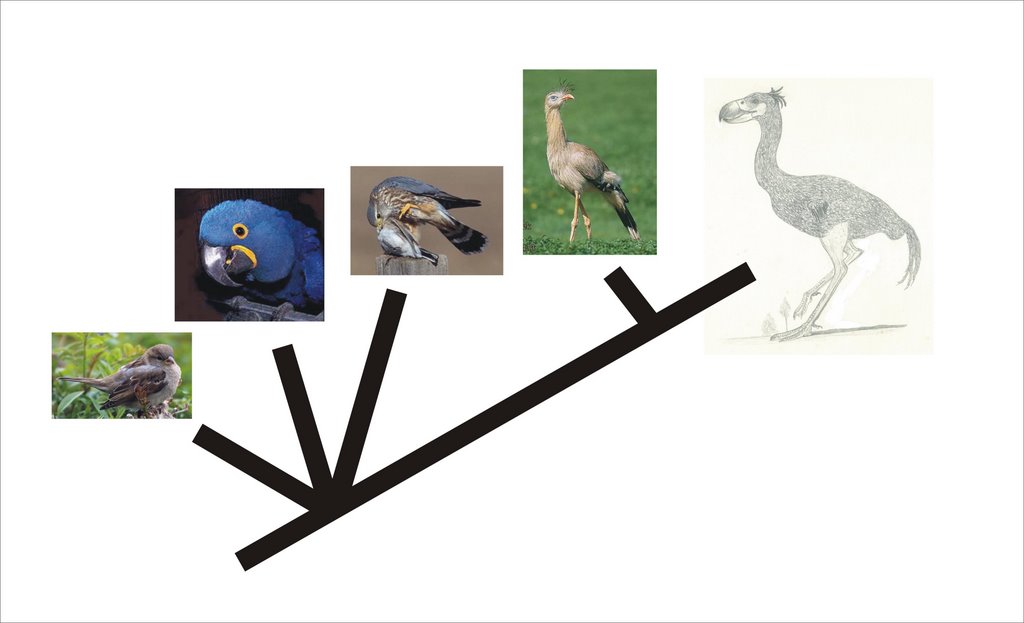
As with any idea in science, it’s possible of course that future investigation or discovery will provide new data that supports the idea that cariamaens, hoatzins and so on are all close relatives. But for now we can reject it as poorly supported and far less well supported than other views on neornithine phylogeny. Like so many alternative theories, the South American landbird theory hinges on just a few characters that are swamped by a larger number of characters that convey a different signal. So, as appealing as it might be to imagine that condors, caracaras, turacos and hoatzins are all close kin of phorusrhacids, it really is all vague and sadly lacking in any sort of good character support. Oh well.

PS - as I write I am half-watching episode II of series 2 of the BBC’s Planet Earth. While looking at the wildlife of the Tibetan Plateau, they just featured Tibetan groundpeckers Pseudopodoces humilis, and they also just featured a Lesser florican Sypheotides indica, the bustard species pictured above.

Refs - -

Cracraft, J., Barker, F. K., Braun, M., Harshman, J., Dyke, G. J., Feinstein, J., Stanley, S., Cibois, A., Schikler, P., Beresford, P., García-Moreno, J., Sorenson, M. D., Yuri, T. & Mindell, D. P. 2004. Phylogenetic relationships among modern birds (Neornithes): towards an avian tree of life. In Cracraft, J. and Donoghue, M. (eds), Assembling the Tree of Life, pp. 468-489.

Ericson, P. G. P., Anderson, C. L., Britton, T., Elzanowski, A., Johansson, U. S., Källersjö, M., Ohlson, J. I., Parsons, T. J., Zuccon, D. & Mayr, G. 2006. Diversification of Neoaves: integration of molecular sequence data and fossils. Biology Letters doi:10.1098/rsbl.2006.0523

Fain, M. G. & Houde, P. 2004. Parallel radiations in the primary clades of birds. Evolution 58, 2558-2573.

Hughes, J. M. 2000. Monophyly and phylogeny of cuckoos (Aves, Cuculidae) inferred from osteological characters. Zoological Journal of the Linnean Society 130, 263-307.

- . & Baker. Phylogenetic relationships of the enigmatic hoatzin (Opisthocomus hoazin) resolved using mitochondrial and nuclear gene sequences. Molecular and Biological Evolution 16, 1300-1307.

Johnson, K. P., Goodman, S. M. & Lanyon, S. M. 2000. A phylogenetic study of the Malagasy couas with insights into cuckoo relationships. Molecular Phylogenetics and Evolution 14, 436-444.

Livezey, B. C. 1998. A phylogenetic analysis of the Gruiformes (Aves) based on morphological characters, with an emphasis on the rails (Rallidae). Philosophical Transactions of the Royal Society of London B 353, 2077-2151.

- . & Zusi, R. L. 2001. Higher-order phylogenetics of modern Aves based on comparative anatomy. Netherlands Journal of Zoology 51, 179-205.

Mayr, G. & Clarke, J. 2003. The deep divergences of neornithine birds: a phylogenetic analysis of morphological characters. Cladistics 19, 527-553.

Sibley, C. G. & Ahlquist, J. E. 1990. Phylogeny and Classification of Birds: A Study in Molecular Evolution. Yale University Press, New Haven.

- . & Ahlquist, J. E. 1973. The relationships of the hoatzin. The Auk 90, 1-13.

Sorenson, M. D., Oneal, E., García-Moreno, J. & Mindell, D. P. 2003. More taxa, more characters: the hoatzin problem is still unresolved. Molecular Biology and Evolution 20, 1484-1499.

Labels: ,

Friday, November 03, 2006

Giant hoatzins of doom

Inspired by the recent description of a new and exciting phorusrhacid – a giant predatory South American landbird – I have lately been producing various blog posts on members of this group, as you’ll know if you’re a regular reader. See Terror birds and More on phorusrhacids. There is lots more to say: I am planning also to blog about phorusrhacid skull and hand anatomy, and about their alleged survival into near-modern times. The horrible danger is that the distractions that constantly arise will cause me to veer off at a tangent, and already the paper on the British dinosaurs of the Kimmeridge Clay that Dave Martill, Sarah Fielding and I have finally had published has me wanting to move on to something else. I am also desperate to blog about the lions of Chobe National Park (Botswana), as their ability to kill adult elephants has finally been filmed and is due to be screened on TV next week. Furthermore, there is that AMAZING discovery of a bottlenose dolphin with a perfect pair of miniature hind-flippers (go here), and there is that Mantellisaurus thing. Stay tuned.

While I’m here I want to note some recent updates I’ve made to some articles. Firstly, thanks to comments that have been added by anonymous mammalogists (PLEASE leave your name when you leave a comment), I’ve done some minor updating to The first new European mammal in 100 years? We are now at 31 ‘100 year’ mammals. Secondly, inspired by some questions from Mark Abuys, I have also added some new comments to Graeme’s Pleistocene megafrog. Mark was interested in my mention of the carn-pnay, a crypto-frog from New Guinea with an alleged length of 30 cm.

To return to phorusrhacids...... in the previous posts I at least alluded to ideas about their affinities: it is universally agreed that their closest living relatives are the South American seriemas (or cariamids), and it is furthermore agreed that two fossil groups, the bathornithids of Eocene-Miocene North America and the idiornithids of Eocene-Oligocene Europe, are also close relatives of both seriemas and phorusrhacids. Several features unite these birds (Mayr 2002). They all have a strongly hooked bill, a simple, block-like hypotarsus (a site of ligament attachment on the posterior surface of the tarsometatarsus), distinctively proportioned toe bones, and a laterally compressed, strongly curved and sharp-tipped claw on the second toe (discussed previously here). All of these birds – idiornithids, bathornithids, cariamids and phorusrhacids – form a clade termed the Cariamae Fürbringer, 1888, and conventionally they’ve been regarded as part of Gruiformes, the group that includes rails, cranes, trumpeters and several other groups. A few other fossil groups have been suggested to be part of Cariamae, like the cunampaiids of Eocene Argentina.

Are cariamaens really close allies of rails and cranes? Storrs Olson (1985, p. 143) wrote that the classification of cariamaens within Gruiformes was ‘largely by default, as they do not clearly seem to belong in any other order’, and there is a long-running disagreement among ornithologists as to whether gruiforms are a natural group or not. We’ll look at this issue in the next post.

The South American landbird hypothesis

If you’re a regular reader of this blog you’ll know that I’m a big fan of ‘alternative’ theories on phylogenetic relationships (see, for example, We flightless primates). While I always find these ideas interesting, note the caveat that I do not necessarily endorse them: in fact they often turn out to be poorly supported or spurious. As it happens, one of my favourite ‘alternative’ theories involves cariamaens: it is the South American landbird hypothesis.

Based predominantly on the morphology of the carpometacarpus, some ornithologists have proposed that cariamaens are closely related to the Hoatzin* Opisthocomus hoazin**, that bizarre folivorous, arboreal bird that (uniquely among birds) practices foregut fermentation. In contrast to those of most other neornithines, the carpometacarpi of cariamaens and hoatzins possess a particularly broad, strongly bowed third metacarpal. This is also true of turacos and some cuckoos (indeed, many ornithologists have proposed that hoatzins might be close allies of turacos and/or cuckoos).

* Like ‘fossa’ and ‘sifaka’, ‘hoatzin’ is one of those words that is, apparently, not pronounced the way in which it is written. Some sources state that it is properly pronounced ‘watson’.

** That’s not a typo. Furthermore, the name Opisthocomus cristatus, used by some authors relatively recently (e.g., Chatterjee in The Rise of Birds) was coined (so far as I can tell) by Johann Illiger in 1811 and thus post-dates Statius Muller’s 1776 publication of the name Phasianus hoazin (that’s right - the hoatzin was originally described as a type of pheasant).

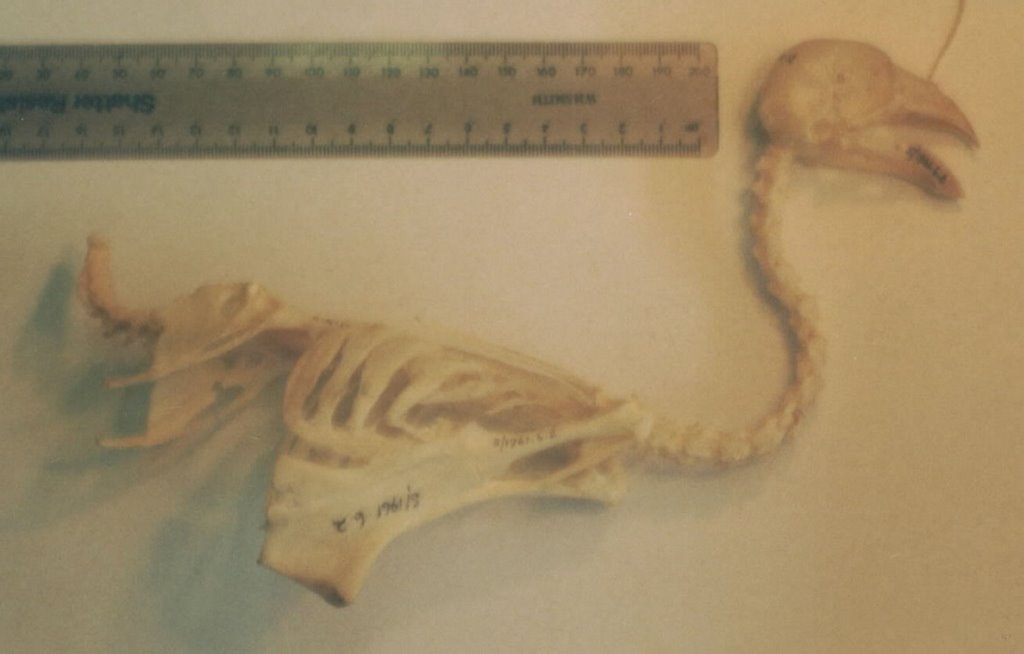
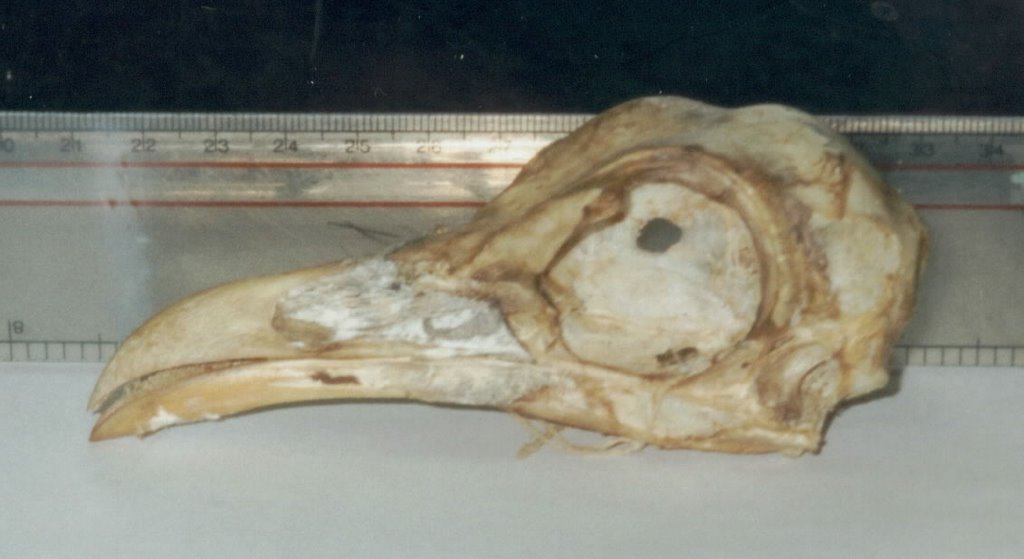
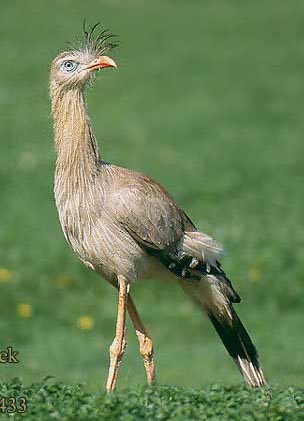
Hoatzin and seriema skeletons are also somewhat similar overall: I suppose you could believe that seriemas (and hence other cariamaens) are just big, long-legged hoatzins, modified for a cursorial, raptorial lifestyle whereas the various modifications possessed by hoatzins reflect their folivorous lifestyle (these features include a bizarre sternum where the keel is virtually absent anteriorly, thereby allowing room for the huge crop, and a notably deep, short pelvis) [the adjacent photos show, from top to bottom, a hoatzin skeleton, and a Cariama cristata skull and partial postcranium. Sorry the hoatzin photo is so bad]. Hoatzins and seriemas also possess a few bony and soft-tissue characters that are shared only by these birds, turacos and cuckoos: these include details of the hip musculature and the presence of distinctive bony recesses on the top of the pelvis.

Olson (1985) supported the possible monophyly of the South American landbird group, writing ‘the seriemas and hoatzins appear to be part of an early radiation of primitive land birds, members of which have persisted in South America, perhaps as a result of its isolation’ (pp. 143-144). He further suggested that falcons ‘probably represent a raptorial branch of this radiation’ (p. 144), a suggestion presumably based on the anatomy of caracaras. Note that falconids are essentially a South American group (only a few, recently evolved genera have left the continent). A few fossil taxa might also be interpreted as providing support for the monophyly of this group. Mourer-Chauviré (1983) regarded idiornithids as similar to both seriemas and hoatzins and her conclusions are similar overall to those of Olson (1985). Incidentally, both Olson and Mourer-Chauviré came up with the same idea independently. A long delay in publication meant that Olson (1985) came out after Mourer-Chauviré (1983), by which time Olson decided not to rewrite his text: ‘partly out of laziness and frustration but more to show that we arrived independently at the same basic conclusions’ (p. 151).

Among the most enigmatic of Cenozoic fossil birds is Foro panarium (image at left) from the Eocene Green River Formation of Wyoming: it seems to combine features of hoatzins, cuckoos and turacos but, interestingly, is also superficially raptor-like. This could be used to provide tentative support for Olson’s idea that falcons might be linked to hoatzins and other South American landbirds.

We saw above that hoatzins have often been linked with turacos, and that turacos share with hoatzins and seriemas that unusual and distinctive robust, bowed third metacarpal, as well as other characters. Might turacos also, then, be members of the South American landbird group? True, they aren’t South American but African (though with fossil representatives in Europe). In what might be regarded as a deviant version of the South American landbird group theory, Chandler (1997) proposed that turacos were the sister-taxon to Cariamae. In a novel twist, he further announced that New World vultures (vulturids, aka cathartids) were the next closest relatives of the turaco-cariamaen clade. He noted that fossils, osteology and preliminary biochemical data all provided supportive evidence for this novel hypothesis, though unfortunately he only ever published an abstract on it, and a full paper has yet to appear.

Based – it has to be said – on just a handful of detailed morphological characters, combined with some inference based on biogeography and superficial similarity, the South American landbird group theory suggests the following: that there might be a hoatzin-cariamaen clade, probably persisting as relicts in South America but more widespread during the early Cenozoic. It may perhaps involve turacos, and perhaps also falcons. Finally, New World vultures (which have all their earliest fossil occurrences in the Old World) might be allies of the South American landbird group. I am deliberately avoiding bringing in cuckoos and accipitrids (the latter noted by Olson as being possible allies of the turacos) in order to keep things simple-ish. Furthermore, the South American trumpeters (psophiids) share a number of characters with cariamaens and have also been regarded as part of this story by some authors.

Predictably, I cannot help but find the idea that condors, caracaras, turacos and hoatzins are all close kin of phorusrhacids highly appealing, but it does all seem very vague and sadly lacking in good character support. So, do larger studies – those incorporating molecular and/or morphological information from lots of taxa – support a possible link between these birds? See the next post (Goodbye my giant predatory, cursorial, flightless hoatzin).

For the latest news on Tetrapod Zoology do go here.

Refs - -

Chandler, R. M. 1997. New discoveries of Titanis walleri (Aves: Phorusrhacidae) and a new phylogenetic hypothesis for the phorusrhacids. Journal of Vertebrate Paleontology 17 (supplement to 3), 36-37.

Mayr, G. 2002. A new specimen of Salmila robusta (Aves: Gruiformes: Salmilidae n. fam.) from the Middle Eocene of Messel. Paläontologische Zeitschrift 76, 305-316.

Mourer-Chauviré, C. 1993. Les Gruiformes (Aves) des Phosphorites du Quercy (France). 1. Sous-ordre Cariamae (Cariamidae et Phorusrhacidae). Systématique et biostratigraphie. Palaeovertebrata 13, 83-143.

Olson, S. L. 1985. The fossil record of birds. In Avian Biology, Volume III, pp. 79-238.

Labels: , ,

Wednesday, November 01, 2006

More on phorusrhacids: the biggest, the fastest, the mostest out-of-placest

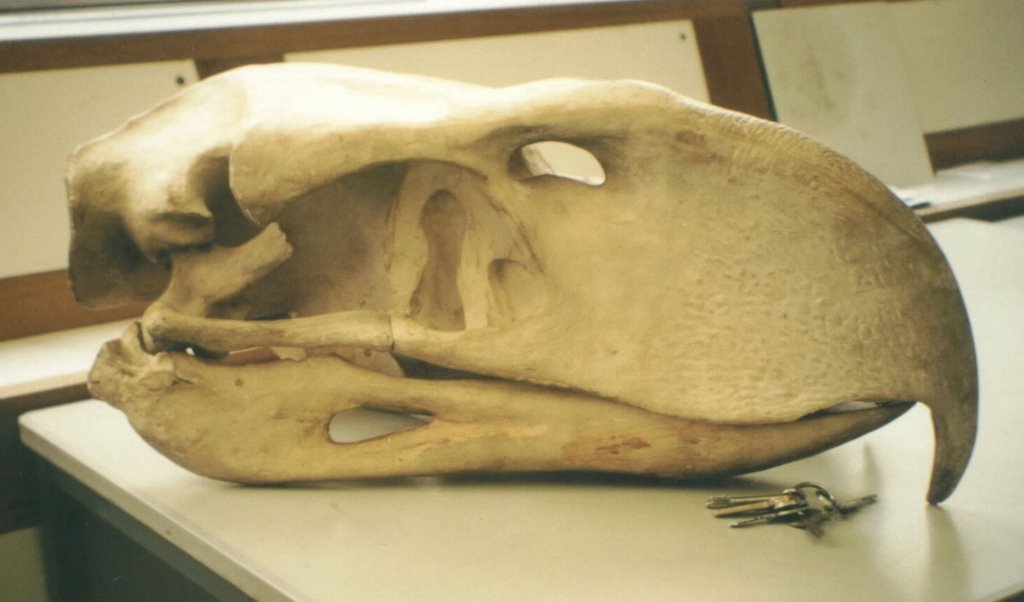
In the previous post we looked briefly at phorusrhacid diversity, stopping on the way to look at the discovery and naming of that ‘well known’ species Phorusrhacos longissimus from the Miocene of Argentina. All of this has been inspired by Chiappe & Bertelli’s (2006) description of the immense new specimen BAR 3877-11, an unnamed Miocene phorusrhacine phorusrhacid that represents one of the biggest members of the group: its skull is 71 cm long and the live animal probably stood 3 m tall (life restoration at left).

By comparing BAR 3877-11 with phorusrhacids known from fairly complete skeletons, we can estimate that it was about 10% bigger than the previously largest known phorusrhacids. But its markedly slender tarsometatarsus indicates that it was gracile, and thus almost certainly not as heavy as the far more robust giant aepyornithids (aka elephant birds, restricted to Madagascar bar a few dubious reports from continental Africa and elsewhere) and dromornithids (aka mihirungs, an Australian group argued to be giant waterfowl). These slender legs suggest that BAR 3877-11 was a fast-moving, cursorial predator, and Chiappe & Bertelli state that ‘the long-established correlation between their corpulence and reduced cursorial agility needs to be re-evaluated’. In other words, they imply that previous studies have associated giant size with ponderous locomotion.

This is somewhat misleading however, in that the only reason that some giant phorusrhacids have been thought of as relatively slow-moving is that they belong to that particular robust-limbed subgroup, the Brontornithinae. The biggest brontornithine, Brontornis burmeisteri from the Miocene of Argentina, was also arguably the biggest phorusrhacid prior to the discovery of BAR 3877-11, but its leg bones are immensely wide and stocky for their length, and its tarsometatarsi are between 50 and 60% the length of its tibiotarsi. These features suggest that it was a walking bird, not a runner, and it is on the basis of this that some authors have interpreted brontornithines as scavengers. You’ll know from discussions about tyrannosaurs that a pure scavenging lifestyle is highly unlikely for any flightless tetrapod (for energetic reasons). Sure, they probably did scavenge (you can imagine them trying to scare teratorns, or a group of hyaena-like borhyeanids, away from a carcass), but they probably foraged for live prey of various kinds as well.

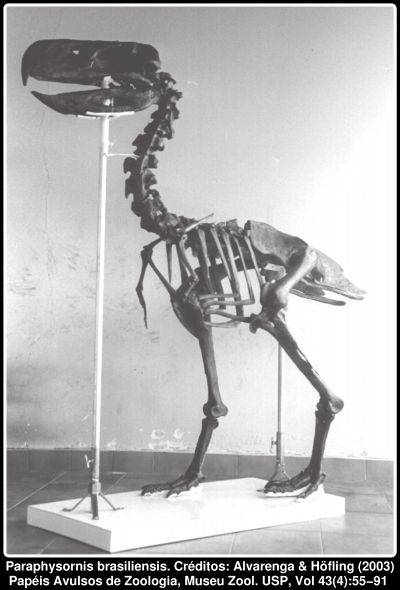
Having mentioned teratorns, while they are now known from the Upper Oligocene/Lower Miocene of South America (Olson & Alvarenga 2002), and thus were contemporaneous with brontornithines, the immense teratorn Argentavis is only known from the Late Miocene, and brontornithines are unknown from this time. So, sorry, you shouldn’t imagine Brontornis scrapping with Argentavis. The oldest teratorn, Taubatornis campbelli, is actually from the same unit – the Tremambé Formation – as the brontornithine Physornis brasiliensis. Both lived alongside New World vultures, flamingos, screamers and caviomorph rodents [the adjacent photo, of the brontornithine Paraphysornis, is borrowed from Cais de Gaia's phorusrhacid blog post].

Getting back to Chiappe & Bertelli’s claims about phorusrhacid running speed, highly relevant is a recent study specifically devoted to this issue. Based on limb proportions and limb bone strength, Blanco & Jones (2005) estimated the running speed of the mesembriornithine Mesembriornis, the patagornithine Patagornis, and a giant phorusrhacine specimen from the Pliocene or Pleistocene of Uruguay. This latter bird (significant in being the youngest phorusrhacid from South America) was one of the largest members of the group, with an estimated height of c. 2.5 m. It might be a species of Devincenzia. Patagornis and the giant phorusrhacine were predicted to have running speeds of 14 metres per second (about 50 km/h) while Mesembriornis had a ridiculous predicted running speed of 27 metres per second (about 97 km/h). For comparison, emus run at 14 metres per second, an ostrich reaches perhaps 17 metres per second (about 60 km/h) and cheetahs are reported to reach or exceed 27 metres per second.

Unsurprisingly, Blanco & Jones (2005) doubted if their predictions were accurate and they wondered if the unusual bone strength of some phorusrhacids – Mesembriornis in particular – might be related to something other than running speed. Could it be something to do with kicking? Based on the forces needed to break bones, they showed that Mesembriornis would be able to produce a force of over 2000 Newtons with its kick: strong enough to fracture bones. Thus it’s possible that some phorusrhacids used kicking as a way of breaking open bones to feed on marrow (how do the brontornithines, with their super-robust limb bones and inferred scavenging habits, fit into this?). It’s also possible that the birds used this kicking power to stun or kill prey, and here you will of course be thinking of the Secretary bird Sagittarius serpentarius, a cursorial raptor (superficially similar to a seriema) that kills or stuns snakes and other terrestrial prey with repeated kicks.

The foot claws of some phorusrhacids also support the idea that they used their feet in maiming or killing as the claws are laterally compressed, curved and sharp-tipped. That’s not necessarily the normal morphology for predatory birds, as many cursorial birds (and non-avian theropods) actually have rather blunt, stout foot claws. Tonni & Tambussi (1988) described the foot morphology of the Miocene psilopterine Psilopterus and showed that its foot claws were nearly identical to those of the living seriema Cariama cristata.

What’s interesting about this is that the second toe claw in Cariama is slightly enlarged relative to those of digits III and IV (as you can see from the very poor accompanying photos). Seriemas reportedly use the claw to aid in tree-climbing, and I’d like to know if they use it in attacking or killing prey. A great many other birds, including raptors and many passerines, have similarly enlarged claws on digit II however. I’ve previously been guilty of comparing this ‘enlarged’ claw with the raised sickle-claw seen in dromaeosaurids and other Cretaceous theropods, but what we have in phorusrhacids and seriemas clearly isn’t as elaborate, so there’s no indication that they used it to slash open the bellies of prey or anything like that (and here I’ll avoid the debate about the function of sickle-claws*). I doubt if even small phorusrhacids climbed trees, so presumably they used the claw in dispatching or manipulating prey.

* A recent study has claimed that sickle-claws could not function as slashing or stabbing weapons, but were perhaps used instead as climbing crampons, enabling dromaeosaurids to climb the bodies of their prey. I feel that there are major flaws in this study and that its conclusions are erroneous (see comments in Naish 2006).

While conventionally regarded as South American birds, there have been occasional reports of phorusrhacids from elsewhere. Two supposed European members of the group, Ameghinornis minor from Eocene-Oligocene France and Aenigmavis sapea from Eocene Germany, were identified in the 1980s (actually, Ameghinornis minor was first described [as Strigogyps minor] in 1839, but its new name and proposed affinity to phorusrhacids weren’t published until 1987). Both were weakly flighted or flightless birds about the size of a partridge.

Given that a few other Eocene European tetrapods have been suggested to be particularly closely related to South American taxa (namely the ratite Palaeotis, the peradectine opossums and the supposed anteater Eurotamandua), Ameghinornis and Aenigmavis were thought to perhaps indicate that phorusrhacids had originated in Europe and later spread (via Africa) to South America (Peters & Storch 1993). However, reanalysis has shown that both names are best regarded as junior synonyms of Strigogyps, and furthermore that Strigogyps differs significantly from phorusrhacids in lacking the derived characters that unite the members of this group (Mayr 2005). We’re not actually sure what Stigogyps is (though its tarsometatarsus is similar in some details to that of a trumpeter), but its re-evaluation strikes phorusrhacids off the list of European fossil taxa. Incidentally, there are unpublished Palaeocene and/or Eocene fragments from England and North America that, inspired by the 1987 identification of Aenigmavis, have also been suggested to be phorusrhacids. They await evaluation but, like Strigogyps, it is doubtful if they really have anything to do with Phorusrhacidae.

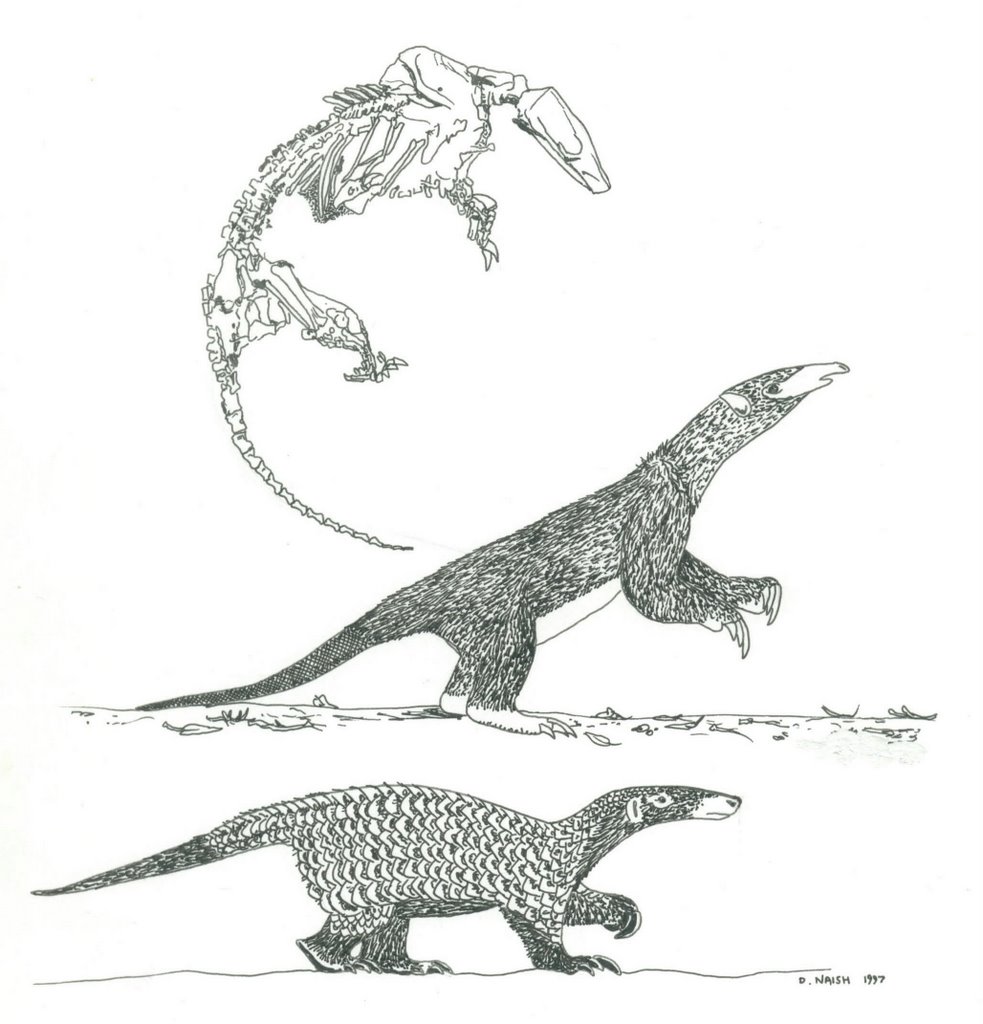
I should point out that the other European Eocene forms previously regarded as being of South American affinity have also been reinterpreted. Palaeotis, a small ratite argued by some to be a stem rhea, has more recently been found to be outside of the clade that includes rheas, ostriches, cassowaries and emus. Peradectine opossums may or may not be of South American origin: however, by the Eocene they occurred in North America and Europe and they later occurred in Asia and Africa. They do not seem to provide special evidence for a faunal link between South America and Europe. Finally, the supposed anteater Eurotamandua seems not to be an anteater, nor even a xenarthran, and as such there is nothing South American about it [adjacent image shows, at top, skeleton and life restoration of Eurotamandua, with the Eocene pangolin Eomanis at bottom. Taken from here].

What is almost certainly a non-American phorusrhacid was reported in 1987… from the Eocene of Antarctica (Case et al. 1987). Known only from the anterior part of the premaxillae, the specimen must have belonged to a reasonably large bird, but not much more than that is known about it. Older phorusrhacids are known from the Palaeocene of South America, so the specimen does not demonstrate that phorusrhacids originated in Antarctica: rather, it probably shows that they were common to both continents prior to their separation in the Oligocene.

An interesting parallel is provided by the fossil record of sloths, as while long regarded as of South American origin, the oldest sloth is a Middle Eocene fossil from Seymour Island (Antarctica). From time to time people make the point that some really interesting, major events in tetrapod history must have occurred in ancient Antarctica – if only it wasn’t for that damned ice sheet. Luckily, we’re doing all we can to get rid of it (that’s meant to be ironic). Anyway, we might speculate that Antarctica was home to numerous phorusrhacid lineages prior to its glaciation, but we’ll likely never know about them.

More to come…

Refs - -

Blanco, R. E. & Jones, W. W. 2005. Terror birds on the run: a mechanical model to estimate its maximum running speed. Proceedings of the Royal Society of London B 272, 1769-1773.

Case, J. A., Woodburne, M. O. & Chaney, D. S. 1987. A gigantic phororhacoid(?) [sic] bird from Antarctica. Journal of Paleontology 61, 1280-1284.

Chiappe, L. M. & Bertelli, S. 2006. Skull morphology of giant terror birds. Nature 443, 929.

Mayr, G. 2005. “Old World phorusrhacids” (Aves, Phorusrhacidae): a new look at Strigogyps (“Aenigmavis”) sapea (Peters 1987). PaleoBios 25, 11-16.

Naish, D. 2006. The Carnivorous Dinosaurs [review]. The Palaeontology Newsletter 62, 122-126 [free pdf available here].

Olson, S. L. & Alvarenga, H. M. F. 2002. A new genus of small teratorn from the Middle Tertiary of the Taubaté Basin, Brazil (Aves: Teratornithidae). Proceedings of the Biological Society of Washington 115, 701-705.

Peters, D. S. & Storch, G. 1993. South American relationships of Messel birds and mammals. Kaupia 3, 263-269.

Tonni, E. P. & Tambussi, C. P. 1988. Un nuevo Psilopterinae (Aves: Ralliformes) del Mioceno tardio de la Provincia de Buenos Aires, Republica Argentina. Ameghiniana 25, 155-160.

Labels: , ,

Friday, October 27, 2006

Terror birds


Were you to visit sunny Texas 5 million years ago (cough cough), a giant predatory bird, 3 m tall with a head 70 cm long, might have kicked you down and eviscerated you with its immense hooked bill. I am of course talking about phorusrhacids, sometimes called terror birds, the mostly large, flightless predatory birds of the prehistoric Americas and elsewhere, and as you’ll know if you’ve been keeping an eye on the news, a new and exciting member of the group was described last week in Nature (Chiappe & Bertelli 2006). I like to promote the idea that big eagles are awesome powerful predators, well able to tackle and kill surprisingly big mammals (see When eagles go bad and The biggest eagle, part I) but, needless to say, even big eagles pale into near-insignificance next to these distant cousins.

Yet again, it’s funny how things work out. My life right now mostly consists of job-hunting, but because of the various part-time teaching jobs I have I am always working on powerpoint presentations. Last week I put the finishing touches to ‘The evolution of birds in the Cenozoic’, and of course I added a section on phorusrhacids. Now that Chiappe & Bertelli (2006) has been published I will have to make a few changes.

I’ve always been very interested in phorusrhacids and, unlike many of the animals I write about (the shame), I have some experience with them. What are they? They are universally agreed to be relatives of the living seriemas (Cariamidae), but differ from them in having a far more robust bill and jaws, smaller bony processes on the humerus, and a narrower pelvis. They also, of course, grew to a much larger size. The two living seriema species are South American, but members of similar, closely related groups (the bathornithids and idiornithids) inhabited North America from the Eocene to the Miocene and Europe from the Eocene to the Oligocene. I have a lot more to say on the affinities of all of these birds: you’ll have to wait for a future post (Giant hoatzins of doom: the ‘South American land bird’ theory).

The various phorusrhacid genera and species have been reviewed twice in the past 50 years. Patterson & Kraglievich (1960) looked at the Pliocene species and mostly discussed the relatively obscure taxa Hermosiornis and Onactornis (the latter is currently regarded as synonymous with Devincenzia). Perhaps because their study was written in Spanish [with only a brief English summary], it has been widely overlooked. It also has far too few illustrations and – to quote Storrs Olson (1985)* – is ‘a nightmare of typographical errors’ (p. 145). Apparently it was meant to be just the preliminary nomenclatural part of a much larger revision of the whole group by Bryan Patterson, but this never appeared. Fortunately, Alvarenga & Höfling (2003) looked at phorusrhacids anew and reviewed all the taxa, providing information on historical taxonomy, palaeoecology, and phylogenetic affinities. While they didn’t perform a cladistic analysis, this is pretty much the sort of study we have long needed, and the fact that it is widely and freely available on the web as a pdf (go here) means that it will enjoy widespread consultation (if only all publishers did this with academic papers: remember, the availability of pdfs is never under the control of authors). For now, it is the ‘standard work’ on the group.

* More than any other person in zoological writing, Olson has produced an impressive list of scathing quotes and insults. One day I’ll make a point of collecting them all together.

Alvarenga & Höfling (2003) grouped phorusrhacids into five subgroups; the small, gracile psilopterines, known from the Palaeocene to the Pliocene and including the oldest of all phorusrhacids; the mid-sized, shallow-skulled, gracile-legged mesembriornithines of the Miocene-Pliocene; the mid-sized patagornithines of the Oligocene, Miocene and Pliocene; the gigantic, robust brontornithines of the Oligocene and Miocene; and the mostly large, gracile-legged phorusrhacines of the Miocene, Pliocene and Pleistocene. The last group was the only one to make it into the Pleistocene, and the only group to invade North America. The smallest psilopterine was about 70 cm tall while the biggest brontornithines and phorusrhacines were about 3 m tall and among the biggest birds of all time. Mesembriornithines were, proportionally, about as long-legged as emus or rheas, while brontornithines included the most stocky-legged birds of them all.

It is of minor frustration that the phorusrhacids we hear about the most are among the most poorly known. The ‘best known’ phorusrhacid, the one featured in every single prehistoric animal book, is Phorusrhacos longissimus from the Miocene of Argentina. But it’s only ‘best known’ because it was the first member of the group to be named, and compared to a number of far more obscure species, it is poorly known and mysterious. Of its skull, for example, we only have the lower jaw and some fragments of cranium. Florentino Ameghino (1854-1911), the famous Argentine zoologist/palaeontologist who discovered and named it and several other phorusrhacids, did write in 1895 of seeing a complete skull, encased in rock in the field, but he was only able to sketch it and recover fragments. His drawing is of a complete, pristine skull and it is on the basis of this that an entire replica skull has been produced (see accompanying image). Compare this with the patagornithines Patagornis and Andalgalornis, for example, both of which are known from awesome, complete skulls with good, associated, near-complete skeletons.

Incidentally, you might have seen the name Phorusrhacos written as Phororhacos (and Phorusrhacidae written as Phororhacidae). The former is the older, and thus correct, spelling, coined by Ameghino in 1887. At this time Ameghino thought that he had discovered a new herbivorous toothless mammal, perhaps a sloth, and Phorusrhacos was named to mean something like ‘branch holder’. It’s also a switched-round version of Rhacophorus, a genus of arboreal Asian frogs: that name also meaning ‘branch holder’. This isn’t a coincidence – Ameghino did this sort of thing with lots of names. When in 1889 Ameghino discovered that Phorusrhacos was really a bird, he changed the name to Phororhacos, as this (apparently) means something like ‘rag bearer’ and Ameghino regarded this as more appropriate etymologically than ‘branch holder’ (I regret that I have no idea why, however). Changing of names like this is not allowed under the guidelines of the ICZN and hence Phororhacos – still used by some people even today – should be suppressed. An ICZN ruling of 1992 made Phorusrhacos and Phorusrhacidae the officially accepted spellings.

Speaking of Phorusrhacos, the painting at top - depicting this taxon - is one of the most famous phorusrhacid renditions ever (it's borrowed from the Burian gallery), and was produced by one of the 20th century's greatest palaeo-artists, Zdenek Burian (1905-1981). The colour scheme used in the painting has been widely copied by other artists: for a discussion on this subject go here.

The new phorusrhacid described by Chiappe & Bertelli (2006) consists only of a skull and some leg bones (other elements might be known, but aren’t mentioned), but is significant for its size and the completeness of the skull. Discovered in Miocene rocks of Comallo, Argentina, it appears to be a phorusrhacine closely related to Devincenzia, another of those obscure taxa known from pretty good remains. For reasons that I don’t quite grasp, the new specimen isn’t named (whether it represents a new taxon that will be named elsewhere, or whether it proves referable to an already-named form [like Devincenzia] is not stated) and currently only has the accession number BAR 3877-11 (BAR = Museo Asociación Paleontológico Bariloche, Argentina). Anyway, with a total length of 71 cm, BAR 3877-11 possesses the largest avian skull. What is slightly odd about Chiappe & Bertelli’s paper is that they continually refer to giant phorusrhacids as the ‘largest birds known’. While it is certainly true that some of these birds – reaching a total height of about 3 m and a weight of 350 kg or more – were immense, they were similar in size to, and perhaps smaller than, the biggest aepyornithids and dromornithids, so this isn’t clear cut.

And I have to stop there. More on phorusrhacids in the next post, looking at brontornithine lifestyle, mesembriornithine running speed (were they the fastest-running birds ever?), and the anatomy of feet and skulls [available here].

PS - I intended to add more images to this post, but I’m having trouble in getting blogger to upload them. For the latest news on Tetrapod Zoology do go here.

Refs - -

Alvarenga, H. M. F. & Höfling, E. 2003. Systematic revision of the Phorusrhacidae (Aves: Ralliformes). Papéis Avulsos de Zoologia, Museu de Zoologia da Universidade de São Paulo 43, 55-91.

Chiappe, L. M. & Bertelli, S. 2006. Skull morphology of giant terror birds. Nature 443, 929.

Olson, S. L. 1985. The fossil record of birds. In Avian Biology, Volume III, pp. 79-238.

Patterson, B. & Kraglievich, J. L. 1960. Sistematica y nomenclatura de las aves fororracoideas del Plioceno Argentino. Publicaciones del Museo Municipal de Ciencias Naturales y Tradicional de Mar del Plata 1, 1-52.

Labels: , ,